Up to 90% of cloud migrations fail to meet their objectives or blow past budget, yet enterprises keep investing billions in cloud transformation every year. That gap between expectation and reality isn’t a technology problem. It’s a strategy problem. Most IT leaders approach cloud migration as a technical upgrade, when it’s actually a business transformation initiative that requires organizational alignment, financial discipline, and a clear-eyed view of what success looks like. This article breaks down the real role of cloud in modern business operations, the key drivers and obstacles you’ll face, and the proven strategies that separate migrations that deliver from those that disappoint.
Table of Contents
- Understanding the role of cloud in modern business operations
- Key drivers and challenges for enterprise cloud migration
- Critical success factors: How to align cloud strategy with business value
- Realizing operational efficiency and cost savings post-migration
- Why conventional approaches to cloud migration often backfire
- Next steps: Seamless cloud migration with AWS experts
- Frequently asked questions
Key Takeaways
| Point | Details |
|---|---|
| Cloud is more than tech | Cloud adoption drives real business transformation when aligned with operational goals. |
| Hidden migration risks | Uncover and plan for dependencies, licensing issues, and costs before moving workloads. |
| Strategic alignment critical | Executive sponsorship and clear business value alignment greatly improve migration success. |
| Post-migration FinOps | Ongoing financial ops are essential to capture savings and avoid cost overruns. |
Understanding the role of cloud in modern business operations
Cloud computing is not a single product. It’s a delivery model for computing resources, and it comes in three primary forms that serve different business needs. Infrastructure as a Service (IaaS) gives you raw compute, storage, and networking on demand. Platform as a Service (PaaS) adds a managed environment for building and deploying applications. Software as a Service (SaaS) delivers fully managed applications over the internet. Understanding which layer you’re operating at matters enormously when planning a migration, because each carries different cost structures, operational responsibilities, and optimization opportunities.
For enterprises, the cloud’s most compelling advantage isn’t cost reduction. It’s speed. The ability to provision new environments in minutes rather than months fundamentally changes how your organization can respond to market shifts, launch new products, or scale during demand spikes. That agility compounds over time. Teams that can experiment without waiting for hardware procurement move faster, fail cheaper, and innovate more consistently.
“Success with cloud adoption goes beyond infrastructure migration to business value realization” — a distinction that separates high-performing cloud adopters from those stuck in perpetual migration mode.
The misconception that cloud is primarily a cost-cutting exercise leads organizations to underinvest in the people, processes, and governance needed to make it work. Strong leadership alignment in cloud adoption is what turns infrastructure decisions into business outcomes.
Here are the core business areas most transformed by cloud adoption:
- Collaboration: Real-time access to shared tools and data across geographies eliminates friction in distributed teams
- Data analysis: Elastic compute lets you run large-scale analytics workloads without owning dedicated hardware
- Global reach: Deploy applications closer to customers in any region within hours, not quarters
- Security and compliance: Centralized identity management and audit logging reduce exposure across the estate
- Innovation speed: Managed services for AI, machine learning, and serverless remove undifferentiated heavy lifting from your engineers
Think of cloud not as a destination but as a capability platform. The organizations extracting the most value aren’t the ones that moved the fastest. They’re the ones that moved with the clearest business intent.
Key drivers and challenges for enterprise cloud migration
Large enterprises pursue cloud migration for a handful of consistent reasons: reducing capital expenditure, improving time to market, scaling infrastructure without proportional headcount growth, and retiring aging data centers. These are legitimate and measurable goals. The problem is that the path to achieving them is far messier than most migration roadmaps acknowledge.
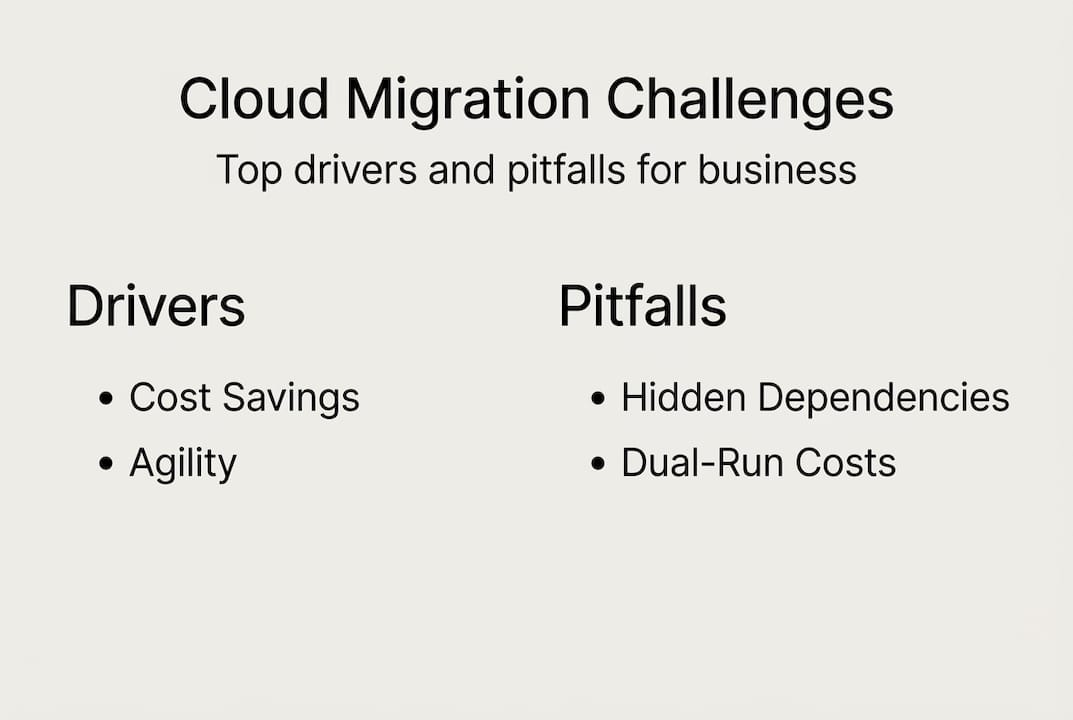
Hidden dependencies, COTS licensing issues, data gravity, and dual-run costs are the most common migration edge cases that derail timelines and budgets. COTS (commercial off-the-shelf) software often has licensing terms that don’t translate cleanly to cloud environments. Data gravity refers to the challenge of moving large datasets when applications and downstream systems are tightly coupled to where that data lives. Dual-running means paying for both on-premises and cloud environments simultaneously during transition, which can double costs for months.
| Top migration drivers | Top migration challenges |
|---|---|
| Reduce capital expenditure | Hidden application dependencies |
| Improve scalability | COTS licensing restrictions |
| Accelerate time to market | Data gravity and transfer limits |
| Retire legacy data centers | Dual-run cost overruns |
| Enable remote and distributed work | Skills gaps in cloud-native operations |
Common warning signs that a migration is heading off track include:
- No formal application inventory before migration begins
- Underestimating the number of interdependent systems
- Assuming all workloads are cloud-ready without validation
- Ignoring network egress costs until invoices arrive
- Treating migration as a one-time project rather than an ongoing program
For smooth AWS transition strategies, the organizations that succeed treat discovery as a non-negotiable first phase, not a formality.
Pro Tip: Before committing to full-scale migration, run a structured discovery and proof-of-concept phase with input from subject matter experts across IT, finance, and the business units that own the workloads. This surfaces hidden dependencies and licensing constraints before they become expensive surprises.
Critical success factors: How to align cloud strategy with business value
Moving workloads to the cloud without a clear business case is the single most reliable predictor of migration failure. The technology works. The failure point is almost always organizational. When cloud projects are driven purely by IT without executive sponsorship and business unit buy-in, they tend to optimize for technical metrics like uptime and migration velocity rather than business metrics like revenue impact, customer experience, or compliance posture.
Migration success rates are dramatically higher when the CEO or C-suite actively sponsors the initiative and ties it to specific business goals. This isn’t about rubber-stamping a budget. It’s about ensuring that every migration decision is evaluated against business outcomes, not just technical feasibility.
Here’s a practical sequence for aligning IT and business on cloud projects:
- Define business outcomes first. Identify the two or three measurable results the organization needs from cloud: faster product launches, lower infrastructure spend, improved disaster recovery, or expanded market reach.
- Map workloads to outcomes. Not every application contributes equally. Prioritize migrations that directly support your defined business outcomes.
- Secure executive sponsorship early. Identify a C-suite champion who can resolve cross-departmental conflicts and keep the program funded through inevitable delays.
- Establish governance before you migrate. Define who owns cloud spend, who approves architectural decisions, and how compliance requirements will be enforced in the new environment.
- Set milestone-based success criteria. Avoid measuring success only at the end. Define what good looks like at 30, 90, and 180 days post-migration.
Multi-cloud strategies sound appealing in theory, but organizations that attempt them without mature cloud operations in a single provider first consistently report lower success rates and higher complexity costs.
The risk of tech-led, business-blind migrations is real. Organizational alignment for cloud projects isn’t a soft skill. It’s a hard requirement for delivering the ROI your stakeholders expect.
Realizing operational efficiency and cost savings post-migration
Here’s the part most migration plans skip: the work isn’t done when the last workload moves. In fact, the first 90 days after migration are when most of the promised efficiency gains are either captured or permanently lost. Without an immediate post-migration review, organizations routinely pay for over-provisioned resources, idle instances, and duplicated services that were never cleaned up during the transition.
Post-migration FinOps is the practice of applying financial accountability to cloud spending, and it’s critical for realizing the savings your business case promised. Without it, costs spiral as teams provision resources independently with no centralized visibility.

| Optimization lever | Typical impact |
|---|---|
| Rightsizing over-provisioned instances | 20-40% compute cost reduction |
| Retiring unused or redundant workloads | 10-25% estate reduction |
| Reserved instance and savings plan adoption | 30-60% discount vs. on-demand pricing |
| Storage tiering and lifecycle policies | 15-30% storage cost reduction |
| Automated scaling policies | Significant reduction in idle capacity spend |
Signs your migration isn’t delivering ROI include:
- Cloud bills growing faster than workload volume
- No centralized tagging or cost allocation by team or product
- Engineers provisioning resources without approval workflows
- No regular review cadence for unused or underutilized resources
- Post-migration architecture that mirrors the old on-premises setup exactly
For post-migration cost optimization, the goal is continuous improvement, not a one-time audit.
Pro Tip: Establish a FinOps practice before migration completes, not after costs spike. Assign cloud cost ownership to individual teams, implement tagging policies from day one, and schedule monthly reviews of spend against defined budgets.
Why conventional approaches to cloud migration often backfire
We’ve worked with enough enterprise migration programs to say this plainly: the lift-and-shift approach, moving applications to the cloud without modifying them, is rarely the right answer for large, complex portfolios. It’s a valid starting point for a small subset of workloads. But when applied broadly, it replicates the inefficiencies of your on-premises environment in a more expensive cloud wrapper.
One of the most consistently overlooked steps is app rationalization before migration. Retiring 10-25% of legacy apps before you migrate them is not a delay tactic. It’s cost avoidance. Migrating an application that should have been decommissioned two years ago doesn’t just waste migration effort. It locks in ongoing cloud costs for something delivering zero business value.
Compliance and data residency requirements also force a more nuanced approach than a full cloud migration. Hybrid models, where some workloads remain on-premises or in private cloud environments, are often the right answer for regulated industries. That’s not a compromise. It’s a deliberate architectural choice that protects the organization.
The deeper issue is that building migration business value requires treating cloud as an ongoing operating model, not a project with a completion date. The organizations that extract the most from cloud are the ones that keep adjusting, retiring, optimizing, and re-architecting long after the initial migration is complete. A one-off move without that follow-through almost never delivers what the business case promised.
Next steps: Seamless cloud migration with AWS experts
The patterns that separate successful migrations from costly failures are well understood. The challenge is executing against them under real organizational constraints, competing priorities, and technical complexity.
At AWS Migration Services, we help mid to large enterprises navigate every phase of cloud migration, from initial discovery and workload assessment through execution, governance, and post-migration cost optimization. As an AWS Certified Migration Partner, we bring the technical depth and business alignment frameworks that turn migration programs into measurable business outcomes. If your organization is evaluating a cloud move or trying to recover value from a migration that hasn’t delivered, schedule a consultation with our team to map a clear path forward.
Frequently asked questions
What are the most common pitfalls in enterprise cloud migration?
Hidden dependencies and cost pitfalls like dual-running expenses, poor workload discovery, and missing business alignment are the primary obstacles that derail enterprise migrations before they deliver value.
How can my organization ensure cloud migration delivers business value?
Business alignment and executive sponsorship are the two most reliable predictors of migration success; retire unnecessary workloads first and maintain post-migration cost controls to protect your ROI.
Is hybrid cloud necessary for compliance or are full migrations recommended?
Hybrid retention for compliance is a deliberate and often necessary architectural choice, particularly in regulated industries where data residency requirements prevent moving every workload to public cloud.
What is FinOps and why is it important after cloud migration?
FinOps (financial operations in the cloud) is the practice of applying cost accountability and optimization discipline to cloud spending; ongoing FinOps is essential to prevent costs from growing unchecked after migration completes.