TL;DR:
- Cloud migration is a strategic transformation that enhances scalability, compliance, and operational resilience.
- Proper planning, including the 7 Rs and phased approach, minimizes risks and maximizes value.
- Post-migration optimization is crucial for unlocking true cloud benefits and cost efficiencies.
Cloud migration is often pitched as a cost-cutting exercise. That framing is incomplete and, for fintech and eCommerce leaders, potentially dangerous. A 30% infrastructure cost reduction achieved through a zero-downtime AWS migration that also passed a financial regulatory audit tells a more complete story. Migration, done right, is a strategic transformation. It reshapes how your organization scales, responds to compliance demands, and competes. This article breaks down the real drivers behind cloud adoption, the methodologies that reduce risk, the migration lifecycle in practice, and the tradeoffs that most planning guides skip over.
Table of Contents
- What drives organizations to move to the cloud?
- Key cloud migration methodologies: The 7 Rs
- From planning to execution: Phases of a secure AWS migration
- Risks, compliance, and tradeoffs: What to watch for
- Expert perspective: Why most organizations miss out on cloud’s true value
- Ready to accelerate your cloud migration?
- Frequently asked questions
Key Takeaways
| Point | Details |
|---|---|
| Strategic drivers | Organizations move to the cloud for more than cost—resilience, compliance, and innovation are key motivators. |
| Migration frameworks | Choosing the right migration methodology and following phased approaches ensures both risk management and transformation. |
| Compliance focus | Early and continuous attention to regulatory requirements prevents costly setbacks and legal risks. |
| True value capture | Only a minority achieve full cloud value; post-migration optimization and business integration are critical. |
What drives organizations to move to the cloud?
Cost savings get most of the credit in boardroom presentations. But for organizations operating in regulated, high-transaction environments, the actual drivers run much deeper. Understanding what really pushes companies toward cloud migration is the first step to planning a migration that delivers lasting value, not just a lower hosting bill.
The real business drivers
For eCommerce platforms, the need for elastic scalability is often the tipping point. A product launch or seasonal sale can spike traffic by 10x in hours. On-premises infrastructure either over-provisions year-round (expensive) or fails under load (catastrophic). AWS gives you the ability to scale on demand, pay for what you use, and absorb traffic bursts without engineering heroics.

For fintech companies, the pressure comes from a different angle: compliance. Regulations like GDPR, PSD2, and DORA impose strict requirements around data residency, auditability, and operational resilience. Cloud providers like AWS offer purpose-built compliance frameworks and audit tooling that would take internal teams years to replicate on-prem.
Here are the primary drivers organizations cite when initiating cloud migrations:
- Scalability: Handle demand spikes without over-provisioning hardware
- Compliance and data residency: Meet GDPR, PSD2, DORA, and sector-specific requirements
- Operational resilience: Reduce single points of failure with multi-AZ and multi-region architectures
- Innovation velocity: Deploy faster using managed services, serverless, and CI/CD pipelines
- Security posture: Benefit from AWS’s shared responsibility model and enterprise-grade tooling
- Cost optimization: Move from capital expenditure to predictable operational expenditure
“Cloud migration isn’t a destination. It’s a platform for ongoing transformation. The organizations that treat it as a one-time project are the ones that end up with expensive, underperforming infrastructure on someone else’s servers.”
The caveat worth taking seriously: only 10% of organizations actually capture full cloud value at scale, according to McKinsey research. The gap between “we moved to cloud” and “we’re leveraging cloud” is where most organizations stall. Post-migration optimization is not optional; it’s where the real ROI lives.
Regulatory complexity adds another layer of risk. Exploring cloud adoption strategies before launch helps, but many organizations underestimate how technical configurations create compliance exposure. For example, enabling AWS S3 Cross-Region Replication (CRR) as a disaster recovery measure can inadvertently transfer data to US-based buckets without Standard Contractual Clauses in place, a direct regulatory due diligence gap that regulators are increasingly catching. Complex ERP integrations during migration can also inflate costs well beyond initial projections when dependency mapping is incomplete.
The organizations that succeed treat migration as a phased strategic program, not a technology swap.
Key cloud migration methodologies: The 7 Rs
Understanding the drivers, the next logical step is selecting the right migration approach. AWS formalizes this through the 7 Rs framework, a set of migration strategy options that cover every type of workload, from legacy monoliths to modern containerized applications. Choosing the wrong R for a given workload is one of the most common and costly migration mistakes.
The 7 Rs explained
| Strategy | Description | Best use case |
|---|---|---|
| Rehost | Lift and shift with no changes | Legacy apps, fast migrations, cost reduction |
| Replatform | Minor optimizations during migration | Apps that benefit from managed services |
| Refactor | Rearchitect for cloud-native design | High-priority apps needing scalability or performance |
| Repurchase | Move to SaaS alternative | Apps with viable off-the-shelf replacements |
| Relocate | Move to AWS with VMware or similar | VMware-based workloads moving to VMware Cloud on AWS |
| Retain | Keep on-premises for now | Apps with dependencies that block migration |
| Retire | Decommission the workload | Redundant or end-of-life applications |
In practice, most complex organizations use a blend. A fintech migrating its core banking system might rehost non-critical internal tools immediately, replatform its reporting layer using Amazon RDS, and refactor its transaction processing engine over a longer timeline. Phased waves based on risk and dependencies are the standard approach at scale.
Here is how to think through the selection process:
- Inventory your workloads and classify each by business criticality, compliance sensitivity, and technical complexity
- Identify quick wins that can be rehosted or retired, building momentum and reducing portfolio complexity
- Flag refactor candidates early, since these require architecture design, not just infrastructure provisioning
- Plan dependency waves so that tightly coupled systems migrate together, not sequentially in ways that break integrations
- Reserve retain decisions for workloads with genuine blockers, and set a re-evaluation timeline
Pro Tip: The R you choose for a workload today is not permanent. Many organizations start with rehost for speed, then replatform or refactor once operational in AWS. This staged approach reduces initial risk while keeping the door open for deeper optimization. Following migration best practices from the start makes these transitions smoother.
Choosing the right R up front directly affects your long-term total cost of ownership. A lift-and-shift of a poorly designed monolith might get you into AWS faster, but you’ll pay cloud prices for on-prem inefficiencies indefinitely.
From planning to execution: Phases of a secure AWS migration
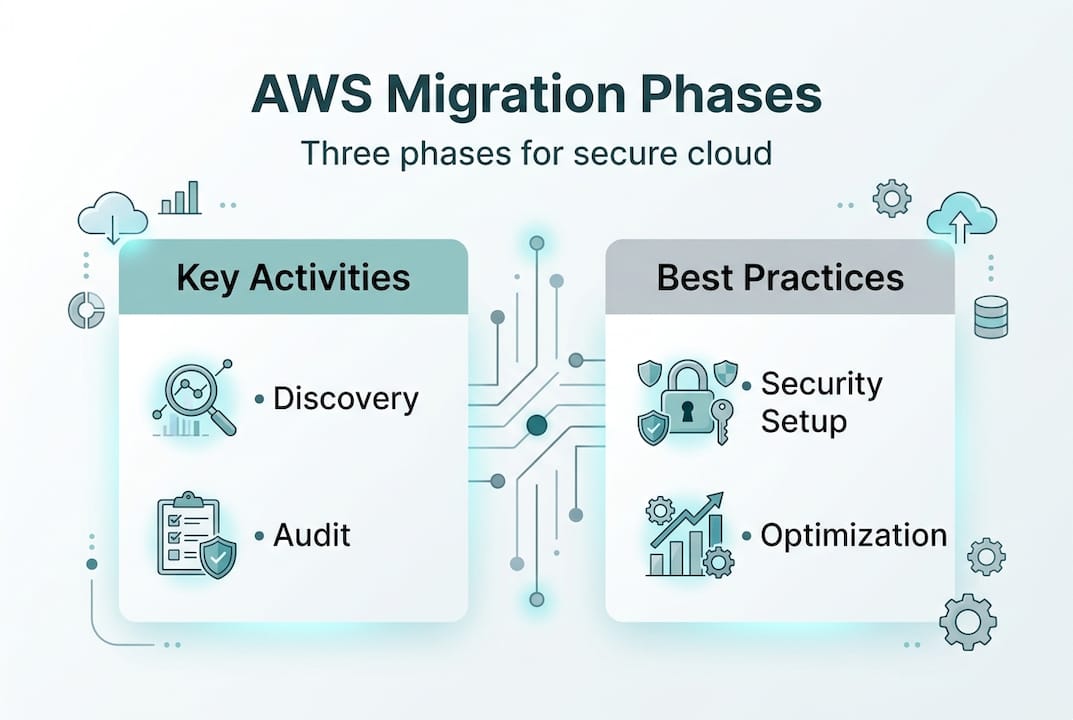
Once you’ve chosen the right migration methodology, executing with a structured plan is critical. AWS organizes the migration lifecycle into three phases, guided by the Well-Architected Framework’s six pillars: operational excellence, security, reliability, performance efficiency, cost optimization, and sustainability.
The three migration phases
-
Assess: Discover and evaluate your current environment. This includes workload inventory, dependency mapping, compliance classification, and total cost of ownership analysis. Security and regulatory requirements must be documented before a single server moves.
-
Mobilize: Build the foundations. This means establishing your AWS landing zone (account structure, networking, identity management), training your team, developing runbooks, and running pilot migrations on lower-risk workloads. This phase also covers setting up monitoring, logging, and incident response before production workloads arrive.
-
Migrate and modernize: Execute migration waves, validate each workload post-migration, optimize configurations, and begin leveraging cloud-native capabilities that weren’t available on-prem.
| Phase | Key activities | Best practices |
|---|---|---|
| Assess | Workload discovery, compliance audit, TCO analysis | Use AWS Migration Evaluator; classify data by sensitivity |
| Mobilize | Landing zone setup, pilot migration, team enablement | Follow AWS Control Tower; run tabletop security exercises |
| Migrate and modernize | Wave execution, validation, optimization | Automate with AWS Migration Hub; monitor with CloudWatch |
The assess phase is where most organizations underinvest. Rushing through discovery to get to execution is the single most reliable way to create expensive problems in production. Compliance gaps discovered after migration are far more disruptive than those caught during assessment.
Security configurations deserve particular attention during mobilize. IAM roles, VPC design, encryption at rest and in transit, and logging policies should all be locked down before the first production workload migrates. These are not things to retrofit later, especially in fintech environments where regulators will ask for evidence of controls from day one of cloud operation.
Our migration case studies consistently show that organizations which invest in a thorough mobilize phase have significantly fewer post-migration incidents and faster time to optimization.
Risks, compliance, and tradeoffs: What to watch for
A well-structured migration is only as strong as the risk controls built in. Even organizations with solid technical plans encounter compliance failures, unexpected costs, and architectural decisions that constrain future flexibility. Understanding where the real dangers lie lets you build defenses before they become incidents.
Common risks in fintech and eCommerce migrations
- Data residency violations: Automated DR configurations (like S3 Cross-Region Replication) can move data across jurisdictions without explicit intent, creating GDPR exposure
- IAM misconfigurations: Overly permissive roles are a primary attack vector; the Capital One breach is a widely studied example of how a misconfigured cloud identity can expose sensitive customer data
- Integration cost overruns: Complex ERP and payment gateway integrations frequently expand scope and cost when dependency analysis is incomplete before migration begins
- Shadow IT in the migrated environment: Teams spinning up resources outside governance frameworks create compliance blind spots
- Vendor lock-in: Heavy reliance on proprietary AWS services can create exit costs that weren’t visible during planning
Pro Tip: Conduct a regulatory gap analysis during the assess phase, before architecture decisions are finalized. Map each data flow against your compliance obligations (GDPR, PSD2, DORA, FSCA) and flag any service configuration that could result in unauthorized data transfers. This single exercise prevents the majority of post-migration compliance incidents.
The multi-cloud versus single-provider debate is worth addressing directly. Multi-cloud architectures offer genuine resilience benefits, but they introduce management complexity and cost that many organizations underestimate. Vendor lock-in and GDPR/DORA compliance concerns drive many fintech leaders toward multi-cloud, but the operational overhead of managing two provider environments, separate toolchains, different IAM models, and duplicate monitoring stacks is substantial. For most eCommerce and fintech organizations, a well-designed single-provider AWS environment with robust disaster recovery is more efficient and easier to audit than a fragmented multi-cloud setup.
“Multi-cloud sounds like resilience insurance. Often it’s technical debt with a marketing name. Unless your regulatory environment or acquisition history forces your hand, a production-grade single-provider setup with strong DR coverage outperforms split-provider complexity on every operational metric that matters.”
Cloud migration risks are manageable when you treat risk controls as a first-class workstream alongside technical execution, not an afterthought.
Expert perspective: Why most organizations miss out on cloud’s true value
The industry measures migration success by whether workloads run in AWS. That is the wrong metric. The real question is whether your organization is operating differently and more effectively because of the cloud.
Only 10% of organizations reach the level of cloud maturity where the economics and capabilities truly differentiate them from competitors. The other 90% moved workloads but didn’t move mindsets, processes, or architectures. They’re paying cloud prices for on-prem thinking.
The uncomfortable truth is that lift-and-shift migrations, while fast and low-risk in the short term, frequently lock organizations into a more expensive version of what they had before. The real transformation happens in the refactor and modernize stages, and most organizations either never get there or don’t plan for them from the start.
Regulated sectors have a specific trap. Many start with hybrid environments, keeping sensitive workloads on-prem while migrating peripheral systems to cloud. That’s a sound risk-reduction strategy. But too many organizations treat hybrid as an endpoint rather than a transition state. The long-term strategies for cloud success require turning hybrid learnings into a roadmap for deeper adoption, not a justification for staying partial.
Post-migration optimization is where value is created. Rightsizing, reserved instance purchasing, database engine upgrades, and architecture improvements after the initial migration are where real cost and performance gains emerge. Organizations that skip this phase are leaving substantial value unrealized.
Ready to accelerate your cloud migration?
Migrating to AWS in a regulated, high-load environment is not something to approach with a generic playbook.
At AWS Migration Services, we bring 700+ completed projects and AWS Advanced Tier Partner status to every engagement. We specialize in eCommerce and fintech environments where downtime, compliance gaps, or cost overruns translate directly into lost revenue and regulatory exposure. Our work covers the full lifecycle: infrastructure audit, strategy design, hands-on execution, and post-migration optimization. Whether your workloads need a rehost, replatform, or refactor approach, we build architectures designed for scale and compliance from day one. Explore our migration best practices to understand how a structured, expert-led approach delivers measurable outcomes without adding operational burden to your team.
Frequently asked questions
What are the most common reasons organizations migrate to the cloud?
Organizations primarily migrate to improve scalability, reduce long-term infrastructure costs, meet regulatory requirements, and accelerate innovation, with cost reduction and compliance outcomes often cited together as the top justifications in regulated industries.
Which cloud migration method is best for fintech or eCommerce companies?
No single method fits all workloads; the most effective approach for fintech and eCommerce environments uses the 7 Rs framework in phased waves, prioritizing compliance-sensitive workloads and applying deeper refactoring to systems where performance and scalability directly affect revenue.
How can organizations avoid the biggest cloud migration risks?
The most effective defense is a thorough regulatory gap analysis and dependency mapping during the assess phase, catching data residency and integration risks before architecture decisions are finalized rather than discovering them in production.
Is multi-cloud a safer choice than a single cloud provider?
Multi-cloud adds resilience against provider outages but introduces significant complexity, cost, and auditability challenges; for most organizations, multi-cloud vs. single-provider is a tradeoff that favors single-provider efficiency unless regulatory mandates or business continuity requirements explicitly demand otherwise. A multi-cloud strategy works best when driven by genuine business need, not theoretical risk hedging.