TL;DR:
- Cloud consultants serve as strategic partners beyond technical support, shaping architecture, cost models, and organizational change. They reduce migration risk through workload mapping, pilot deployments, and automated compliance, ensuring security and uptime. A successful engagement requires early involvement, clear cost ownership, and integrating organizational transformation to maximize cloud value.
Most companies hiring cloud consultants expect technical help. What they actually get, when the engagement works well, is something closer to a business transformation partner. The role of cloud consultants extends far beyond configuring servers or selecting the right instance type. It covers strategy development, financial governance, organizational change, and long-term architecture decisions that affect your bottom line for years. If you’ve been treating cloud consulting as a procurement category rather than a strategic input, this guide will change how you think about it.
Table of Contents
- Key takeaways
- The role of cloud consultants: core responsibilities
- How consultants reduce migration risk in practice
- Cloud cost optimization and financial governance
- Organizational change and capability building
- Emerging trends shaping cloud consulting
- My take: what companies actually get wrong about cloud consulting
- From strategy to execution with IT-Magic
- FAQ
Key takeaways
| Point | Details |
|---|---|
| More than technical support | Cloud consultants shape strategy, architecture, cost models, and organizational change alongside technical execution. |
| Migration risk requires a structured approach | Pilot migrations and automated compliance checks dramatically reduce downtime and security exposure. |
| Cost control starts at design | FinOps models embedded during architecture planning outperform reactive cost reviews by a wide margin. |
| People and process matter as much as technology | Organizational alignment is where most cloud initiatives fail, and consultants who address it directly improve outcomes. |
| Emerging advisory areas are expanding fast | AI infrastructure planning and multi-cloud governance are now core cloud advisor responsibilities, not niche specialties. |
The role of cloud consultants: core responsibilities
The term “cloud consultant” is a practical label that covers what the industry formally calls a cloud technology consultant or cloud strategy advisor. These professionals blend technical knowledge with business acumen to assess, design, and implement cloud strategies aligned with an organization’s specific objectives. That definition sounds clean in a job description. In practice, it means navigating competing priorities across engineering, finance, compliance, and executive stakeholders simultaneously.
Here is what the work actually involves at its core:
- Cloud strategy assessments and business case development. A consultant evaluates your existing infrastructure, identifies gaps, and builds the financial and operational case for cloud adoption. This is not a slide deck exercise. It requires understanding your revenue model, growth trajectory, and risk tolerance.
- Cloud architecture design. Consultants design cloud environments that fit your industry’s regulatory requirements, your team’s skill profile, and your performance needs. A fintech company and a retail operation need very different architectures even when running on the same provider.
- Migration roadmap creation and workload prioritization. Not every workload migrates the same way or at the same time. Consultants sequence workloads based on dependencies, risk, and business value to avoid unnecessary disruption.
- Stakeholder alignment. Cloud technology consultants create roadmaps and develop business cases that connect technical and executive teams. Getting buy-in across functions is often harder than the technical work itself.
What separates a strong cloud strategy advisor from a vendor-aligned one is the ability to stay objective. A good consultant acts as a partner, not a vendor, which means recommending the architecture that fits your situation rather than the one that maximizes provider revenue.
How consultants reduce migration risk in practice

Cloud migration is where good plans either hold or fall apart. The complexity compounds quickly in high-load environments with legacy dependencies, compliance requirements, and zero tolerance for downtime. This is where cloud migration assistance from an experienced consultant pays off most clearly.
Here is how a structured migration approach reduces risk at each stage:
- Workload mapping before anything moves. Every application gets documented: dependencies, data flows, performance requirements, and criticality. Skipping this step is the single most common cause of migration failures.
- Pilot migrations for complex environments. Pilot migrations test the environment and validate your assessment before critical workloads move. Run a representative subset first, measure everything, then apply those lessons to the full migration.
- Security posture and compliance management. NIST SP 800-70r5 security configuration checklists help consultants reduce vulnerabilities by automating compliance and detecting unauthorized changes. The deeper lesson here is that security failures frequently come from configuration drift over time, not just from initial misconfiguration.
- Automation and tooling to limit downtime. Providers like Google Cloud offer purpose-built migration tools that reduce downtime and eliminate unnecessary rewriting, including replication-based compute migrations that keep production systems running during the transfer.
- Post-migration validation. A migration is not complete when the workload lands in the cloud. Consultants run performance benchmarks, verify failover behavior, and confirm that monitoring is capturing the right signals before handing off to operations.
Pro Tip: Before signing any migration engagement, ask your consultant to walk you through how they handle a mid-migration rollback. If they hesitate or give a generic answer, that tells you something important about their actual execution experience.
You can review the specific migration strategy choices involved in rehost, replatform, and refactor decisions to better prepare for that conversation.
Cloud cost optimization and financial governance
Cost is where cloud adoption either delivers on its promise or quietly destroys the business case. Most organizations hit a wall six to twelve months after migration when the bills come in higher than projected and nobody owns the problem. Cloud optimization experts prevent this by treating financial governance as a design input, not an afterthought.
The mechanism they use is called a FinOps operating model. FinOps includes cost visibility, allocation, budgeting, forecasting, and cross-team accountability for continuous value. Applied correctly, it turns cloud spending from a shared cost center into something every team can see, understand, and influence.
The practical elements look like this:
- Tagging and allocation frameworks that attribute costs to specific teams, products, or services from day one.
- Budget thresholds and alert policies tied to actual business KPIs rather than arbitrary spend caps.
- Rightsizing and reservation analysis run on a regular cadence to match capacity to actual demand.
- Governance guardrails embedded in the architecture itself, so cost controls operate automatically rather than through manual reviews.
High-performing consultants integrate FinOps as an ongoing design input including tagging, budgeting, guardrails, and ownership structures for cost accountability. This approach contrasts sharply with the one-time chargeback report that most organizations produce instead.
Pro Tip: Ask your cloud consultant to define what “cost ownership” means in your new environment before migration begins. If the answer is vague, you will likely be having the same budget conversation twelve months later.
For a detailed look at the technical side of this, IT-Magic’s guide on AWS cost optimization covers the specific levers that matter most without sacrificing performance.
Organizational change and capability building
Here is the uncomfortable truth that most technology conversations avoid: cloud projects fail more often because of people and process problems than technical ones. Executives consistently underestimate that cloud adoption involves significant people and process transformation beyond technology. The impact of cloud consultants who take organizational change seriously is measurably different from those who focus only on architecture.
What this looks like in practice:
- Executive engagement and barrier removal. Consultants work with senior leaders to identify where organizational inertia is blocking progress. Budget authority, procurement processes, and legacy governance models all need to adapt.
- Training and staffing recommendations. Moving to cloud requires different skills than operating on-premises infrastructure. Consultants assess current team capabilities, identify gaps, and recommend whether to hire, train, or partner externally.
- Cloud Center of Excellence design. A CCoE gives organizations a structured way to set standards, share best practices, and maintain governance without creating bottlenecks. Setting it up correctly early prevents the “shadow IT” problem that emerges when teams work around slow central processes.
- Operating model alignment. Cloud consultants enable organizational change by guiding staffing, training, and aligning people, processes, and technology to help unlock cloud value. This is the difference between a functioning cloud operation and one that requires constant firefighting.
The companies that get the most from their cloud investment are almost always the ones where the CIO or CTO treated the engagement as an operating model change, not a technology swap.
Emerging trends shaping cloud consulting
The scope of what cloud consultants are expected to cover has expanded significantly. Cloud consulting has matured from early advisory into complex transformation services including AI infrastructure planning and advanced cost management. Here is how current trends are reshaping the role.
| Trend | What it means for your organization |
|---|---|
| AI infrastructure advisory | Consultants now help design environments for GPU workloads, LLM inference, and data pipelines, not just traditional compute. |
| Multi-cloud strategy | Managing multiple providers adds governance complexity that requires specialized consultant expertise to avoid cost and security fragmentation. |
| Industry vertical specialization | Regulated industries like fintech and healthcare need consultants who understand compliance requirements as well as cloud architecture. |
| Published thought leadership | Reputation signals like case studies and certifications have become meaningful filters when evaluating consultant quality. |
The AI dimension deserves particular attention. Organizations deploying machine learning workloads on cloud infrastructure face a different set of tradeoffs around compute costs, data residency, and latency that a generalist consultant may not handle well. Vertical expertise is no longer a bonus feature. It is a selection criterion.
My take: what companies actually get wrong about cloud consulting
I’ve spent years working through cloud migrations across eCommerce and fintech environments, and the pattern that surprises me most is how often leadership treats the consulting engagement as a project with a fixed endpoint. You hire a consultant, they deliver a migration, and then you consider the work done.
In my experience, the organizations that get real value treat the relationship differently. They bring consultants into architecture reviews before decisions are made, not after. They ask for honest assessments of their team’s readiness, even when that feedback is uncomfortable. They invest in the FinOps model before they need it, rather than scrambling to contain costs six months after go-live.
What I’ve learned from the engagements that went well is that the best outcomes come from collaborative friction, not smooth agreement. A consultant who challenges your assumptions about which workloads to migrate first, or questions whether a particular service is actually the right fit for your load profile, is doing their job. One who simply confirms your existing plan is expensive validation, not consulting.
The hardest part to get right is always the organizational side. Technical problems have solutions you can look up. Getting a finance team to adopt cloud cost ownership, or convincing engineering leads to change deployment practices, requires a different kind of work entirely. That is where the real value gets created or lost.
— Oleksandr
From strategy to execution with IT-Magic
Getting cloud consulting strategy right is only half the work. The other half is executing a migration that actually delivers what the strategy promises, without downtime, budget overruns, or security gaps.
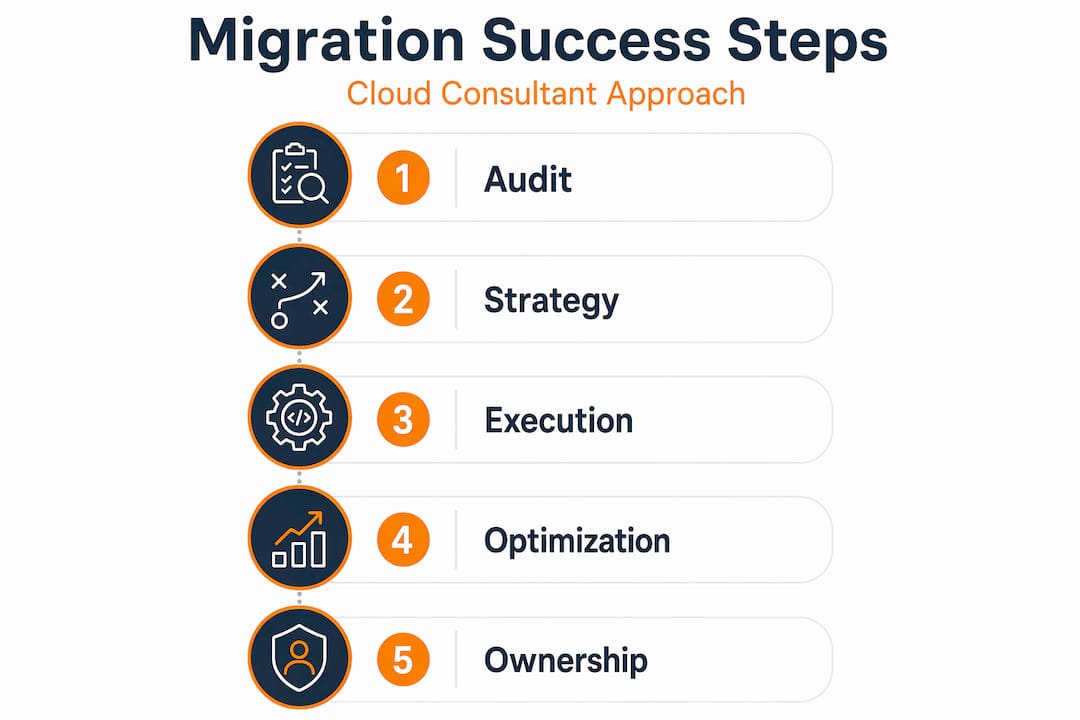
IT-Magic’s AWS migration services cover the full lifecycle: infrastructure audit, strategy, hands-on implementation, and post-migration optimization. As an AWS Advanced Tier Partner with 700+ completed projects, IT-Magic specializes in complex, high-load environments where the stakes are highest, particularly in eCommerce and fintech. Whether you need a rehost, replatform, or refactor approach, the team takes full ownership of outcomes. Explore the AWS migration best practices guide to see how a structured migration process maps to the consulting principles covered in this article.
FAQ
What does a cloud consultant actually do?
A cloud consultant assesses your infrastructure, designs a cloud strategy, guides workload migration, and manages cost governance. Their scope covers both technical architecture and organizational change management.
What are the main benefits of cloud consultants?
The core benefits include reduced migration risk, faster time to production, better cost visibility through FinOps models, and organizational alignment that sustains cloud value long after go-live.
How do cloud consultants reduce migration downtime?
Consultants use workload mapping, pilot migrations, and automation tools to sequence and execute migrations with minimal service disruption. Replication-based migration tools keep production systems live during the transfer process.
How do I choose a cloud consultant for my organization?
Prioritize consultants with documented experience in your industry vertical, verifiable case studies, and a clear methodology for both technical execution and organizational change. Ask specifically about their approach to mid-migration rollbacks.
When should a business bring in a cloud strategy advisor?
Bring in a cloud strategy advisor before architecture decisions are finalized, not after. Early engagement shapes cost models, security posture, and operating model design in ways that are expensive to correct later.