
TL;DR:
- Managed cloud services handle the full lifecycle of AWS environments, freeing IT teams to focus on core business growth. They offer improved security, cost management, and faster migration processes, especially for complex enterprise workloads. However, organizations must consider risks like vendor lock-in and data sovereignty when adopting hybrid or fully managed models.
AWS migration does not have to mean months of disruption, runaway costs, or sleepless nights worrying about security gaps. Yet many CIOs and IT managers still treat it as an unavoidable ordeal. The shift happening right now is that managed cloud services handle the full lifecycle of AWS environments, from architecture and migration through security and ongoing optimization, freeing your team to focus on what actually grows the business. This guide cuts through the noise and gives you a practical, evidence-backed framework for evaluating these services and putting them to work.
Table of Contents
- What are managed cloud services?
- Top providers and their AWS specialization
- Key benefits for enterprise AWS migration
- Risks, limitations, and hybrid strategies
- The real-world tradeoffs: Lessons for CIOs
- How AWS migration experts can empower your journey
- Frequently asked questions
Key Takeaways
| Point | Details |
|---|---|
| Full-scope management | Managed services cover AWS migration, security, and optimization so IT focuses on innovation. |
| Enterprise-grade providers | Top MCSPs specialize in secure, large-scale transitions for regulated industries. |
| Cost and risk control | Expert management reduces downtime, cost spikes, and compliance headaches compared to DIY approaches. |
| Know the tradeoffs | MCSPs add value but risks like vendor lock-in mean hybrid strategies are popular. |
What are managed cloud services?
A managed cloud service provider (MCSP) is a third party that takes ownership of your AWS environment so you do not have to. That means more than just “keeping the lights on.” It covers the full stack: architecture design, migration planning, infrastructure provisioning, performance monitoring, security hardening, compliance management, and continuous cost optimization.
The scope matters because enterprise AWS environments are rarely simple. You might be running hundreds of workloads across production, staging, and development, each with its own security policies, compliance requirements, and performance thresholds. An MCSP brings specialized tooling and certified expertise to manage that complexity without pulling your internal engineers into reactive firefighting.
Core responsibilities of a quality MCSP include:
- Infrastructure audit and discovery to map your current state before any workload moves
- Migration planning and execution using rehost, replatform, or refactor strategies depending on business context
- 24/7 monitoring and incident response to catch problems before they become outages
- Security and compliance management covering identity, access, encryption, and regulatory frameworks
- Cost governance through reserved instances, savings plans, right-sizing, and usage analysis
- Post-migration optimization to keep performance and spend aligned with business goals
The market for these services reflects just how valuable this capability has become. The cloud managed services market is projected to grow from $83 billion in 2021 to $319 billion by 2031, driven by enterprise cloud complexity and escalating security demands. That growth is not hype. It reflects real budget decisions by CIOs who have concluded that building and retaining equivalent internal expertise is slower and costlier than partnering with specialists.
The practical benefit for your IT team is focus. When routine infrastructure management shifts to an MCSP, your engineers work on AWS migration services that differentiate the business, not on patching, monitoring alerts, or capacity planning spreadsheets.
Top providers and their AWS specialization
The enterprise managed cloud market has several well-established players. Knowing where each one excels helps you write a sharper RFP and avoid expensive mismatches between provider strengths and your specific environment.
Here is a comparison of the major providers you will encounter:
| Provider | Industry fit | Migration depth | Security and compliance |
|---|---|---|---|
| Accenture | Finance, healthcare, retail | Deep; full refactor capability | Strong regulatory frameworks, FedRAMP, HIPAA |
| Capgemini | Manufacturing, telco, public sector | Strong replatform and rehost | ISO 27001, GDPR, SOC 2 |
| HCL Technologies | Finance, energy, pharma | Strong rehost and replatform | Advanced threat monitoring, compliance automation |
| NTT Data | Banking, insurance, healthcare | Full lifecycle; strong hybrid | Global compliance, zero-trust architecture |
| TCS | Retail, manufacturing, utilities | Strong at scale, rehost focus | GDPR, PCI DSS, sector-specific frameworks |
These key enterprise AWS providers suit large-scale secure migrations across industries like finance, manufacturing, and healthcare. But size and name recognition alone are not the right selection criteria.
When to choose a global MCSP:
- You have multi-region workloads with complex regulatory requirements across jurisdictions
- Your migration involves significant application refactoring and modernization
- You need dedicated security operations center (SOC) coverage
- Procurement prefers large, established vendors for contract risk management
When a specialized boutique makes more sense:
- Your environment is primarily AWS-native and does not need multi-cloud abstraction
- You want faster execution without enterprise sales and onboarding cycles
- Your use case is eCommerce or fintech where deep vertical expertise matters more than global scale
- You need a provider that will actually own outcomes, not just bill for hours
Exploring AWS migration best practices before issuing an RFP will sharpen your evaluation criteria considerably. You should also research provider alternatives to benchmark your options honestly.
Pro Tip: When evaluating any provider, ask specifically how they handle migration cutover windows for high-load, customer-facing systems. Generic answers reveal a lack of real execution depth. You want a detailed rundown of their rollback procedures, traffic switching approach, and post-cutover monitoring protocol.
The right provider for AWS digital transformation is the one whose execution methodology matches the risk tolerance and complexity of your specific environment, not the one with the most impressive slide deck.
Key benefits for enterprise AWS migration
The business case for managed AWS migration goes well beyond convenience. You get measurable operational gains, security improvements, and cost predictability that are difficult to replicate with internal teams alone.

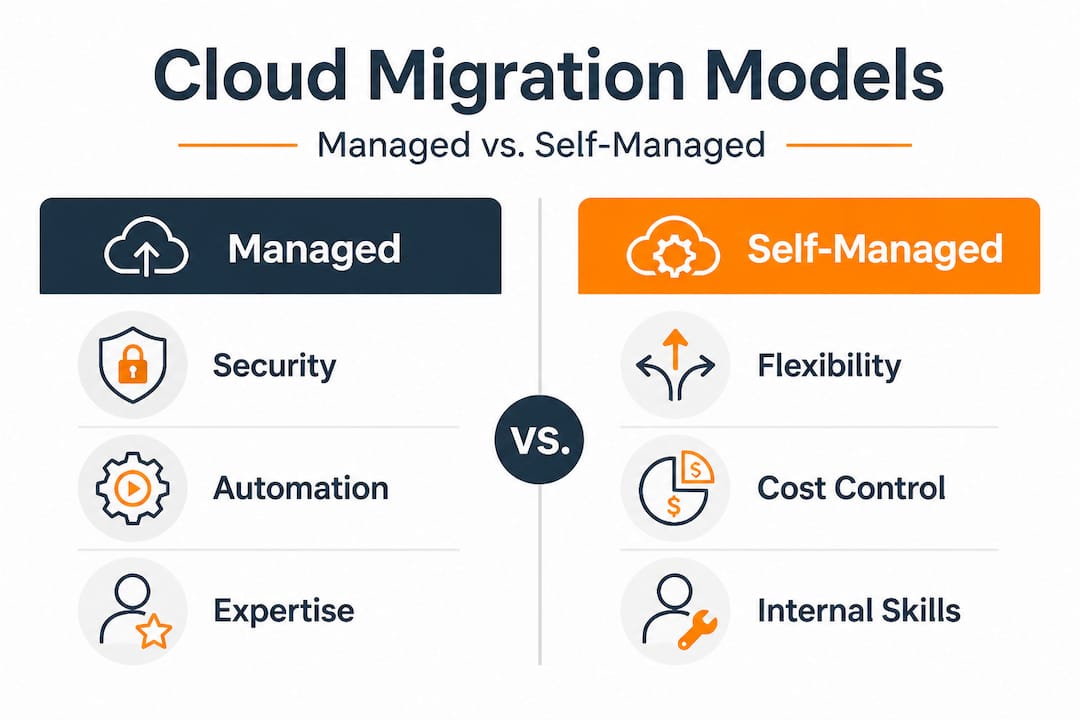
Here is how managed and self-managed migration compare across the dimensions that matter most to enterprise IT leaders:
| Dimension | Managed migration | Self-managed migration |
|---|---|---|
| Security posture | Proactive hardening, automated compliance checks | Reactive; depends on internal security team bandwidth |
| Downtime risk | Minimized through proven cutover frameworks | Higher; often tied to team experience gaps |
| Cost predictability | Structured SLAs and governance models | Variable; hidden costs emerge post-migration |
| Staffing impact | Internal team stays focused on innovation | Internal team stretched across migration and operations |
| Compliance coverage | Continuous automated monitoring and reporting | Manual reviews; audit gaps are common |
| Speed to production | Faster with established tooling and templates | Slower; custom tooling and process development required |
The managed migration advantage is most visible in complex environments where security, compliance, and uptime requirements are non-negotiable.
A typical managed AWS migration moves through these phases with predictable outcomes at each step:
- Discovery and audit — Inventory all workloads, dependencies, data flows, and compliance requirements. Output: a prioritized migration backlog.
- Strategy and architecture design — Select rehost, replatform, or refactor per workload based on business value and complexity. Output: a migration blueprint with risk ratings.
- Pilot migration — Move a low-risk workload first to validate tooling, runbooks, and monitoring before touching production systems. Output: a tested migration playbook.
- Wave-based production migration — Move workloads in logical waves, with validation gates and rollback procedures at each stage. Output: migrated environment with documented runbooks.
- Post-migration optimization — Right-size instances, implement reserved pricing, tune performance, and establish ongoing governance. Output: reduced AWS spend and improved SLAs.
“The cloud managed services market is expected to reach $319 billion by 2031, reflecting enterprise demand for secure, scalable management as cloud complexity grows.”
Smart optimizing AWS costs does not end at migration. Post-migration governance is where most of the long-term savings actually materialize, and it requires the same level of rigor as the migration itself.
The cloud scalability advantages for application performance become tangible once workloads are properly architected on AWS, not just lifted and shifted with default configurations. Managed providers build for scale from day one.
Risks, limitations, and hybrid strategies
Managed cloud services deliver real value, but they are not universally the right answer. Entering a managed relationship without understanding the downsides can create bigger problems than the ones you were trying to solve.
The most significant risks to evaluate before signing a contract:
- Vendor lock-in — Heavily customized management layers can make it painful and expensive to switch providers later, especially if the MCSP uses proprietary tooling.
- Cost creep — Managed service fees are predictable at contract signing, but scope expansion, usage growth, and add-on services can push actual costs well above initial estimates within 12 to 18 months.
- Skill erosion — When an MCSP handles all infrastructure operations, your internal team can lose the hands-on knowledge needed to evaluate provider quality, troubleshoot deep issues, or negotiate effectively at contract renewal.
- Multi-cloud complexity — If your strategy involves AWS plus Azure or GCP, many MCSPs have stronger depth on one platform than others. Cross-cloud governance gaps are a real operational risk.
- Sovereignty and data residency requirements — Regulated and sovereignty-requiring industries have specific needs around data location, access controls, and vendor jurisdiction that not every MCSP can satisfy. Hybrid models often handle this better.
For organizations in banking, government contracting, or healthcare, the answer is rarely pure managed or pure in-house. A hybrid model splits the responsibility: the MCSP manages commodity workloads like dev/test environments, monitoring infrastructure, and cost optimization, while your internal team retains control over sensitive production systems, encryption key management, and regulatory reporting.
Understanding cloud strategies for business at a strategic level helps you define those boundaries before you negotiate with a provider.
The compliance considerations for cloud deployments extend beyond the migration itself. Your managed provider needs to demonstrate ongoing compliance posture management, not just a clean audit at go-live.
Pro Tip: Build a quarterly architecture and cost review cadence into your managed services contract from day one. This forces both sides to reassess scope, pricing, and technical decisions regularly, which is the most effective guard against lock-in and cost surprises.
The real-world tradeoffs: Lessons for CIOs
Here is the uncomfortable part of this conversation. Best practices look clean on paper. Inside a real organization with legacy systems, internal politics, competing priorities, and a team that learned AWS through trial and error, the managed vs. self-managed decision is messier than any framework suggests.
We have seen enterprises choose global MCSPs because the procurement team felt safer with a Fortune 500 name, only to discover that the actual delivery team was a subcontractor with little context on the client’s environment. We have also seen organizations insist on self-managed migration to maintain control, then struggle for two years with cost overruns and repeated security audit findings.
The honest comparison between managed and self-managed approaches is this: managed services excel in predictability and security at scale, but self-managed suits organizations with genuinely custom needs or unusually deep internal cloud expertise. Hybrid models are not a compromise; for most large enterprises, they are actually the most rational starting point.
The decision rubric we recommend for CIOs evaluating their options:
Go fully managed when: Your team does not have AWS specialization at scale, your migration timeline is aggressive, your compliance requirements are well-defined and standard, and you can accept reasonable tradeoffs on customization for speed and predictability.
Go hybrid when: You have regulatory or sovereignty requirements that demand internal control over specific data or systems, your environment mixes commodity and highly sensitive workloads, or you want to build internal capability while managing operational risk during the transition.
Stay in-house when: You have a large, certified cloud engineering team already running AWS at scale, your workloads have genuinely unique requirements that no MCSP handles well, and your organization has the discipline to maintain governance without external accountability.
AWS cost optimization strategies should factor into whichever model you choose, because the biggest migrations fail not on technical execution but on financial governance after go-live.
Pro Tip: When evaluating providers, ask them to walk you through a real migration they did in an environment similar to yours, including what went wrong and how they handled it. Transparency about failure modes tells you far more than a reference call about success stories.
The CIOs who get this right are not the ones who pick the “best” vendor. They are the ones who define their own boundaries clearly before the first sales call.
How AWS migration experts can empower your journey
If you are weighing your AWS migration strategies, targeted expertise can mean the difference between transformation and turbulence.
At awsmigrationservices.com, we have completed 700+ migrations as an AWS Advanced Tier Partner, with a particular depth in high-load eCommerce and fintech environments where downtime and security gaps translate directly into lost revenue. We take full ownership of execution, from the initial infrastructure audit through post-migration optimization, so your team keeps its focus on the business. Explore enterprise AWS migration solutions or start with a targeted cost analysis using our cost optimization with AWS experts resources. When you are ready to compare approaches, our AWS migration best practices guide provides the framework to move fast without moving blind.
Frequently asked questions
How do managed cloud services reduce AWS migration downtime?
Providers use proven cutover frameworks, automation, and wave-based migration sequencing to minimize operational disruption while moving workloads to AWS. Pre-tested rollback procedures give you a safety net if anything deviates from plan.
Are managed cloud services suitable for highly regulated industries?
Yes. Leading enterprise providers specialize in compliance-driven migrations for finance, healthcare, and government sectors, with built-in controls for frameworks like HIPAA, PCI DSS, and FedRAMP. Always verify that the provider can demonstrate current certifications, not just past ones.
What are the main risks of managed cloud services?
The core risks are vendor lock-in, cost overruns, and skill erosion inside your internal team over time. Structuring contracts with regular review gates and maintaining a core internal cloud competency reduces all three.
How does a hybrid managed cloud model work?
A hybrid model lets you retain control over sensitive workloads while outsourcing routine AWS management, monitoring, and cost optimization to an MCSP. This approach is common in banking and healthcare, where certain data and systems must stay under direct organizational control for regulatory reasons.