TL;DR:
- Most companies confuse cloud migration with true cloud transformation, which involves reengineering processes and operating models. Effective cloud transformation aligns with business strategy, modernizes applications, and adopts cloud-native tools to deliver higher revenue growth and AI readiness. Successful programs follow phased, outcome-driven approaches, emphasizing governance, data quality, and incremental modernization to avoid costly organizational and technical pitfalls.
Most companies think they’ve done cloud transformation when they’ve actually just done cloud migration. Moving your servers to AWS and calling it “transformation” is like buying a gym membership and calling it fitness. Understanding what is cloud transformation, and how it differs from simply lifting and shifting workloads, is what separates organizations that get lasting results from those that spend more and gain less.
Table of Contents
- Key takeaways
- What cloud transformation actually means
- The business case for cloud transformation
- How to approach cloud transformation strategically
- Risks and challenges you need to prepare for
- My honest take on why most cloud programs underdeliver
- Ready to move beyond migration?
- FAQ
Key takeaways
| Point | Details |
|---|---|
| More than migration | Cloud transformation reengineers processes and operating models, not just data and applications. |
| Business outcomes first | Define your business case before selecting technology to avoid unrealistic expectations and wasted spend. |
| Modernization drives AI readiness | Without modernizing legacy architecture, AI initiatives stall due to fragmented data and siloed systems. |
| Governance prevents sprawl | A documented cloud operating model is the single most effective tool against uncontrolled costs. |
| Phased execution works | Incremental modernization aligned to business milestones outperforms big-bang transformation attempts. |
What cloud transformation actually means
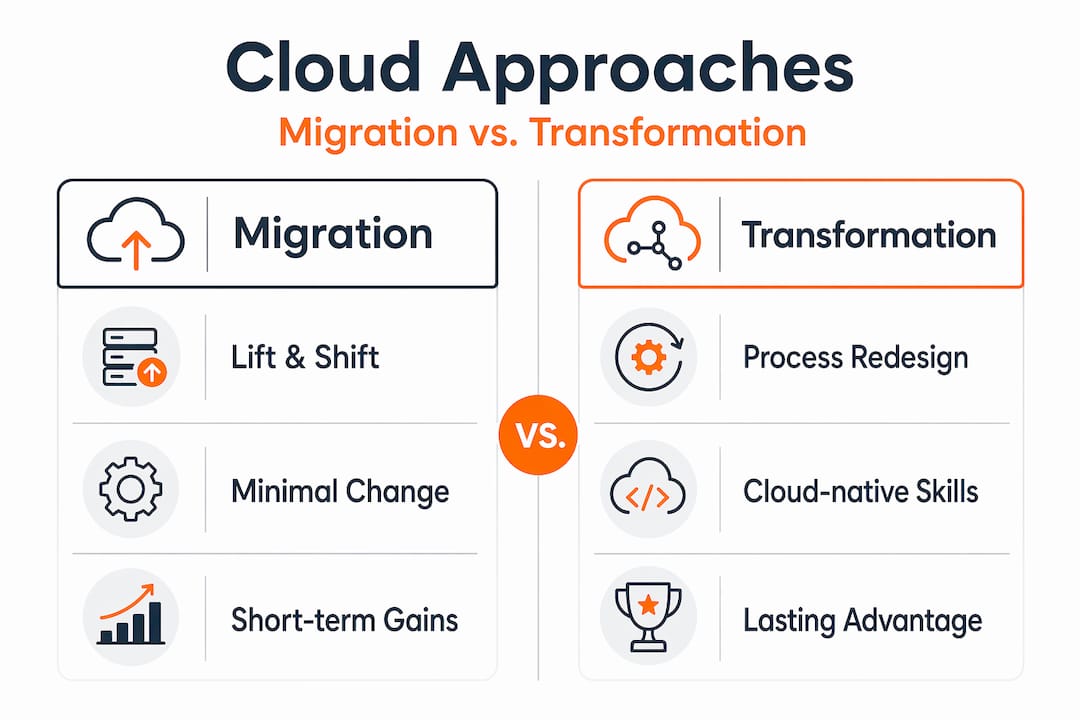
Cloud transformation goes beyond migration by reengineering business processes and adopting cloud-native operating models. Migration moves things. Transformation changes how you work, how you build, and how your organization makes decisions about technology.
The core components of a real cloud transformation include:
- Cloud strategy: A roadmap aligned to midterm corporate goals, not just an IT checklist
- Application modernization: Refactoring or rearchitecting apps to take advantage of cloud-native capabilities
- Operating model redesign: Changing how teams own, govern, and operate infrastructure
- Cloud-native adoption: Moving toward containerization, microservices, and managed services rather than rehosted virtual machines
- Security and compliance governance: Defining accountability under the shared responsibility model
Cloud must align with midterm corporate strategy, including security, data center, and talent development plans. That means cloud transformation is not an IT project handed down from the CTO. It is a business initiative that IT executes.
The distinction between cloud migration and transformation matters most when you are measuring outcomes. A rehost gets you off a data center lease. A transformation gets you faster time to market, lower operational costs, and the architectural foundation to run AI workloads. Those are fundamentally different goals.
Pro Tip: Before you classify your cloud initiative, ask this question: has your organization changed how decisions about infrastructure are made, or just where the infrastructure lives? If it is only the latter, you have migrated, not transformed.
Security is another area where transformation changes the rules. ISO 27017 defines the shared responsibility model as essential for cloud security, with roles shifting depending on whether you are running IaaS, PaaS, or SaaS. Organizations that treat cloud security as purely the provider’s problem discover this mistake expensively.
The business case for cloud transformation
The financial and competitive argument for cloud transformation is not theoretical. Enterprises leveraging cloud technologies report revenue growth rates up to 2.5 times higher and double the profitability improvements compared to peers still running legacy architecture. By 2027, 70% of enterprises are expected to use industry-specific cloud platforms to accelerate business initiatives.
Those numbers explain why the role of cloud in digital transformation has moved from infrastructure conversation to board-level agenda. Organizations that treat cloud as a cost center miss the strategic point entirely.
The benefits that drive real business value include:
- Scalability on demand: Provision capacity in minutes, not months, without capital expenditure cycles
- Reduced infrastructure costs: Legacy infrastructure costs such as Windows Server licensing run 35 to 50% higher than comparable Linux-based cloud workloads
- Faster product delivery: Cloud-native teams ship features faster because infrastructure is no longer a bottleneck
- Data-driven decision making: Centralized, modernized data platforms unlock analytics and machine learning capabilities
- Business continuity: Distributed, resilient architectures eliminate single points of failure that plague on-premise setups
The cost comparison between legacy and cloud is rarely a clean 1:1 calculation. You need to account for licensing, support contracts, data center overhead, and the engineering time spent on keeping old systems alive. When you factor all of that in, the financial case for AWS digital transformation becomes hard to argue against.
The strategic alignment with broader digital transformation matters just as much. Cloud is the infrastructure layer that makes everything else in a digital transformation program possible, from customer experience platforms to real-time analytics.

How to approach cloud transformation strategically
There is no single path through cloud transformation, but there is a sequence of decisions that consistently separates successful programs from expensive disappointments. Here is how organizations that get it right structure their approach:
- Define business outcomes before architecture. Start with the questions your business needs to answer: reduce infrastructure costs by X%, launch new products in Y weeks, meet compliance standards in region Z. Technology choices follow from those answers, not the reverse.
- Audit your current state. Map every workload, dependency, and data flow. You cannot plan a transformation without knowing what you are transforming. This is where most organizations underinvest and later pay for it.
- Choose the right modernization strategy per workload. Rehost (lift and shift) works for speed. Replatform captures quick wins. Refactor delivers the most cloud-native value but takes longer. No single strategy applies to every application.
- Build a cloud operating model. A documented cloud operating model defines roles, governance, and processes and is essential to avoid cloud sprawl and cost overruns. Without this, even well-executed migrations drift into chaos within twelve months.
- Modernize incrementally. Move in phases tied to business milestones, not arbitrary technical timelines. This reduces risk and builds organizational confidence with each completed phase.
- Adopt automation from day one. Infrastructure as code, automated testing, and CI/CD pipelines are not advanced-stage concerns. They are the foundation that makes everything else maintainable.
Pro Tip: Map your workloads into three categories before starting: run-and-maintain applications that just need to move, improvement candidates that can be replatformed for quick gains, and strategic applications worth full refactoring. This triage alone will save months of planning confusion.
For organizations focused on cloud infrastructure optimization, the operating model question is the one that most frequently gets deferred and causes the most damage when ignored.
Risks and challenges you need to prepare for
Cloud transformation fails more often from organizational and process issues than from technical ones. Knowing the pitfalls in advance is the most cost-effective risk management available.
- Unrealistic expectations: Treating cloud as an automatic cost reducer without addressing process inefficiencies first leads directly to disappointment. Business case definition should precede technology selection to avoid exactly this outcome.
- Cloud sprawl: Ungoverned cloud environments generate duplicate resources, orphaned instances, and runaway spend. This is almost always a governance gap, not a technology one.
- Security and compliance gaps: The shared responsibility model means your team is accountable for identity management, data encryption, and network configuration. Assuming the cloud provider handles all of this is a compliance risk.
- Data quality problems: Fragmented, inconsistent data prevents real cloud value realization, especially for analytics and AI workloads. Migration amplifies existing data problems rather than solving them.
- Multi-cloud complexity: Running workloads across multiple cloud providers multiplies operational overhead without proportional benefit for most organizations at the mid-market level.
“Gartner predicts that 25% of organizations will face significant cloud dissatisfaction by 2028, driven by suboptimal implementation, poor data quality, and unmanaged costs.”
That number should focus your thinking. The majority of cloud transformation failures are predictable and preventable. They trace back to the same causes: skipping the operating model, ignoring data quality, and treating governance as something to add later.
Cloud modernization enables enterprises to move from simply running workloads in the cloud to fully leveraging cloud capabilities and becoming AI-ready. Without it, AI initiatives struggle because fragmented data and legacy architecture cannot support what modern AI workloads require. That is the real cost of stopping at migration.
My honest take on why most cloud programs underdeliver
I have worked through enough cloud transformation engagements to see a clear pattern in the ones that disappoint. The technical execution is usually fine. The failure mode is almost always the same: the organization treated transformation as a project with a finish line instead of a shift in how they operate permanently.
What I have learned is that the migration mindset and the transformation mindset are genuinely different things. Migration asks “how do we move this?” Transformation asks “should this exist in its current form at all?” Those are not the same question, and conflating them is where most programs lose months and budget.
The organizations I have seen succeed did something counterintuitive. They spent more time on governance and operating model design upfront than felt comfortable. They resisted the pressure to show quick wins by lifting and shifting everything, and instead ran a small, genuine refactoring effort on a high-value workload first. That proof of concept changed how the whole program was funded and prioritized.
There is also an AI readiness dimension that almost no one is factoring into their cloud transformation planning right now. Modernization enables AI readiness in ways that simple adoption does not. If your data is fragmented, your architecture is legacy, and your operating model is undocumented, you will not be able to run production AI workloads no matter how many cloud services you subscribe to. Cloud transformation is the prerequisite, not the end state.
My take: if you are planning a cloud program in 2026, build your business case around AI readiness as a destination, not just cost reduction. It will get funded faster, stay funded longer, and deliver outcomes that your organization can measure beyond the first budget cycle.
— Oleksandr
Ready to move beyond migration?
If this article has clarified the gap between cloud migration and genuine transformation, the next question is where your organization sits on that spectrum. Awsmigrationservices has completed 700+ migrations as an AWS Advanced Tier Partner, covering the full lifecycle from infrastructure audit through post-migration optimization. The focus is on execution in complex, high-load environments where downtime and cost overruns are not acceptable.
Whether you need a rehost for speed, a replatform for quick efficiency gains, or a full refactor for cloud-native capability, Awsmigrationservices takes ownership of outcomes, not just deliverables. Explore AWS migration services to see how this approach applies to your environment, or review AWS migration best practices to understand what a well-structured program actually looks like in practice.
FAQ
What is cloud transformation vs. cloud migration?
Cloud migration moves applications and data to the cloud. Cloud transformation reengineers business processes, operating models, and application architecture to fully leverage cloud-native capabilities, delivering fundamentally different business outcomes.
What are the main benefits of cloud transformation?
Organizations that complete genuine cloud transformation report revenue growth rates up to 2.5 times higher than peers, reduced infrastructure costs, faster product delivery, and the architectural foundation required to run AI and analytics workloads at scale.
How do you avoid cloud sprawl during transformation?
A documented cloud operating model that defines roles, governance, and cost accountability is the most direct way to prevent cloud sprawl. Without it, ungoverned resource creation drives costs up regardless of how well the initial migration was executed.
What is cloud modernization and how does it relate to transformation?
Cloud modernization is the process of refactoring or rearchitecting applications to use cloud-native services such as containers, microservices, and managed databases. It is a core component of cloud transformation and the step that unlocks AI readiness and long-term scalability.
How long does cloud transformation take?
There is no fixed timeline, but organizations that succeed use phased approaches tied to business milestones rather than technical deadlines. A realistic program for a mid-size enterprise typically spans 12 to 36 months depending on workload complexity and the depth of modernization required.