TL;DR:
- A multi-cloud strategy involves deliberately using and managing multiple public cloud providers to optimize workloads, increase flexibility, and enhance resilience. It differs from hybrid cloud, which integrates private and public environments through orchestration, by focusing on provider diversity and workload placement without requiring interoperability. Successful implementation depends on governance, workload placement criteria, and operational tooling, as most strategies fail due to poor governance and unaligned processes.
A multi-cloud strategy is the deliberate use and governance of multiple cloud providers to optimize workload placement, increase flexibility, and improve system resilience. Rather than defaulting to a single vendor, organizations running a multi-cloud model distribute workloads across providers like AWS, Microsoft Azure, Google Cloud, or Oracle Cloud based on technical fit, regulatory requirements, and cost. The result is a portfolio approach to cloud infrastructure that demands intentional design, not just account proliferation.
What is multi-cloud strategy and how does it differ from hybrid cloud?
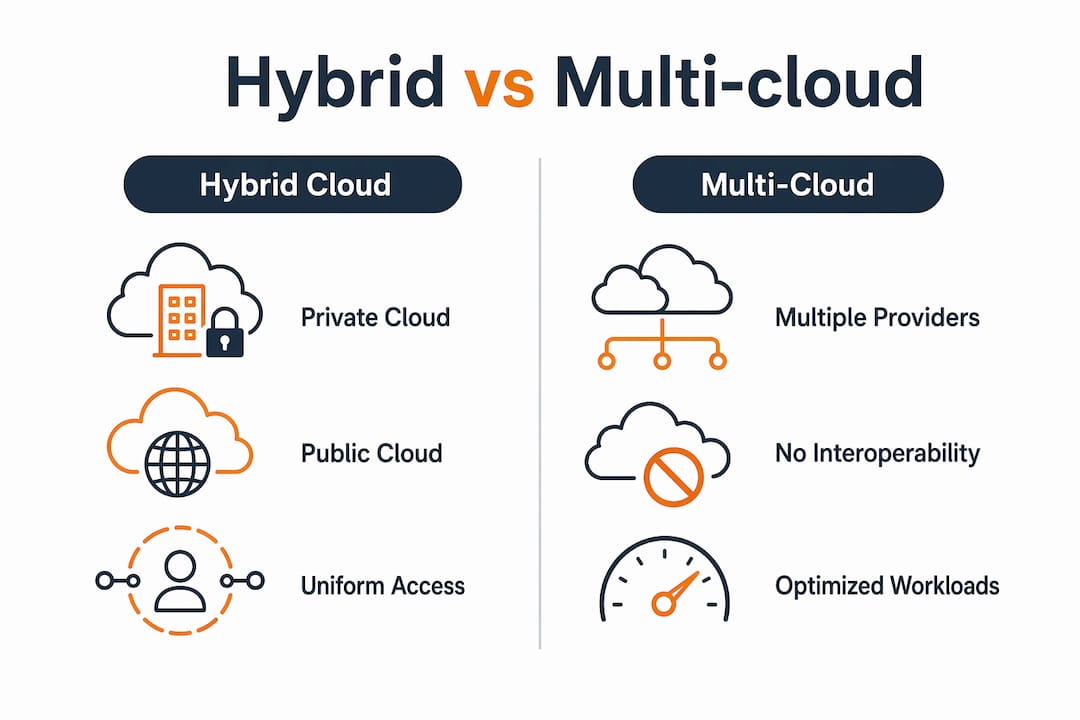
Multi-cloud and hybrid cloud are frequently used interchangeably, but they describe fundamentally different architectures. Multi-cloud uses multiple public providers focused on provider diversity, while hybrid cloud integrates private and public environments through orchestration. Confusing the two leads to applying the wrong design principles from day one.

Hybrid cloud is built around the goal of uniform resource access between on-premises infrastructure and one or more public clouds. A financial services firm running its core transaction processing on private infrastructure while offloading analytics to AWS is operating a hybrid model. The defining characteristic is the private-to-public integration layer, which requires orchestration tooling to manage workload mobility between environments.
Multi-cloud, by contrast, does not require complete interoperability between providers. Public clouds are not interchangeable; AWS Lambda, Azure Functions, and Google Cloud Run each behave differently, expose different APIs, and carry different pricing models. A multi-cloud architecture accepts this divergence and designs workload placement decisions around it rather than abstracting it away.
| Dimension | Hybrid cloud | Multi-cloud |
|---|---|---|
| Environment types | Private and public clouds | Multiple public clouds only |
| Primary goal | Uniform resource access across environments | Best-fit provider selection per workload |
| Interoperability requirement | High, requires orchestration layer | Low to moderate, portability is optional |
| Typical use case | Regulated data on-premises, compute in public cloud | Separate workloads on specialized providers |
| Design complexity | Orchestration and networking between private and public | API divergence and cross-provider governance |
Both models can coexist. An enterprise running SAP on-premises connected to Azure (hybrid) while also running its data platform on Google BigQuery and its eCommerce stack on AWS is operating a hybrid multi-cloud architecture. The distinction matters because each model requires a different governance and integration approach.
What are the key benefits and challenges of a multi-cloud approach?
The case for multi-cloud is strongest when organizations need more than one provider can offer. Multi-cloud benefits include avoiding vendor lock-in, improving resilience through workload distribution, and selecting best-of-breed services per use case. Each of these advantages is real, but none of them materialize automatically.
Core benefits:
- Vendor independence. No single provider controls your pricing, roadmap, or availability. When AWS announced changes to its S3 pricing model, organizations with multi-cloud storage strategies had negotiating leverage that single-vendor customers lacked.
- Resilience through redundancy. Distributing critical workloads across providers reduces the blast radius of a regional outage. A payment processor running transaction routing on both AWS and Azure can failover without customer impact.
- Best-of-breed service access. Google Cloud leads in managed ML infrastructure with Vertex AI. AWS leads in breadth of managed services. Oracle Cloud Infrastructure offers price-performance advantages for Oracle Database workloads. Multi-cloud lets you use each where it excels.
- Commercial leverage. Committing spend across providers creates negotiating room that single-vendor enterprise agreements do not.
Core challenges:
- API and tooling fragmentation. Every provider has its own control plane, CLI, IAM model, and monitoring stack. Teams managing AWS CloudWatch, Azure Monitor, and Google Cloud Operations simultaneously face real cognitive and operational overhead.
- Cost visibility gaps. Each provider bills differently. Without a unified cost allocation model, spend attribution across teams and workloads becomes guesswork.
- Security baseline drift. Maintaining consistent security controls across providers requires deliberate effort. A misconfiguration in one environment does not automatically surface in another.
- Operational complexity. Multi-cloud complexity requires governance tools and orchestration systems for unified management. Without them, you are not running a strategy. You are running multiple disconnected cloud accounts.
Pro Tip: Before adding a second cloud provider, document the specific workload requirement that the first provider cannot meet. If you cannot name it precisely, the second provider adds cost without adding value.
How do organizations establish governance and operational controls?
A successful multi-cloud strategy is a governed operating model that enforces consistent policies, financial controls, and repeatable workload placement across providers. Organizations that treat it as an infrastructure decision rather than an operating model consistently underperform on cost, security, and reliability.
Governance in multi-cloud operates across four domains:
- Identity and access management. Centralized identity governance means your entitlement model travels with workloads, not per-provider. Using a federated identity provider like Okta or Azure Active Directory across AWS, GCP, and Azure reduces the risk of orphaned accounts and privilege escalation in any single environment.
- Security baseline consistency. NIST’s Zero Trust Architecture provides a framework for securing resources distributed across clouds and on-premises. Applying ZTA principles, including continuous verification and least-privilege access, as a provider-agnostic baseline reduces the manual compliance work required per provider. For a deeper look at applying these frameworks, the cloud security best practices guide covers implementation specifics for 2026 environments.
- Financial governance through FinOps. Cross-team coordination between finance, engineering, and platform teams is the foundation of multi-cloud cost control. FinOps in a multi-cloud context means unified tagging taxonomies, clear ownership of spend by team and workload, and automated alerts when costs deviate from baseline. Without this, cloud bills become a forensic exercise rather than a managed outcome. Practical approaches to cross-provider cost allocation are worth reviewing before you scale beyond two providers.
- Orchestration and management platforms. Tools like HashiCorp Terraform, Pulumi, and cloud management platforms such as CloudHealth or Apptio Cloudability provide unified visibility across provider dashboards. Management platforms monitor resources, policy compliance, and operational optimization across clouds from a single control plane.
Pro Tip: Implement a mandatory tagging policy before onboarding your second cloud provider. Retroactively tagging resources across two or more providers is one of the most time-consuming remediation tasks in multi-cloud operations.
Effective multi-cloud requires consistent identity, policy, and financial governance as a unified system. Mature setups provide centralized controls that travel with workloads, which simplifies audits and security reviews significantly.
What practical steps help implement multi-cloud effectively?
Implementation quality separates organizations that benefit from multi-cloud from those that accumulate cloud debt. Workload placement in multi-cloud relies on criteria including regulatory requirements, latency demands, data gravity, service specialization, and cost. Applying these criteria consistently requires a placement framework, not ad hoc decisions.
The following practices define mature multi-cloud execution:
- Define placement criteria before selecting providers. Map each workload to its requirements across latency, data residency, compliance, and service dependencies. A healthcare application with HIPAA requirements and sub-50ms latency needs in the US Northeast has a different placement profile than a batch analytics pipeline with flexible scheduling.
- Prioritize providers with established ecosystem partnerships. Oracle Cloud and Microsoft Azure ecosystem partnerships offer high-performance networking and reduced data transfer costs. Choosing providers that have invested in interconnects reduces latency and egress fees for workloads that communicate across clouds.
- Plan for portability explicitly. Public cloud services require explicit portability plans per workload to avoid operational lock-in. This means containerizing where feasible, using open standards like Kubernetes for orchestration, and avoiding deep proprietary service dependencies unless the business case justifies the lock-in.
- Build repeatable operating patterns. Infrastructure-as-code templates, standardized deployment pipelines, and documented runbooks for each provider reduce the knowledge concentration risk that comes with multi-cloud complexity.
- Align cross-team accountability. Security, finance, and engineering teams each have a stake in multi-cloud outcomes. Establishing shared ownership models, with defined responsibilities per team per provider, prevents the accountability gaps that produce both security incidents and budget overruns.
For organizations placing AWS at the center of their multi-cloud architecture, reviewing AWS migration best practices provides a practical foundation for the migration and integration phases.
Key takeaways
A multi-cloud strategy succeeds only when governance, financial controls, and workload placement criteria are defined before providers are added, not after.
| Point | Details |
|---|---|
| Definition matters | Multi-cloud is governed use of multiple public providers, not just having multiple cloud accounts. |
| Hybrid vs. multi-cloud | Hybrid integrates private and public environments; multi-cloud selects among multiple public providers for workload fit. |
| Governance is the core | Consistent identity, security baselines, and FinOps controls must travel with workloads across all providers. |
| Placement drives value | Workload placement decisions based on latency, compliance, and service fit determine whether multi-cloud delivers ROI. |
| Complexity requires tooling | Orchestration platforms like Terraform and cost management tools like CloudHealth are operational requirements, not optional additions. |
Why most multi-cloud strategies fail before they scale
I have seen organizations announce a multi-cloud strategy and then spend 18 months discovering they built a multi-account mess instead. The pattern is consistent: a team adopts a second provider for a specific project, governance does not follow, and within a year you have two separate cloud operating models running in parallel with no shared visibility on cost, security posture, or compliance status.
The uncomfortable truth is that multi-cloud is harder than single-cloud, and the difficulty is almost entirely in the governance layer, not the infrastructure layer. Spinning up an AWS account and a GCP project takes an afternoon. Building a unified tagging taxonomy, federated identity model, and FinOps reporting structure that works across both takes months of cross-functional alignment.
What I consistently recommend to leadership teams is to treat the governance design as the first deliverable, not the last. Before you place a single production workload on a second provider, you need answers to three questions: Who owns cost accountability per provider? How does your identity model extend to the new environment? What is your security baseline, and how will you verify it continuously? If those answers are not documented, the second cloud provider is a liability, not an asset.
The organizations that get multi-cloud right are the ones that invest in platform engineering capability, not just cloud accounts. They build internal tooling, enforce tagging policies, and run FinOps reviews as a regular business rhythm. That discipline is what separates a mature multi-cloud strategy from an expensive experiment.
— Oleksandr
Migrate to AWS as part of your multi-cloud strategy
If AWS is part of your multi-cloud architecture, the migration and optimization phases carry the most execution risk. IT-Magic has completed 700+ AWS migrations as an AWS Advanced Tier Partner, specializing in high-load eCommerce and fintech environments where downtime and cost overruns are not acceptable outcomes. The team takes full ownership of execution, from infrastructure audit through post-migration optimization, so your internal teams stay focused on product delivery. Whether you are rehosting, replatforming, or refactoring, IT-Magic delivers predictable, production-grade results. Explore AWS migration services to see how IT-Magic structures engagements for complex, multi-provider environments.
FAQ
What is a multi-cloud strategy in simple terms?
A multi-cloud strategy is the deliberate use of services from multiple cloud providers, such as AWS, Azure, and Google Cloud, to place each workload where it performs best technically and commercially. It requires governance, not just accounts across multiple vendors.
How does multi-cloud differ from hybrid cloud?
Hybrid cloud integrates private and public cloud environments through orchestration, while multi-cloud uses multiple public providers without requiring full interoperability. The two models can coexist but require different design and governance approaches.
What are the biggest risks of a multi-cloud strategy?
The primary risks are cost visibility gaps, security baseline drift across providers, and operational complexity from managing divergent APIs and control planes. These risks are manageable with unified governance tooling and FinOps practices, but they require proactive investment.
What governance tools support multi-cloud management?
HashiCorp Terraform and Pulumi handle infrastructure-as-code across providers, while platforms like CloudHealth and Apptio Cloudability provide unified cost and compliance visibility. NIST Zero Trust Architecture offers a provider-agnostic security baseline framework.
When does a multi-cloud strategy make business sense?
Multi-cloud makes sense when a single provider cannot meet all workload requirements across performance, compliance, cost, or service capability. Organizations with regulatory data residency requirements across multiple regions or workloads that benefit from provider-specific services like Google Vertex AI or AWS SageMaker are strong candidates.