TL;DR:
- Treating cloud migration as a single-step process is costly, leading to stalls and overruns due to scope creep and dependencies. A structured, phased migration roadmap aligned with business goals reduces risk, ensures compliance, and improves success rates in complex eCommerce and fintech environments. Flexibility, ongoing reassessment, and expert support are essential for adapting plans and avoiding failure in large-scale cloud transitions.
Cloud migration is not a one-step process, and treating it like one is one of the most expensive mistakes an organization can make. Scope creep, piecemeal planning, and underestimating dependencies cause migrations to stall, balloon in cost, or collapse entirely. Research shows that phased migration strategies achieve 92% success rates compared to just 58% for wholesale approaches. This article gives you a step-by-step, evidence-backed migration roadmap framework built specifically for eCommerce and fintech environments where downtime and compliance failures translate directly into lost revenue.
Table of Contents
- Defining the migration roadmap: What it is and why it matters
- Core phases of AWS migration for eCommerce and fintech
- Wave-based execution: Reducing risk and accelerating timelines
- Edge cases and customization: Handling compliance and seasonality
- Migration strategies: Rehost vs refactor for speed and value
- Why rigid roadmaps fail: Lessons from years of AWS migrations
- Get expert help for your AWS migration roadmap
- Frequently asked questions
Key Takeaways
| Point | Details |
|---|---|
| Roadmaps double migration success | Structured migration plans nearly double success rates compared to wholesale attempts. |
| Wave-based approach lowers risk | Migrating in phases reduces downtime and security incidents, especially for complex workloads. |
| Customize for fintech and eCommerce | Tailor migration strategies for zero downtime, compliance, or rapid scaling based on your business model. |
| Rehost vs refactor depends on deadlines | Choose rehost for speed; refactor for long-term optimization of revenue-critical apps. |
| Adapt roadmaps to skills and change | Frequent skills checks and decision records keep migration plans relevant and effective. |
Defining the migration roadmap: What it is and why it matters
A migration roadmap is not a checklist or a Gantt chart. It is a strategic project plan that aligns your technical execution with your business goals, risk tolerance, and operational realities. Think of it as the architectural blueprint before construction begins. Without it, every team member interprets priorities differently, and those inconsistencies compound quickly.
For eCommerce and fintech companies, the stakes are particularly high. A payment processing platform that goes offline for two hours during peak traffic is not just an IT problem. It is a revenue event that damages customer trust. A migration roadmap structures the move to AWS in a way that accounts for these business-critical constraints from day one.
The AWS Well-Architected Framework Migration Lens defines three core migration phases: Assess, where you inventory workloads and build a business case; Mobilize, where you set up a landing zone and define strategies; and Migrate and Modernize, where you execute waves and refactor as needed. These phases are not interchangeable. Skipping or rushing through Assess, for example, creates blind spots in your dependency mapping that surface as outages later.
Key benefits of a structured roadmap include:
- Alignment across teams: Engineering, security, finance, and operations all work from the same document and shared priorities.
- Dependency mapping: You identify which workloads must move before others and avoid mid-migration surprises.
- Compliance integration: Security controls are embedded early, not retrofitted after the fact.
- Scope control: Predefined phases and success criteria prevent feature or scope creep that derails timelines.
- Budget predictability: Phased milestones with cost models reduce the risk of runaway AWS spend.
Following migration best practices from the start of planning, not the middle of execution, is what separates migrations that deliver ROI from those that drain it.
Pro Tip: During the Assess phase, document every major architecture decision in an Architecture Decision Record (ADR). An ADR captures the context, options considered, and rationale for each choice. When team members change or priorities shift mid-migration, ADRs prevent the team from relitigating resolved decisions and losing weeks of progress.
Core phases of AWS migration for eCommerce and fintech
Now that we have defined the roadmap’s importance, here is how its core phases play out in complex migrations. The sequence matters. Jumping straight to execution without completing Assess and Mobilize is the equivalent of pouring a foundation before completing the soil survey.
-
Assess: Inventory all workloads and map dependencies. Build a detailed business case that quantifies current infrastructure costs, projected AWS costs, and the total cost of migration. Identify which applications are revenue-critical, which carry compliance requirements, and which are candidates for decommission. Output: a prioritized workload inventory and a go/no-go recommendation for migration.
-
Mobilize: Set up the AWS Landing Zone, which is the governance-ready, multi-account AWS environment your workloads will migrate into. Define IAM (Identity and Access Management) policies, VPC (Virtual Private Cloud) architecture, logging configurations, and security baselines. Establish the cloud infrastructure for AWS migration before a single production workload moves. Output: a production-ready AWS environment with guardrails in place.
-
Migrate and Modernize: Execute workload migrations in structured waves, starting with the lowest-risk applications and progressing toward core systems. As capacity and confidence build, introduce modernization steps such as containerizing applications or rearchitecting databases. The AWS migration phases framework recommends migrating first, then modernizing, to meet strict deadlines without overextending your team.
The table below compares how these phase objectives differ between eCommerce and fintech:
| Phase | eCommerce focus | Fintech focus |
|---|---|---|
| Assess | Catalog seasonal traffic patterns, CDN dependencies | Map regulatory compliance requirements, audit logging needs |
| Mobilize | Configure auto-scaling policies, CDN setup | Deploy encryption at rest/transit, AWS Control Tower governance |
| Migrate | Prioritize storefront and payment services uptime | Zero-downtime cutover for transaction processing systems |
| Modernize | Adopt Spot Instances for batch jobs, caching layers | Refactor for audit trails, data residency, and PCI DSS compliance |
Using this phase-by-phase structure, paired with the right services guide for secure migration, ensures your team is building for compliance and scalability simultaneously, not as an afterthought.
Wave-based execution: Reducing risk and accelerating timelines
We have covered the phases. Now let us look at how wave-based execution changes outcomes in large migrations. This is where theory meets real-world complexity.

Wave-based migration means grouping workloads into sequential batches based on risk, dependency, and business criticality. Each wave builds on the last. This approach prevents the most common failure mode in large migrations: trying to move everything at once, only to discover mid-flight that two systems have an undocumented dependency that nobody mapped.
A well-structured wave plan follows this pattern:
- Wave 0 (Foundation): Set up the AWS Landing Zone, networking, identity management, and security tooling. No production workloads move yet. This wave is entirely about building the environment that everything else depends on.
- Wave 1 (Pilot and low-risk): Migrate development, test, and staging environments first. These systems carry low business risk but give your team real-world practice with the migration toolchain, runbooks, and rollback procedures. Quick wins here build confidence and surface unexpected issues in a controlled setting.
- Wave 2 and beyond (Core and complex): Move revenue-critical and compliance-heavy workloads only after the earlier waves have validated your process. By this point, your team knows the patterns, the tooling is proven, and your runbooks reflect actual operational experience rather than untested theory.
“For medium-large eCommerce and fintech environments, wave-based execution starting with foundation, then low-risk, then core complex systems is the most reliable path to meeting deadlines without compromising compliance or stability.” Source: Cloud Migration Checklist
The data behind wave-based execution is compelling. Organizations using a structured legacy to cloud migration approach report significantly lower security incident rates and faster time to production compared to single-phase migrations. Here is a snapshot of the difference:
| Migration approach | Success rate | Security incidents | Average timeline overrun |
|---|---|---|---|
| Big-bang (single phase) | ~58% | High | 40-60% over estimate |
| Wave-based (phased) | ~92% | Reduced by up to 40% | Less than 10% over estimate |
| Pilot-first hybrid | ~85% | Moderate | 15-25% over estimate |
Pro Tip: Always run a dry-run cutover during Wave 1 using your actual migration tooling. This validates your rollback procedure under realistic conditions without touching production. Teams that skip this step often discover rollback gaps only when it is too late to use them cleanly.
Edge cases and customization: Handling compliance and seasonality
How do specialized requirements impact roadmaps? Here is how edge cases shape the migration plan for eCommerce and fintech specifically.
For fintech companies, the non-negotiable requirement is zero downtime architecture during cutover. Blue-green deployments, where you run two identical environments simultaneously and shift traffic gradually, are the standard approach for transaction processing systems. Database replication must be active and validated before any traffic is moved. AWS Control Tower enforces governance policies at the account level so that encryption, logging, and access controls are consistent across the entire environment from day one, not bolted on after an audit finding.
Regulatory hurdles also create real delays for fintech migrations. A Refactor strategy, which requires rearchitecting applications for cloud-native services, often cannot be completed on a short timeline when compliance approval workflows span multiple quarters. In these cases, a Rehost-first approach allows the team to meet the data center exit deadline while compliance and modernization work continues in parallel.
For eCommerce companies, the critical variable is seasonality. A retailer migrating its platform in October risks running directly into the highest-traffic period of the year. Roadmaps for eCommerce must include:
- Seasonal blackout windows where no production migrations occur
- Pre-configured auto-scaling policies that are tested before peak season
- Spot Instance configurations for batch processing and background jobs that can absorb variable demand without fixed cost
- Load testing against AWS infrastructure at projected peak volumes, not average volumes
Governance frameworks reduce security incidents by up to 40%, according to research on cloud migration strategies, which is a powerful argument for investing in AWS Control Tower and IAM governance early in the Mobilize phase rather than treating it as a post-migration task.
Understanding which cloud strategies fit your business context is what separates a generic roadmap from one that actually works in production.
Migration strategies: Rehost vs refactor for speed and value
After handling custom needs, the next critical decision is choosing the right migration strategy. This choice shapes your timeline, skill requirements, cost projections, and long-term technical debt.
Rehost (lift and shift) means moving workloads to AWS without redesigning them. The application runs on EC2 instances in AWS exactly as it ran on your on-premises servers. This approach is fast. It requires the least AWS expertise. It is the right choice when you have a firm deadline, such as a data center contract expiration, and cannot afford the risk of a failed refactor attempt blocking your exit. The tradeoff is that you do not immediately realize the full cost savings or performance benefits that cloud-native architectures deliver.
Refactor (rearchitect) involves redesigning applications to use AWS-native services. A monolithic application might be broken into microservices. A self-managed database might be replaced with Amazon RDS or Aurora. This approach delivers the highest long-term value but requires deeper AWS skills, longer timelines, and careful risk management. For revenue-critical applications where performance and scalability matter directly to business outcomes, refactor investments pay off substantially over time.
Here is a direct comparison:
| Factor | Rehost | Refactor |
|---|---|---|
| Speed | Fast (weeks to months) | Slow (months to years) |
| Skill required | Low to moderate | High |
| Immediate cost savings | Minimal | Significant |
| Long-term value | Limited | High |
| Risk | Low | Moderate to high |
| Best for | Deadline-driven, legacy apps | Revenue-critical, scalability-dependent apps |
Key considerations when choosing your strategy:
- Start with rehost for large-scale migrations. Approximately 70% of workloads in large migrations are rehosted initially. AWS large-scale migration guidance explicitly recommends migrating first and modernizing later to maintain momentum and meet hard deadlines.
- Reserve refactor for your highest-value targets. Identify the three to five applications where cloud-native architecture will deliver measurable business impact, and invest refactor effort there.
- Do not refactor everything upfront. This is a common trap. It delays migration timelines, consumes budget, and introduces unnecessary risk before the team has real AWS operational experience.
Pro Tip: When optimizing your environment post-migration, apply a structured cost and performance review. The optimizing infrastructure for migration framework helps identify right-sizing opportunities and reserved instance purchases that can cut AWS spend by 30 to 40 percent after the initial migration is complete.
Why rigid roadmaps fail: Lessons from years of AWS migrations
Here is the part that most migration guides skip. Frameworks, phases, and wave plans are essential tools, but following them rigidly without adaptation is itself a recipe for failure.
In practice, migrations surface information that was not visible during the Assess phase. A legacy application that looked like a simple rehost candidate turns out to have undocumented dependencies on an end-of-life middleware component. A compliance requirement that was not flagged during scoping requires three months of additional testing. These are not edge cases. They are the norm in complex environments.
The teams that succeed are not the ones with the most detailed initial roadmap. They are the ones that treat the roadmap as a living document. That means scheduled recalibration checkpoints, not just at the end of each wave, but mid-wave when signals indicate drift. It means honest skills assessment. The AWS migration lens specifically recommends assessing team skills readiness before migration begins, because skill gaps that are not addressed upfront turn into operational crises at the worst possible moments.
It also means using ADRs consistently. When a team decides to switch from a self-managed Kubernetes deployment to Amazon EKS mid-migration, that decision needs documentation. Without it, the next engineer to review the architecture has no context and may undo a decision that took weeks to reach.
Big-bang migrations, where everything moves at once, fail at nearly twice the rate of phased approaches. The organizational pressure to “just get it done” is real, but the technical debt and incident load that follows a failed big-bang migration costs far more in recovery time than a structured phased approach ever would.
Our managed services for migration success work shows us consistently that the organizations most resistant to course correction mid-migration are the ones most likely to end up in costly remediation cycles afterward. Build recalibration into the roadmap from the start.
Get expert help for your AWS migration roadmap
Building a migration roadmap that holds up in production takes more than a framework. It takes hands-on experience with the specific failure modes your industry faces.
At IT-Magic, our AWS migration solutions team has completed 700+ migrations across eCommerce and fintech environments. We do not hand you a plan and walk away. We take ownership of execution, from infrastructure audit through post-migration optimization. Whether you need to validate your existing roadmap or build one from scratch, we apply the right strategy for your business context. Explore our migration best practices resources or review how we approach cloud scalability solutions for high-load environments. Let us help you move to AWS without downtime, compliance gaps, or cost overruns.
Frequently asked questions
What are the essential phases of a migration roadmap?
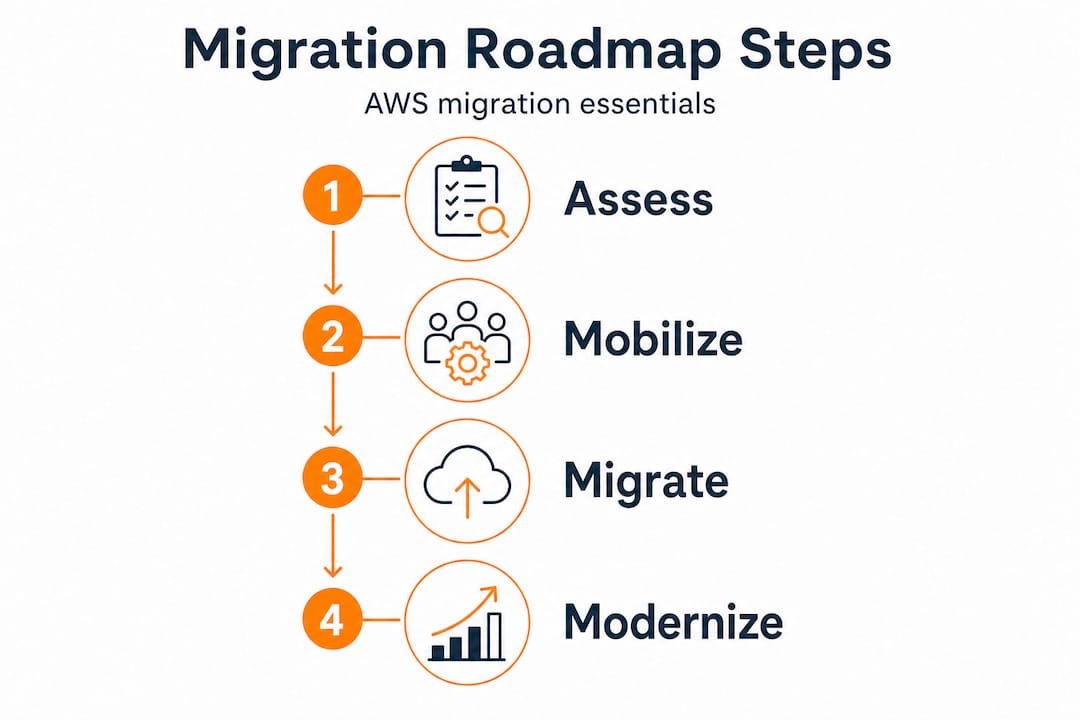
The roadmap covers four phases: Assess, Mobilize, Migrate, and Modernize, each with distinct goals including workload inventory, landing zone setup, and iterative transformation. The AWS migration phases framework sequences these so that governance and security are in place before any workload moves.
How do wave-based migrations reduce risk?
Wave-based migrations move low-risk workloads first, validating tooling and runbooks before touching business-critical systems. This phased execution model means issues surface in controlled environments rather than in production.
What is the difference between rehost and refactor strategies?
Rehost moves systems to AWS without redesign, delivering speed but limited optimization. Refactor rebuilds applications for cloud-native services, delivering higher long-term value at greater complexity and cost, as outlined in AWS’s large-scale migration guidance.
How do eCommerce and fintech roadmaps differ?
Fintech roadmaps prioritize zero downtime, encryption from day one, and regulatory compliance workflows. eCommerce roadmaps focus on seasonal traffic management, auto-scaling configurations, and fast deployment cycles, each requiring tailored migration approaches rather than a generic template.
Why do rigid roadmaps often fail?
Roadmaps fail when treated as fixed documents rather than adaptive plans. Skills gaps, undocumented dependencies, and shifting compliance requirements all demand recalibration, which is why the AWS migration lens emphasizes ongoing assessment alongside structured execution.