TL;DR:
- Effective AWS cost management requires ongoing FinOps governance integrated into organizational processes to prevent cost drift and improve visibility. Designing for cost and performance during architecture planning ensures sustainable savings through right-sizing, autoscaling, and strategic use of Spot Instances and Storage Tiering. Continuous routines, cultural commitment, and leadership support transform cost optimization from isolated projects into a sustainable, enterprise-wide discipline.
AWS bills have a way of growing faster than the workloads that drive them. You approve a migration, optimize for launch, and then watch monthly spend creep upward quarter after quarter as teams spin up resources without clear ownership, reserved capacity sits idle, and nobody flags the anomalies until the invoice lands. This guide cuts through the noise and gives CIOs and IT managers a structured, governance-driven approach to reducing AWS cloud costs without sacrificing performance or compliance. You will walk away with specific tools, frameworks, and comparisons that make cost control a repeatable discipline, not a fire drill.
Table of Contents
- Establish AWS FinOps governance for ongoing optimization
- Design for cost and performance simultaneously
- Tools and practices for identifying and sustaining savings
- Head-to-head: what happens when cost reduction is episodic vs. continuous
- Why the best cloud cost reduction is a culture, not a checklist
- Need help with AWS cloud cost reduction at scale?
- Frequently asked questions
Key Takeaways
| Point | Details |
|---|---|
| Governance comes first | Build cost optimization into your organization’s process for continual results, not just quick wins. |
| Design for cost and performance | Factor in cost choices early to avoid unexpected trade-offs or overruns. |
| Monitor, review, repeat | Leverage AWS tools routinely for early detection and sustained cost savings. |
| Continuous beats episodic | Ongoing refinement outperforms sporadic cost control efforts in large enterprises. |
Establish AWS FinOps governance for ongoing optimization
Cloud cost reduction fails when it is treated as a project with a start and end date. The moment your team celebrates a 20% savings win and moves on, cost drift begins. New instances get provisioned without tagging, autoscaling thresholds get loosened “temporarily,” and within two quarters you are back where you started. The AWS Well-Architected Cost Optimization Pillar is explicit: implement FinOps governance as an ongoing lifecycle process with clear ownership, budgeting and forecasting, cost-aware organizational processes, and proactive monitoring and reporting.
Practically, this means building governance into your standard IT operating model. Think of it less as a FinOps program and more as balancing AWS cost and performance as a standing responsibility shared across engineering, finance, and leadership.
Key governance elements every enterprise environment needs:
- Named ownership per account or business unit. Costs without owners drift. Assign a responsible party to every AWS account or cost center.
- Monthly budgets and forecasts. Set dollar thresholds and forecast against actuals. Variance is actionable data.
- Cost-aware development and deployment processes. Code reviews and architecture decisions should include a cost checkpoint, not just a security one.
- Automated anomaly alerts. AWS Cost Anomaly Detection can flag unexpected spend spikes before they compound.
- Regular spend reviews. A standing 30-minute monthly review across stakeholders is more valuable than a quarterly deep-dive that happens too late.
“Cost optimization is not a one-time activity. It is a continuous cycle of review, adjustment, and improvement embedded in how your organization builds and operates on AWS.”
Pro Tip: Start your governance practice by tagging every resource in your AWS environment with at minimum three tags: team, environment (production, staging, dev), and project. Without tagging, cost allocation reports are noise, and accountability becomes impossible.
The goal of governance is not bureaucracy. It is visibility. When every team can see what their workloads cost in near real time, cost awareness spreads organically. That cultural shift is what unlocks AWS scalability and savings at the enterprise level, because it removes the dependency on a single FinOps team to catch every problem.
Design for cost and performance simultaneously
One of the most expensive habits in enterprise AWS environments is designing for performance first and then applying cost optimizations as patches afterward. By the time your architecture is in production, the expensive decisions are already locked in. Oversized EC2 instances, single-region redundancy where multi-AZ would suffice, or Lambda functions running at maximum memory allocations, all of these are much harder to fix post-launch than to get right during the design phase.
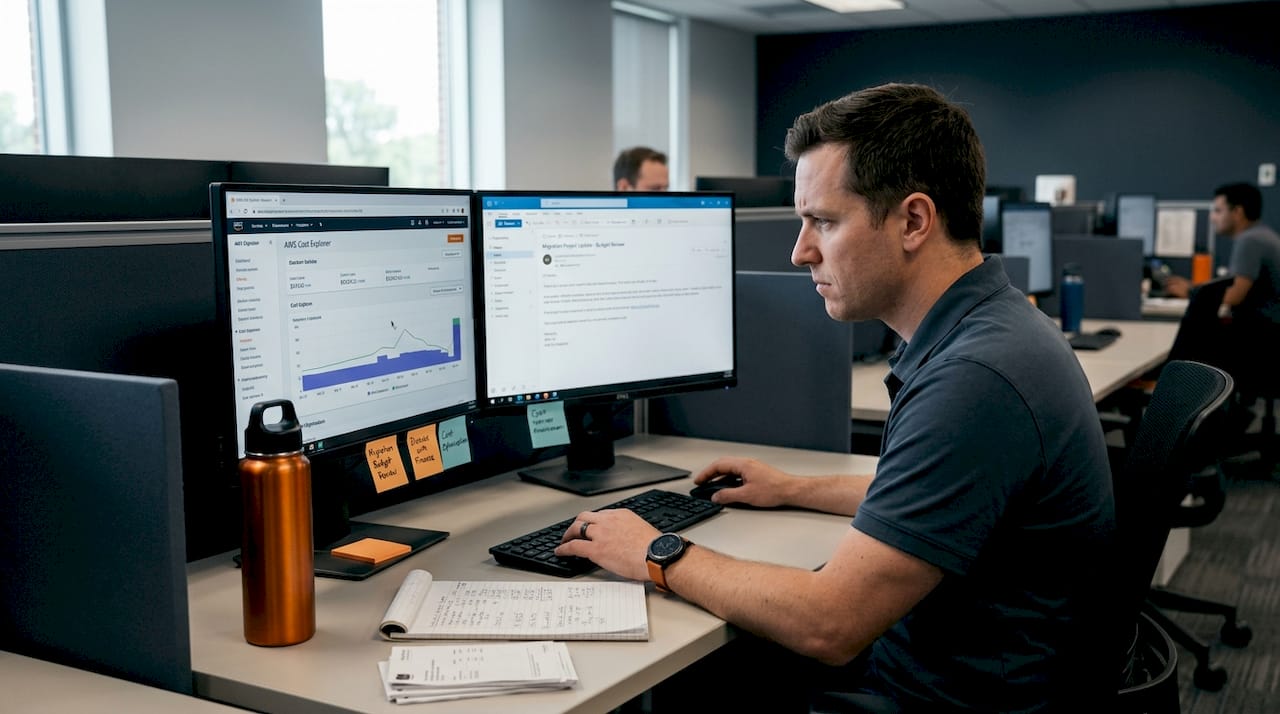
The AWS Well-Architected Performance Efficiency Pillar makes cost explicit in performance decisions: factor cost into architecture choices through right-sizing and elasticity, and use cost tooling to identify cost drivers, set budgets, get recommendations, and detect anomalies. That is not an either/or trade-off. It is an integrated lens.
What this looks like in practice:
- Right-sizing at design time. Use AWS Compute Optimizer recommendations before you finalize instance types, not after six months of overprovisioning.
- Autoscaling as a first-class design requirement. If your architecture cannot scale down during off-peak hours, you are paying for capacity you do not use. Autoscaling is not optional in a cost-efficient design.
- Spot Instances and Savings Plans for predictable workloads. Committing to a 1-year or 3-year Savings Plan on baseline compute can reduce costs by 30 to 72 percent compared to on-demand pricing.
- Storage tiering by access frequency. S3 Intelligent-Tiering and EBS volume type selection are not afterthoughts. They belong in your initial architecture decisions.
- Factoring in cost-efficient AWS transformation principles during any replatform or refactor project, not just the initial migration.
The AWS native toolset makes this integration practical:
- AWS Cost Explorer: Analyze historical spend trends and model future costs.
- AWS Pricing Calculator: Estimate costs for new architectures before you build them.
- AWS Budgets: Set cost and usage thresholds with automated alerts.
- AWS Compute Optimizer: Get machine-learning-powered right-sizing recommendations for EC2, Lambda, ECS, and EBS.
- AWS Trusted Advisor: Identify underutilized resources, idle load balancers, and unassociated Elastic IPs across your environment.
- AWS Cost Anomaly Detection: Catch unusual spend patterns using machine learning, reducing the lag between a cost problem occurring and your team knowing about it.
Pro Tip: Run AWS Compute Optimizer on your EC2 fleet every 90 days. Instance families and pricing evolve, and recommendations that were unavailable when you launched may now offer significant savings with no performance impact.
Avoiding the performance-compliance trap matters here too. Aggressive cost cutting that removes redundancy, reduces monitoring coverage, or downsizes security tooling to save a few hundred dollars a month is not optimization. It is risk transfer. The goal is to find waste, not remove value.
Tools and practices for identifying and sustaining savings
Having the right tools is necessary but not sufficient. What separates organizations that sustain savings from those that backslide is whether they have operationalized routines around those tools. One-time audits find today’s waste. Recurring routines prevent tomorrow’s.
Here is how to sequence your cost management routine each month:
- Review Cost Anomaly Detection alerts. Before you do anything else, check whether unexpected spend occurred in the prior period. Address anomalies while the context is fresh.
- Audit AWS Budgets against actuals. Compare committed budgets to actual spend by account and cost center. Flag variances above 10% for review.
- Pull Compute Optimizer recommendations. Identify any new right-sizing opportunities that emerged from the prior month’s usage patterns.
- Check Trusted Advisor for idle or underutilized resources. Unassociated Elastic IPs, idle load balancers, and underutilized EC2 instances are common sources of quiet waste.
- Review Reserved Instance and Savings Plan coverage. Ensure your committed spend is covering baseline usage. Coverage gaps mean you are paying on-demand rates for predictable workloads.
The following table clarifies which tool to reach for in each scenario:
| Scenario | Best tool | Primary action |
|---|---|---|
| Investigating a cost spike | Cost Anomaly Detection | Identify root cause, adjust or alert |
| Monthly spend trend analysis | Cost Explorer | Identify patterns and model scenarios |
| Proactive budget enforcement | AWS Budgets | Set thresholds and automate alerts |
| Right-sizing compute resources | Compute Optimizer | Apply instance type recommendations |
| Finding idle or wasted resources | Trusted Advisor | Terminate or resize underused assets |
| Estimating new architecture costs | Pricing Calculator | Model before you build |
The AWS Well-Architected Performance Efficiency Pillar reinforces that right-sizing and elasticity tied to operational governance, budgets, alerts, and anomaly detection, protect against compliance and performance regressions that purely cost-driven changes can introduce.
Organizations that align their cloud strategies for business success with these routines typically find that cloud costs stabilize as a percentage of revenue, rather than growing as a percentage of IT budget. That is the metric that matters to your CFO. For teams exploring third-party tools to complement AWS native capabilities, it is worth reviewing AWS cost automation alternatives to understand where native tooling is sufficient and where gaps exist.
Head-to-head: what happens when cost reduction is episodic vs. continuous
Most enterprises have experienced at least one episodic cost reduction effort. A quarterly review finds bloated spend, a task force is assembled, a rightsizing initiative is run, costs drop, and the task force disbands. Six months later, costs are climbing again. This is not a technology failure. It is an organizational one.
The AWS Well-Architected Cost Optimization Pillar makes clear that rightsizing alone will not sustain savings if organizational cost drift continues. The framework explicitly emphasizes capability building and continuous improvement through budgets and forecasting, cost-aware processes, proactive monitoring, and clear ownership rather than one-time cuts.
Here is how the two approaches compare directly:
| Dimension | Episodic optimization | Continuous lifecycle model |
|---|---|---|
| Cost trajectory | Spike, cut, creep cycle | Steady or declining over time |
| Team ownership | Assigned task force | Distributed across all teams |
| Tooling use | Reactive audits | Proactive alerts and routine reviews |
| Compliance risk | Higher (rushed cuts) | Lower (deliberate, governed changes) |
| Performance impact | Risk of regression | Managed through design integration |
| Organizational maturity | Low | High |
Key takeaways from this comparison:
- Episodic optimization generates one-time gains. It is better than nothing, but it does not compound.
- Continuous models build institutional knowledge. Teams learn what drives costs in their specific workloads and get better at avoiding waste over time.
- Compliance and performance protections are stronger in continuous models because changes go through governance review rather than being rushed to hit a savings target.
- The ROI of governance investment grows over time. The effort of setting up ownership, tagging, and monthly reviews pays for itself repeatedly.
“The organizations that sustain cloud cost reductions are the ones that treat cost visibility the same way they treat security monitoring: as a permanent, non-negotiable operational function.”
For teams ready to move from episodic to continuous, the transition starts with sustained AWS cost optimization practices that anchor savings in process, not in heroics.
Why the best cloud cost reduction is a culture, not a checklist
Here is the uncomfortable reality we see repeated across mid-sized and large enterprises: organizations invest in AWS cost tooling, run optimization sprints, and still watch their bills grow. The tools are not the problem. The culture is.
When cloud costs are owned by a central FinOps team and every other team views cost as someone else’s responsibility, you get exactly the dynamic described above. Developers provision for peak load because that is what they do on-premise. Data engineers keep staging clusters running overnight because spinning them back up takes time. DevOps teams add redundancy “just in case” without calculating the ongoing cost. None of these decisions are malicious. They are rational within a culture that does not reward cost awareness.
The transformation we have seen work at scale is not about stricter controls or better dashboards. It is about making cost a first-class metric alongside latency, availability, and security. When engineering teams get monthly cost reports tied to their own services, when architecture reviews include a cost checkpoint, and when leadership recognizes cost-efficient design as a professional achievement, the culture shifts.
This is not a soft observation. The most cost-efficient AWS environments we encounter are built by teams that have internalized cost as a design constraint, not a finance problem. They ask “what does this cost at scale?” the same way they ask “what is the failure mode here?”
The path to that culture runs through organizational practices: clear ownership, regular reviews, cross-team visibility, and leadership that signals cost matters. Following organizational best practices for migration builds these habits from day one of your AWS journey rather than retrofitting them after costs spiral.
Checklists expire. Culture compounds.
Need help with AWS cloud cost reduction at scale?
Executing a governance-driven cost optimization strategy while keeping your existing workloads running at full performance is a significant undertaking for any internal team. It requires deep AWS tooling knowledge, cross-functional coordination, and the organizational bandwidth to build repeatable processes without taking engineers off product work.
At IT-Magic, our optimize AWS costs practice is built around the same lifecycle model described in this article: governance setup, architecture review, tooling integration, and ongoing optimization embedded in your operations. As an AWS Advanced Tier Partner with 700+ completed projects, we take ownership of execution and outcomes, not just recommendations. Whether you are looking to reduce infrastructure spend, improve cloud scalability and cost reduction, or establish governance for the first time, our team provides hands-on support. Visit awsmigrationservices.com to explore how we help enterprises achieve sustained, compliant, performance-grade savings on AWS.
Frequently asked questions
What is the first step to reducing AWS cloud costs?
The first step is establishing clear ownership, budgets, and monitoring so costs are managed proactively and continuously. As the AWS Well-Architected guidance emphasizes, implementing FinOps governance as an ongoing lifecycle process is the foundation for every other optimization effort.
Does rightsizing cloud infrastructure guarantee long-term savings?
No. Rightsizing produces initial savings, but without continuous cost governance, cost drift erodes those gains over time. The AWS Well-Architected Cost Optimization Pillar explicitly states that capability building and continuous improvement are required to sustain results.
How do AWS Budgets and Cost Explorer help with cost optimization?
AWS Budgets provides proactive alerts when spend approaches defined thresholds, while Cost Explorer reveals usage patterns and cost drivers that guide optimization decisions. The AWS Well-Architected Performance Efficiency Pillar identifies both tools as key mechanisms for identifying cost drivers and opportunities.
Is there a conflict between cost optimization and cloud performance?
Not when cost optimization is integrated into design and governed through ongoing monitoring. The AWS Well-Architected framework ties cost optimization to performance decisions and operational governance precisely to prevent compliance and performance regressions from cost-driven changes.
Recommended
- How to optimize AWS costs without sacrificing performance
- Unlock cloud scalability: cut costs and boost agility with AWS
- AWS Digital Transformation: Scalable, Cost-Efficient Change
- AWS Migration Best Practices for a Seamless Cloud Move
- Actionable ways to lower shop utility bills and boost efficiency