TL;DR:
- Cloud migration should be a strategic transformation focused on agility, scaling, and business outcomes.
- Key AWS services and tools enable cost-efficient, compliant, and scalable enterprise workloads.
- Effective migration requires careful planning, dependency mapping, and alignment with organizational goals.
Most enterprises approach cloud migration as a hosting swap. Move the servers, reduce the data center bill, call it a transformation. That assumption is where costly, high-risk projects begin. AWS is not a cheaper place to run the same old infrastructure. It’s a platform that, when applied strategically, restructures how your organization scales, competes, and responds to market pressure. For CIOs and IT leaders in eCommerce and fintech, that distinction matters enormously. This guide walks through what real AWS-driven transformation looks like, which tools power it, how to plan your migration safely, and how to measure whether it’s actually working.
Table of Contents
- Understanding digital transformation in the enterprise landscape
- Core AWS services that power transformation
- Strategic migration: Frameworks, planning, and best practices
- Measuring digital transformation success on AWS
- Our perspective: What most IT leaders miss about AWS-driven transformation
- Accelerate your AWS journey with expert help
- Frequently asked questions
Key Takeaways
| Point | Details |
|---|---|
| AWS enables real transformation | Cloud migrations with AWS unlock agility, cost savings, and scalability for enterprise IT. |
| Strategic migrations minimize risk | Wave planning and phased adoption cut migration risk and enable smoother transitions. |
| Optimize for cost and performance | Leverage Graviton chips and spot instances for significant computing savings on AWS. |
| Measure system and business impact | Focus on both technical KPIs and business outcomes to track digital transformation ROI. |
Understanding digital transformation in the enterprise landscape
Digital transformation is one of those phrases that gets used so broadly it can lose meaning fast. For enterprise leaders in eCommerce and fintech, it has a very specific definition: the ability to ship faster, scale on demand, reduce operational overhead, and remain compliant while doing all three simultaneously. That’s a tall order for organizations still running workloads on aging on-premises hardware.
The obstacles are real and well-documented. Legacy systems create dependency chains that slow every new initiative. Infrastructure costs behave unpredictably when demand spikes. In fintech especially, compliance requirements around data residency, encryption, and access controls add layers of complexity that traditional infrastructure handles poorly. These aren’t edge cases. They’re the daily operating environment for most mid-to-large enterprises in these sectors.
Cloud migration addresses all of these pain points, but only when treated as a strategic initiative rather than a lift-and-shift exercise. The core advantages are:
- Agility: Deploy new environments in minutes, not weeks
- Elastic scaling: Match compute capacity to actual demand without over-provisioning
- Cost predictability: Move from capital expenditure to variable, usage-based spending
- Compliance readiness: Leverage pre-certified infrastructure for PCI DSS, SOC 2, and GDPR requirements
- Reduced operational burden: Shift maintenance responsibility from your team to AWS-managed services
AWS holds a commanding position in this space. Its breadth of services, global region coverage, and compliance certifications make it the default choice for high-load, regulated industries. As the AWS prescriptive guidance confirms, cloud adoption enables scalability and cost-efficiency that on-premises architectures simply cannot match at speed.
“The question for enterprise leaders is no longer whether to migrate to the cloud, but how to do it in a way that delivers measurable business outcomes without exposing the organization to unnecessary risk.”
For organizations exploring their options, our AWS migration services provide the full lifecycle support that complex environments require, from infrastructure audit through post-migration optimization.
Core AWS services that power transformation
With transformation drivers established, the next question is which AWS tools actually deliver the results. The answer depends heavily on your workload profile, but a core set of services covers the vast majority of enterprise use cases in eCommerce and fintech.
EC2, S3, VPC, and Lambda form the foundation. EC2 provides flexible compute with dozens of instance families optimized for different workload types. S3 delivers durable, infinitely scalable object storage. VPC gives you network isolation at the architecture level, which is critical for compliance. Lambda enables event-driven, serverless execution that eliminates idle compute costs entirely.

Beyond the basics, two capabilities deserve special attention from a cost perspective:
| AWS capability | Benefit | Ideal use case |
|---|---|---|
| Graviton processors | 40% better price-performance vs. x86 | API services, containerized workloads |
| Spot instances | Up to 90% cost reduction vs. on-demand | Batch jobs, data processing, CI/CD |
| Auto Scaling groups | Right-size capacity dynamically | eCommerce peak traffic events |
| AWS Shield + WAF | DDoS and application-layer protection | Public-facing fintech APIs |
For eCommerce platforms, the autonomous scaling story is compelling. During a promotional event or holiday spike, Auto Scaling groups spin up additional EC2 capacity within seconds and terminate it when traffic drops. You pay only for what you use. That’s a fundamentally different cost model than provisioning for peak capacity year-round.
For fintech companies, PCI compliance isolation is where AWS really earns its place. Cardholder data environments can be isolated within dedicated VPCs with strict security group rules, private subnets, and no internet gateway access. This architecture satisfies PCI DSS zone segregation requirements without building a separate physical network.
Pro Tip: If you’re running containerized workloads, switching to Graviton-based instance types is one of the fastest, lowest-risk ways to cut compute costs. Most container images compile cleanly for ARM64, and the performance gains are immediate.
When migrating workloads to AWS, choosing the right instance family and purchase model from day one prevents the costly right-sizing exercises that happen six months post-launch when bills arrive.
Strategic migration: Frameworks, planning, and best practices
Leveraging AWS’s portfolio is one thing. Planning your migration to minimize risk and accelerate value is quite another. The single biggest mistake enterprises make is treating migration as a big-bang event: move everything at once, figure out problems on the other side. That approach consistently produces downtime, budget overruns, and frustrated engineering teams.
The proven alternative is wave-based migration. Here’s how it works in practice:
- Inventory and dependency mapping: Catalog every workload, its dependencies, and its risk profile before touching anything
- Define migration waves: Group workloads by risk level, business criticality, and technical dependency
- Start with low-risk pilots: Migrate dev/test environments or non-critical services first to validate tooling and process
- Validate cutover with AWS MGN: Use AWS Application Migration Service to test cutovers in a sandbox before production
- Promote to production gradually: Move waves in sequence, confirming stability at each step before advancing
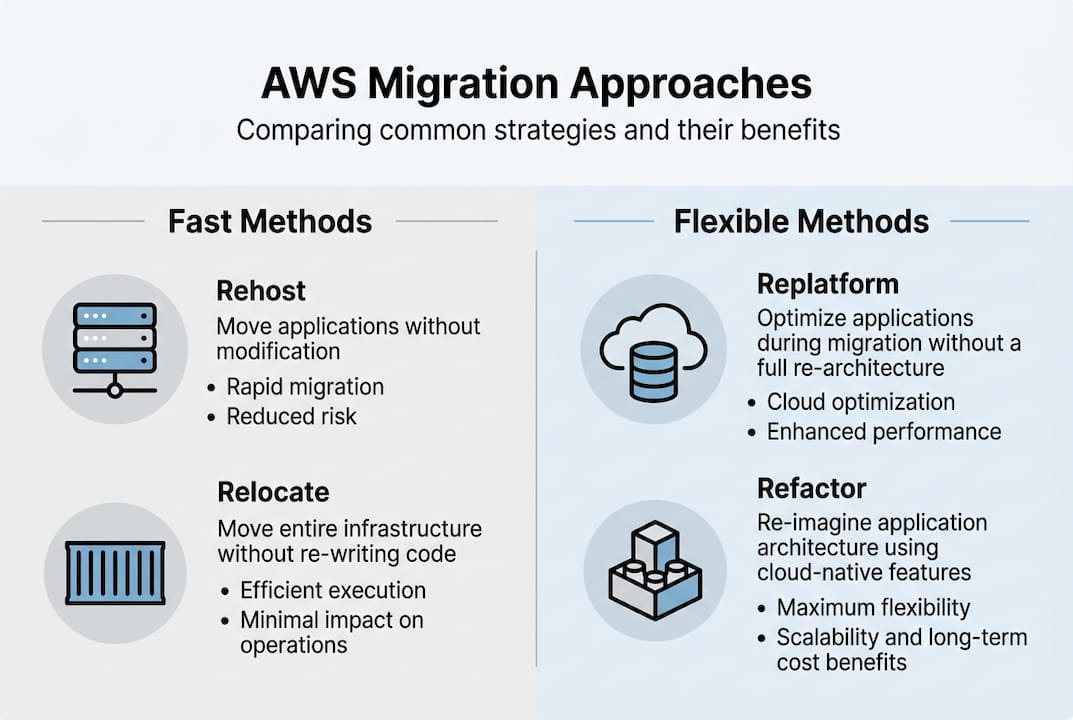
This structure reflects a core principle: avoiding full application refactoring during initial migration significantly reduces both risk and cost. Rehost first, optimize later. Refactoring adds scope and complexity that can delay value realization by months.
| Migration strategy | Speed | Risk level | Cost upfront | Best for |
|---|---|---|---|---|
| Rehost (lift-and-shift) | Fast | Low | Low | Legacy apps, quick wins |
| Replatform | Moderate | Medium | Medium | Apps needing managed services |
| Refactor | Slow | High | High | Core systems needing redesign |
Licensing is another planning dimension that trips up enterprise projects. BYOL (Bring Your Own License) lets you apply existing SQL Server or Windows Server licenses to EC2 instances, avoiding double-payment. AWS Marketplace offers alternative licensing models for many software vendors that can reduce total cost compared to traditional procurement.
Wave planning by dependency and risk is the single most effective practice for keeping large-scale migrations on schedule and within budget.
Pro Tip: Map your application dependencies before finalizing wave assignments. Tools like AWS Application Discovery Service automate this process and frequently surface hidden dependencies that would have caused production incidents if discovered mid-migration.
For teams planning their transition to AWS Cloud, a well-structured wave plan typically cuts total migration time by 30 to 40 percent compared to unplanned approaches.
Measuring digital transformation success on AWS
After planning and executing your migration, it’s essential to demonstrate real-world progress through clear metrics. This is where many transformation initiatives lose credibility with the board. Technical teams celebrate successful deployments while business stakeholders ask where the promised cost savings are. The gap is usually a measurement problem.
Start by establishing the right KPIs before migration begins, not after. The critical categories are:
- Cost efficiency: Total AWS spend vs. prior infrastructure cost, broken down by workload
- Scalability performance: Time to scale under load, peak capacity achieved without manual intervention
- Availability and uptime: Percentage uptime vs. SLA targets, incident frequency and mean time to recovery
- Speed to market: Deployment frequency, lead time for changes, and release cycle duration
- Compliance posture: Number of open findings in AWS Security Hub, audit pass rates
AWS provides native tooling for each category. CloudWatch tracks infrastructure and application performance in real time. Cost Explorer breaks down spend by service, tag, and linked account, making it straightforward to connect cloud costs to specific business units or products.
Statistic callout: Spot instance savings and Graviton performance translate into measurable ROI when tracked consistently against baseline infrastructure costs from before migration.
The business translation matters more than the technical metrics. An eCommerce platform that previously crashed during Black Friday now scales automatically to handle 10x normal traffic without a single page-load failure. A fintech company that took four hours to provision a new environment for compliance testing now does it in eight minutes. These are the outcomes that justify the investment.
Soft benefits are also worth tracking, even though they’re harder to quantify. Developer productivity, reduced on-call burden, and faster onboarding for new engineering hires are real advantages that compound over time.
For organizations focused on tracking AWS migration results, tying every infrastructure metric back to a business outcome converts migration from a cost center story into a growth enabler story.
Our perspective: What most IT leaders miss about AWS-driven transformation
After 700+ completed migrations, the pattern we see most often is this: technically sound projects that underdeliver on business outcomes. The AWS architecture is solid. The migration went smoothly. But six months later, the expected savings haven’t materialized and business stakeholders are skeptical.
The root cause is almost never technical. It’s the absence of organizational alignment. Teams weren’t educated on the new cost model. Business units weren’t consulted on KPI definitions. The migration was treated as an IT project rather than a business transformation initiative.
Rushed, mass migrations without clear business objectives are the most reliable way to burn budget and erode trust. The companies that extract disproportionate value from AWS are the ones that treat each migration wave as a learning cycle. They measure, adjust, and educate as they go.
AWS’s versatility is genuinely powerful. But that power is only as useful as the strategic vision behind it. If you’re optimizing for the wrong outcomes, faster and cheaper infrastructure just gets you to the wrong place faster. Our enterprise AWS migration insights reflect hard lessons from environments where the stakes were high and the margin for error was low.
Accelerate your AWS journey with expert help
If your team is ready to unlock the full potential of AWS for digital transformation, here’s where to start.
As a trusted AWS migration partner with AWS Advanced Tier status and 700+ completed projects, we take full ownership of your migration from infrastructure audit through post-migration optimization. Our team specializes in exactly the high-load, compliance-sensitive environments that eCommerce and fintech companies operate in. We build plans around your business objectives, not generic templates. Explore our sample project outcomes to see the measurable impact we’ve delivered for organizations like yours, then reach out to discuss what a tailored migration roadmap looks like for your team.
Frequently asked questions
What is the main benefit of using AWS for enterprise digital transformation?
AWS enables scalable, flexible, and cost-efficient infrastructure, letting businesses quickly adapt to new demands while reducing traditional IT overhead. Cloud adoption enables the scalability and cost-efficiency that drive real business outcomes.
How can AWS help reduce cloud computing costs for large enterprises?
Through options like spot instances and Graviton processors, AWS offers up to 90% savings on compute and 40% better price-performance compared to standard x86 instances.
What’s the safest way to migrate legacy systems to AWS?
Use wave planning by dependency and risk, start with pilot migrations, and avoid full refactoring upfront to minimize risk and control costs.
How does AWS support PCI compliance for fintech companies?
AWS enables PCI isolation of CDE using Virtual Private Clouds with strict security controls, private subnets, and no direct internet exposure.