
TL;DR:
- Effective cloud security relies on identity-centric controls rather than perimeter defenses, as distribution across environments diminishes IP-based boundaries.
- Implementing continuous monitoring, automated policy enforcement, and microsegmentation minimizes lateral movement and ensures compliance, reducing breach risks.
Cloud environments hold your most sensitive data, yet most cloud breaches start with identity misconfigurations and excessive permissions that nobody caught in time. If you are planning a migration or managing workloads already in the cloud, knowing how to strengthen cloud security is not optional. It is the difference between a predictable, compliant environment and a breach that surfaces six months after go-live. This article breaks down the architectural decisions, operational practices, and monitoring strategies that actually work in production environments.
Table of Contents
- Key takeaways
- How to strengthen cloud security with identity-first architecture
- Network segmentation: moving beyond IP-based rules
- Cloud data protection: classify, encrypt, and minimize exposure
- Continuous monitoring, compliance automation, and incident response
- Common pitfalls when enhancing cloud security measures
- My take: the identity-first shift is non-negotiable
- Secure your AWS migration from day one
- FAQ
Key takeaways
| Point | Details |
|---|---|
| Identity is your security perimeter | Replace network-based trust with identity-first controls and phishing-resistant MFA for every session. |
| Microsegmentation reduces blast radius | Use workload identities in policies instead of IP addresses to isolate failures and limit lateral movement. |
| Classify data before protecting it | Continuous data classification lets you apply encryption, masking, and access controls where they matter most. |
| Automate compliance or fall behind | Policy-as-Code prevents configuration drift in ephemeral cloud environments that manual reviews cannot keep pace with. |
| Monitor across every cloud layer | Unified logging and behavioral analytics across multi-cloud platforms are the only way to spot attack paths before damage occurs. |
How to strengthen cloud security with identity-first architecture
Every serious cloud security framework treats identity as the actual security boundary. Not the network perimeter. Not the firewall. Identity. The reason is simple: in a cloud environment, your workloads, users, and services are distributed across regions and providers where IP-based boundaries mean almost nothing.
The starting point is understanding the shared responsibility model. Enterprises often assume cloud providers secure the application and data layers, but that is the customer’s responsibility to configure and audit explicitly. AWS, Azure, and GCP secure the underlying infrastructure. You are responsible for what runs on top of it.
From there, the practical steps to improve cloud security through identity controls include:
- Federate identity with your corporate identity provider (Okta, Azure AD/Entra ID, or similar) so that authentication is centralized and auditable.
- Enforce phishing-resistant MFA on every access path. FIDO2/WebAuthn satisfies NIST SP 800-63B high-assurance requirements; SMS-based MFA does not.
- Apply per-session authentication rather than relying on persistent tokens that can be hijacked and replayed.
- Treat every access request as untrusted by default, which is the foundation of zero trust. Location and network segment are not trust factors.
Pro Tip: Audit your IAM roles and service accounts every 90 days. Permission creep accumulates faster in cloud environments than anywhere else, and unused roles with broad permissions are a standing invitation for attackers.
Google Cloud recommends 60 vetted security controls across six domains including authentication, resource management, and data protection. That number sounds large, but authentication and identity controls alone account for a significant share. Getting identity right eliminates entire categories of risk before you touch the network layer.
Network segmentation: moving beyond IP-based rules
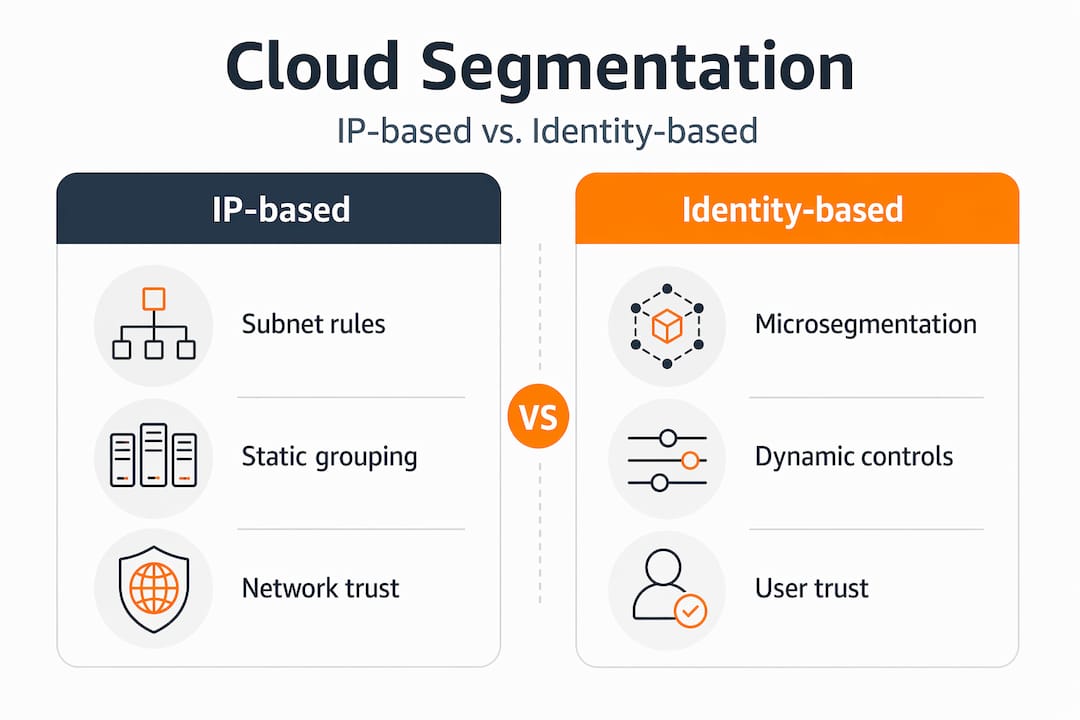
Traditional network security drew lines based on IP addresses and subnets. In cloud environments, those lines shift constantly as workloads scale up and down, containers spin and terminate, and services move across availability zones. Security strategies in 2026 must shift from perimeter-based models to identity-based microsegmentation, treating every workload communication as a policy decision.
Here is how identity-based segmentation compares to the traditional approach:
| Dimension | IP-based segmentation | Identity-based microsegmentation |
|---|---|---|
| Trust anchor | Network location | Workload identity (SPIFFE/SPIRE, IAM Role) |
| Policy stability | Breaks when IPs change | Survives scaling, migration, redeployment |
| Attack surface | Broad east-west traffic allowed | Default-deny; explicit policy required |
| Incident response | Manual VLAN isolation | Dynamic workload quarantine via policy |
| Multi-cloud support | Fragmented, inconsistent | Consistent across AWS, Azure, GCP |
The default-deny posture is the critical shift. Instead of allowing all internal traffic and blocking known bad actors, you allow only the specific communication paths that workloads actually need. Everything else is rejected. This limits lateral movement so that a compromised service cannot reach unrelated parts of your infrastructure.
For hybrid environments, consistency matters. Applying different segmentation models on-premises versus in cloud creates blind spots that attackers routinely exploit. Using workload identity standards like SPIFFE/SPIRE gives you a portable trust mechanism that works across environments without depending on network topology.
Pro Tip: Build dynamic isolation into your incident response plan before you need it. The ability to quarantine a single workload by changing a policy, without touching the network, cuts containment time from hours to minutes.
Cloud data protection: classify, encrypt, and minimize exposure
You cannot protect data you have not identified. Continuous data classification is the starting point for any serious cloud data protection program. This means scanning your storage buckets, databases, and data pipelines regularly, not just at migration time, and tagging sensitive assets so that access controls and encryption policies apply automatically.

On encryption, the baseline requirements are straightforward. Encrypt data at rest using AES-256 and data in transit using TLS 1.2 or higher. What separates a solid program from a minimal one is key management. Customer-managed keys (CMK) give you control over key rotation and revocation, which matters when a workload is decommissioned or a vendor relationship ends.
Beyond encryption, consider these data exposure reduction techniques:
- Data masking and pseudonymization for non-production environments. Developers do not need real customer PII to test application behavior.
- Attribute-based access control (ABAC) to enforce least privilege dynamically based on data classification tags rather than manually managed role lists.
- Backup immutability configured with appropriate retention periods. Effective immutability requires a retention period plus a block generation period (for example, a 7-day retention plus a 10-day block generation on Azure or S3-compatible storage). Simply enabling versioning is not sufficient.
Evidence-based immutable backups that are directly searchable satisfy both GDPR and DORA compliance requirements while also accelerating forensic recovery. The ability to query backup content without a full restoration is a material operational advantage when you are under incident pressure.
Fragmented visibility across multi-cloud environments makes centralized correlation the only practical way to connect data exposures with identity misconfigurations and configuration drift. A single platform that correlates these signals reduces alert fatigue significantly and surfaces the actual attack paths rather than isolated events.
Continuous monitoring, compliance automation, and incident response
Knowing how to secure cloud storage and workloads is only half the work. The other half is verifying that your controls are actually in place and functioning, continuously, not just at the last audit. Cloud environments change too fast for manual review cycles to keep up.
Here is a practical sequence for building continuous security assurance:
- Deploy a CNAPP (Cloud-Native Application Protection Platform) to get unified visibility across your cloud workloads, configurations, and runtime behavior. CNAPP tools combine CSPM, CWPP, and CIEM capabilities into a single signal stream.
- Implement Policy-as-Code using tools like Open Policy Agent or AWS Config rules. Automating policy enforcement is the only way to prevent configuration drift and permission creep in environments where infrastructure changes happen dozens of times per day.
- Centralize logging across every cloud provider into a single SIEM. Without unified logs, attack paths that span multiple cloud accounts or providers are invisible.
- Integrate behavioral analytics and anomaly detection so that deviations from established baselines trigger alerts rather than requiring manual log review. AI-assisted detection is now table stakes in environments with high log volumes.
- Test your incident response plan on a schedule. A plan that exists only in a document has never been validated. Run tabletop exercises and simulated breach scenarios at least twice per year.
Pro Tip: Treat your incident response communication plan with the same rigor as the technical plan. Knowing who calls whom, in what order, and with what authority to isolate workloads is what turns a contained incident into a crisis.
Security treated as a continuous architecture across identity, segmentation, and policy enforcement is the standard that serious organizations hold themselves to in 2026.
Common pitfalls when enhancing cloud security measures
Even well-intentioned security programs have patterns of failure. Understanding where things go wrong is as useful as knowing what to do right.
- Defaulting to cloud provider settings without verification. AWS, Azure, and GCP ship with permissive defaults in many areas. S3 buckets, security groups, and IAM policies all require explicit hardening. The shared responsibility model does not give you a pass on this.
- Ignoring identity misconfigurations at scale. Roles created for a temporary project, service accounts with admin-level permissions, and unused API keys sitting dormant for months are the attack surface that breaches actually exploit.
- Underestimating multi-cloud visibility gaps. Centralized platforms correlating misconfigurations across identity and data are the only way to identify attack vectors when your workloads span multiple providers.
- Misconfiguring backup immutability. Setting a retention period without accounting for the block generation period leaves you with backups that can still be deleted or modified during that window. Both values must be configured correctly.
- One-time segmentation without continuous enforcement. Microsegmentation policies that are configured once and never reviewed degrade as workloads change. Without automated policy reconciliation, segmentation becomes theater.
Avoid these patterns and you eliminate the most common reasons that cloud security postures erode over months or years after initial deployment.
My take: the identity-first shift is non-negotiable
I’ve spent years working through cloud migrations with organizations that came in confident their existing security practices would translate cleanly. They almost never do. The ones that got into trouble shared one characteristic: they brought a perimeter mindset into an environment where there is no perimeter.
What I’ve learned is that identity is not just one pillar of cloud security. It is the load-bearing wall. When identity controls are weak or inconsistent, every other control becomes harder to enforce and easier to bypass. The segmentation work means nothing if a stolen token can traverse it. The encryption means nothing if access policies are overpermissioned.
The other hard lesson is about configuration drift. Organizations that do great security work at migration time often find themselves six months later with a posture that has quietly degraded. New roles were created without review. A temporary exception became permanent. A new microservice was deployed outside the standard baseline. Without automated enforcement, this is inevitable, not exceptional. The only reliable answer is treating your security configuration as code that gets tested, versioned, and deployed like any other production artifact.
Zero trust is not a product you buy. It is a discipline you practice continuously. The organizations I’ve seen do it well share one habit: they never assume a control is working. They verify it.
— Oleksandr
Secure your AWS migration from day one
Cloud security decisions made during migration set the architecture you will maintain for years. Getting them wrong is expensive to fix after the fact.
Awsmigrationservices brings AWS migration expertise to organizations that cannot afford security gaps or downtime during transition. As an AWS Advanced Tier Partner with 700+ completed projects, we implement zero trust principles, microsegmentation, and Policy-as-Code controls as standard practice, not optional add-ons. Our team handles the full lifecycle from infrastructure audit through post-migration optimization so your internal team is not stretched thin covering security and migration simultaneously. If you want to enhance cloud security measures while executing a predictable, cost-efficient migration, we can help.
FAQ
What is the most common cause of cloud security breaches?
Identity misconfigurations and excessive permissions are the leading cause of cloud breaches. Automating policy enforcement with Policy-as-Code is the most effective way to prevent the configuration drift that creates these vulnerabilities.
How do you secure cloud storage against unauthorized access?
Encrypt data at rest and in transit, configure customer-managed keys, apply least-privilege access with attribute-based controls, and set backup immutability with both retention and block generation periods correctly configured.
What are the steps to strengthen cloud security during migration?
Start with an IAM audit, enforce phishing-resistant MFA, implement microsegmentation with default-deny policies, classify and encrypt sensitive data, and deploy continuous monitoring before migrating production workloads.
How does zero trust improve cloud security?
Zero trust treats every access request as untrusted regardless of network location, requiring explicit verification of identity and context for every session. This eliminates the lateral movement paths that attackers use after an initial compromise.
What is the difference between CSPM and CNAPP?
CSPM (Cloud Security Posture Management) focuses on configuration and compliance visibility, while CNAPP (Cloud-Native Application Protection Platform) combines CSPM with runtime workload protection and identity entitlement management into a unified platform for broader cloud security coverage.