TL;DR:
- Cloud compliance is an ongoing discipline involving continuous governance, documentation, monitoring, and verifiable control evidence. Understanding interconnected regulatory mandates, control frameworks, and evidence models is essential for ensuring adherence across cloud environments. Effective programs rely on clear ownership, automated evidence collection, cross-framework mapping, and embedded compliance in daily operations to prevent audit failures.
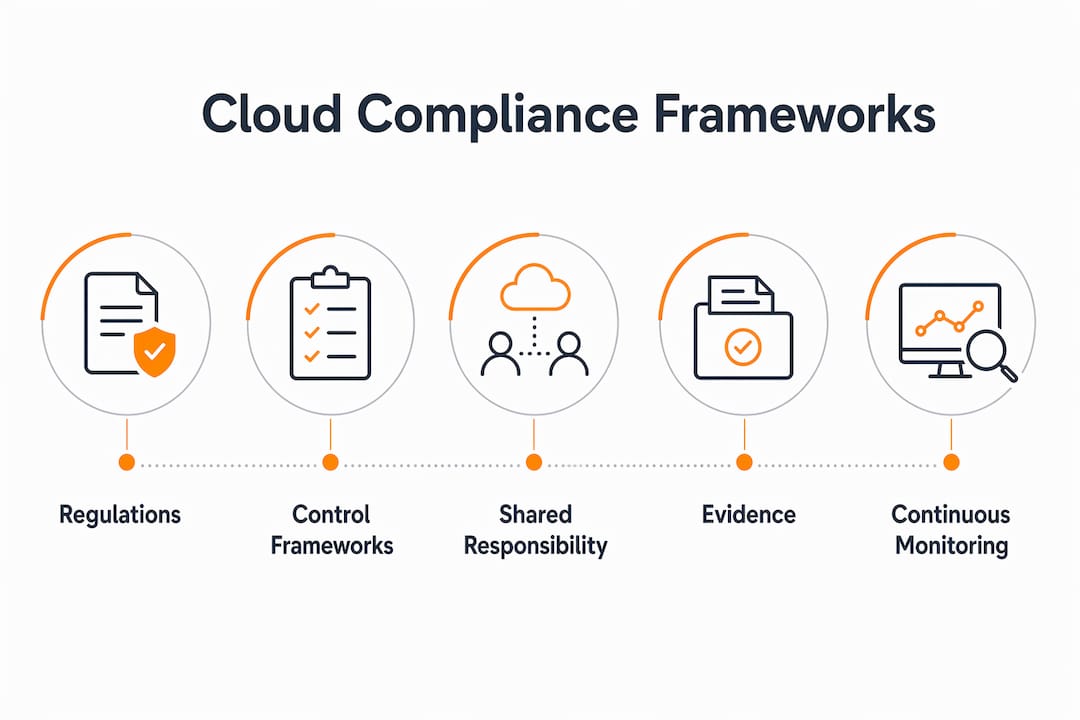
Cloud compliance is defined as the ongoing discipline of ensuring that cloud service usage adheres to applicable laws, regulations, standards, and internal policies, supported by verifiable, auditable evidence. This is not a one-time audit exercise. Cloud compliance requires continuous governance, documentation, monitoring, and the ability to prove control effectiveness at any point in time. For IT professionals and compliance officers, understanding cloud compliance explained means grasping three interconnected layers: the regulatory mandates that define what you must do, the control frameworks that translate those mandates into technical and operational controls, and the evidence model that proves your controls actually work.
What are the main regulatory and framework requirements in cloud compliance?
Cloud compliance follows a tiered structure: regulatory mandates sit at the foundation, control frameworks convert those mandates into specific controls, and third-party assessments generate the audit evidence that closes the loop. Understanding which regulations apply to your organization is the first step in building any compliance program.

The primary regulations shaping cloud compliance today include GDPR for personal data protection in the EU, HIPAA for protected health information in the US healthcare sector, PCI DSS for payment card data, SOX for financial reporting controls, and FISMA for federal information systems. Each regulation defines what data must be protected and what outcomes must be achieved. None of them prescribe exactly how to configure a cloud environment.
That gap is filled by control frameworks. NIST SP 800-53 Rev. 5 contains over 1,000 controls across 20 families and serves as the normative baseline for FedRAMP authorization of cloud service providers. This makes it the most technically detailed framework in the US public sector context. ISO/IEC 27001 provides a risk-based information security management system applicable globally. SOC 2 focuses on trust service criteria and is widely used in commercial SaaS environments. The Cloud Security Alliance’s Cloud Controls Matrix (CCM) functions as a meta-framework that maps across all of these.
| Framework / Regulation | Type | Primary Use Case | Audit Mechanism |
|---|---|---|---|
| NIST SP 800-53 | Control framework | US federal and FedRAMP | Third-party assessment (3PAO) |
| ISO/IEC 27001 | Management system standard | Global enterprise | Certification audit |
| SOC 2 | Trust criteria framework | Commercial SaaS | CPA attestation report |
| GDPR | Regulation | EU personal data | Supervisory authority |
| PCI DSS | Security standard | Payment card data | Qualified Security Assessor |
| HIPAA | Regulation | US health data | HHS Office for Civil Rights |
Knowing which column your organization lives in determines your control set, your audit type, and your evidence requirements. Most organizations operate across multiple rows simultaneously.
How does the shared responsibility model impact cloud compliance?
Misunderstanding the shared responsibility model between cloud providers and customers is a leading cause of cloud compliance failures. The model divides compliance duties based on the cloud service type: IaaS, PaaS, or SaaS. Getting this wrong means leaving critical controls unowned.
In an IaaS model (such as AWS EC2), the provider secures physical data centers, hardware, hypervisors, and the global network. The customer owns the operating system, application stack, identity and access management, network configuration, and data encryption. In a PaaS model, the provider absorbs more of the stack, including the runtime and middleware, but the customer still owns application code, data handling, and access controls. In a SaaS model, the provider manages nearly everything except user access governance and data classification decisions.
The compliance pitfalls cluster around three common misunderstandings:
- Assuming the cloud provider’s security certifications (such as AWS’s FedRAMP authorization) automatically extend to the customer’s workloads. They do not.
- Leaving default configurations in place because the provider “handles security.” Default configurations are almost never compliant out of the box.
- Failing to assign a named owner for each control at the customer layer, which creates gaps that surface only during an audit.
Pro Tip: Define shared responsibility boundaries and assign control ownership before you select any compliance tooling. A responsibility assignment matrix (RACI) mapped to your control framework prevents the most common implementation errors, as confirmed by practitioner guidance from Sysdig.
The role of compliance in cloud migration is especially relevant here. Organizations that define ownership during migration planning avoid the costly retrofitting that happens when compliance is treated as a post-migration concern.
What constitutes effective cloud compliance evidence and continuous monitoring?
Evidence is where cloud compliance programs most often break down in practice. Many teams collect screenshots, export PDF reports from their cloud console, and submit them to auditors. This approach fails because controls must be linked to dynamic cloud assets, configurations, logs, and change history rather than point-in-time snapshots.
A mature cloud compliance evidence model treats each control as a chain. That chain connects the control objective to the specific cloud object it governs, the telemetry source that monitors it, the owner responsible for it, and the change history that shows it has operated continuously. Static exports break this chain the moment the environment changes, which in cloud environments happens constantly.
Effective evidence sources include:
- Configuration files and infrastructure-as-code (IaC) templates that show the intended state of a resource
- Cloud provider logs such as AWS CloudTrail, Azure Monitor, or Google Cloud Audit Logs that record every API call and configuration change
- Automated policy scan results from tools like AWS Config, Prisma Cloud, or Orca Security that continuously evaluate resource state against defined rules
- Change history from CI/CD pipelines that links every deployment to an approved change record
Continuous automated scanning of configurations and logs enables early detection of violations and prevents compliance drift between audit cycles. This matters because cloud environments change faster than any manual review process can track. A compliant configuration on Monday can become non-compliant by Wednesday if a developer changes a security group rule.
Pro Tip: Integrate evidence collection directly with cloud-native APIs rather than relying on scheduled exports. AWS Config Rules, for example, can trigger automated remediation the moment a resource falls out of compliance, giving you both prevention and a timestamped evidence record in a single workflow. Pair this with cloud security best practices to build a defensible audit posture.
How can organizations streamline compliance across multiple frameworks?
Most organizations subject to cloud compliance requirements do not operate under a single framework. A healthcare SaaS company processing payments faces HIPAA, PCI DSS, SOC 2, and potentially GDPR simultaneously. Managing these as four separate compliance programs is expensive, redundant, and operationally unsustainable.
The Cloud Security Alliance’s Cloud Controls Matrix (CCM) v4 addresses this directly. CCM v4 includes 197 control objectives mapped across frameworks including ISO 27001, NIST SP 800-53, PCI DSS, and GDPR. This makes it a practical meta-framework for organizations that need to satisfy multiple regulators without building parallel control libraries.
The practical application is a control library with cross-framework traceability. Instead of implementing a separate encryption control for HIPAA, another for PCI DSS, and a third for SOC 2, you implement one encryption control and map it to all three frameworks in a single record. The table below illustrates how a single control maps across frameworks:
| Control Objective | NIST SP 800-53 | ISO 27001 | PCI DSS | SOC 2 |
|---|---|---|---|---|
| Encrypt data at rest | SC-28 | A.8.24 | Req. 3.5 | CC6.1 |
| Manage access credentials | IA-5 | A.5.17 | Req. 8.3 | CC6.2 |
| Log and monitor activity | AU-2 | A.8.15 | Req. 10.2 | CC7.2 |
This mapping approach reduces audit preparation time significantly. When an auditor requests evidence for PCI DSS Requirement 3.5, you pull the same encryption control record you already maintain for NIST SC-28. The evidence chain is identical. The data center security practices that underpin physical and hybrid environments follow the same cross-mapping logic, making this approach applicable beyond pure cloud deployments.
What are the best practices for implementing cloud compliance programs?
Building a cloud compliance program that holds up under audit requires more than deploying a scanning tool. Successful programs depend on clear ownership, defined scope, and compliance embedded into daily operations rather than treated as a periodic review.
-
Define scope and classify systems by risk. Not every workload carries the same compliance burden. Identify which systems process regulated data, apply the appropriate framework, and document the boundary explicitly. Systems outside scope still need baseline security controls, but the audit depth differs.
-
Assign control ownership at the individual level. Every control in your framework needs a named owner, not a team. Teams diffuse accountability. A named owner creates a clear escalation path when a control fails or evidence goes stale.
-
Automate control implementation and evidence collection. Use infrastructure-as-code to enforce compliant configurations at deployment. Use cloud-native policy tools to monitor drift continuously. Automate evidence export to your GRC (Governance, Risk, and Compliance) platform so audit packages assemble themselves rather than requiring manual effort.
-
Conduct regular internal assessments before external audits. Quarterly internal reviews against your control framework surface gaps while you still have time to remediate. External auditors find the same gaps, but remediation at that point is reactive and expensive.
-
Embed compliance into your development and operations workflows. Compliance checks belong in CI/CD pipelines, not just in quarterly reviews. Tools like Checkov for IaC scanning or AWS Security Hub for runtime posture management make compliance a continuous output of normal engineering work rather than a separate program. Strengthening your cloud security posture through these integrations directly reduces compliance risk.
Key takeaways
Cloud compliance is a continuous, evidence-driven discipline that requires defined ownership, framework-aligned controls, and automated monitoring to remain defensible across audits.
| Point | Details |
|---|---|
| Compliance is continuous, not periodic | Controls must produce live, auditable evidence at all times, not just during audit cycles. |
| Shared responsibility requires explicit ownership | Assign named owners to every customer-layer control before selecting tools or platforms. |
| Cross-framework mapping reduces redundancy | CSA CCM v4’s 197 control objectives map across NIST, ISO, PCI DSS, and GDPR to eliminate duplicate work. |
| Automated evidence beats manual exports | Cloud-native APIs, logs, and policy scan results create defensible, timestamped evidence chains. |
| Scope definition drives program efficiency | Classify systems by risk and data type first to focus compliance effort where it matters most. |
Why most cloud compliance programs fail before they start
After working through dozens of cloud compliance engagements, the pattern I see most often is not a technology failure. It is a governance failure that happens before a single tool is deployed.
Teams rush to select a compliance platform, configure scanning rules, and generate dashboards. Then they discover that nobody agreed on who owns the access management controls, the development team is deploying infrastructure outside the compliant baseline, and the evidence the tool collects does not match what the auditor actually needs. The technology works fine. The program underneath it does not.
The shared responsibility model is where this breaks down most visibly. I have seen organizations assume that because their cloud provider holds a SOC 2 Type II report, their own workloads are covered. They are not. The provider’s report covers the provider’s infrastructure. Your application, your data handling, your access controls: those are yours to prove.
The other mistake I see consistently is treating compliance as a documentation exercise rather than an operational one. A policy document does not prove a control works. A timestamped log showing the control operated continuously for the past 12 months does. The shift from “we have a policy” to “we have evidence” is the single most important maturity step a compliance program can make.
Cross-framework mapping is genuinely underused. Most teams I work with are managing HIPAA, SOC 2, and PCI DSS as three separate programs with three separate control libraries. Consolidating those into a single control library with CCM mappings typically cuts audit preparation time by a third. That is not a small efficiency gain. For a compliance team of five people, that is months of recovered capacity per year.
My practical advice: start with a responsibility assignment matrix before you open any tool. Get security, engineering, and compliance in the same room, map every control to an owner, and agree on what evidence looks like for each one. Everything after that is execution.
— Oleksandr
Migrate to AWS with compliance built in from day one
IT-Magic has completed over 700 AWS migrations for organizations in eCommerce and fintech, where compliance gaps translate directly into regulatory exposure and lost revenue. The AWS migration services IT-Magic delivers cover the full lifecycle: infrastructure audit, compliance scope definition, hands-on implementation, and post-migration evidence chain setup. Every migration includes shared responsibility mapping and control ownership assignment as part of the execution plan, not as an afterthought. If your organization is moving workloads to AWS and needs production-grade compliance posture from the first day in production, explore the AWS migration best practices IT-Magic applies across every engagement.
FAQ
What is cloud compliance in simple terms?
Cloud compliance is the practice of ensuring that your organization’s use of cloud services meets all applicable laws, regulations, and internal policies, with documented evidence to prove it. It covers technical controls, governance processes, and continuous monitoring.
What regulations apply to cloud compliance?
The most common regulations include GDPR, HIPAA, PCI DSS, SOX, and FISMA, depending on your industry and the type of data you process. Most organizations must satisfy more than one regulation simultaneously.
How does the shared responsibility model affect compliance?
The cloud provider secures the underlying infrastructure, while the customer is responsible for configurations, access management, and data protection. Misinterpreting these boundaries is one of the top causes of cloud compliance failures.
What counts as valid compliance evidence in a cloud audit?
Valid evidence includes API-sourced configuration records, cloud audit logs, automated policy scan results, and change histories tied to specific controls. Static screenshots or manual exports are generally insufficient for demonstrating continuous control effectiveness.
How can organizations manage compliance across multiple frameworks efficiently?
The Cloud Security Alliance’s CCM v4 maps 197 controls across major frameworks including NIST SP 800-53, ISO 27001, and PCI DSS, allowing organizations to maintain a single control library that satisfies multiple audits simultaneously.