TL;DR:
- Cloud compliance ensures that cloud environments meet legal and security standards through documented proof of active controls. It necessitates understanding industry-specific frameworks, clearly defining responsibilities, and implementing automated, continuous monitoring to prevent drift and audit failures. Effective compliance relies on operational discipline, cross-team collaboration, and proactive evidence collection, not just technical security measures.
Cloud compliance is the ongoing practice of ensuring that your cloud environment meets all applicable laws, regulations, and organizational security standards. For IT professionals managing regulated data, this means satisfying frameworks like GDPR, HIPAA, PCI DSS, SOC 2, and ISO 27001 simultaneously, while maintaining documented proof that controls are active and enforced. Non-compliance carries real consequences: regulatory fines, contract termination, and reputational damage that can outlast any technical incident. Critically, compliance obligations apply equally to a 10-person fintech startup processing payments as to a Fortune 500 healthcare system. The shared responsibility model, Business Associate Agreements (BAAs), and continuous audit readiness are not optional extras. They are the operational baseline.
What is cloud compliance and why does it matter in 2026?
Cloud compliance is defined as the state in which a cloud environment demonstrably satisfies all relevant regulatory, legal, contractual, and internal security requirements. The word “demonstrably” is doing heavy lifting here. Auditors require documented evidence proving controls are active, not just technical security measures in place. A firewall rule that exists but was never logged, tested, or reviewed does not satisfy an auditor. This distinction separates governance from compliance.

Cloud governance and compliance serve distinct roles: governance sets internal policy; compliance is proof that those policies and external regulations are being followed. Many IT teams build strong governance frameworks and then fail audits because they cannot produce time-stamped evidence of control execution. That gap is where most compliance programs break down.
The importance of cloud compliance extends beyond avoiding fines. Organizations that cannot demonstrate compliance lose access to enterprise contracts, government procurement, and regulated markets. In 2026, with PCI DSS 4.0 now fully in effect and ISO/IEC 27001:2022 audits standard across cloud-dependent industries, the documentation bar has risen significantly.
What frameworks and regulations govern cloud compliance?
The major cloud compliance frameworks each target specific industries, data types, and geographies. Understanding which ones apply to your environment is the first step in building a defensible compliance program.
| Framework | Primary Scope | Key Requirement |
|---|---|---|
| GDPR | EU personal data, any organization handling EU residents’ data | Data subject rights, breach notification within 72 hours |
| HIPAA | US healthcare, covered entities and business associates | PHI protection, BAA required with cloud providers |
| PCI DSS 4.0 | Payment card data globally | Cardholder data environment controls, now fully mandatory |
| SOC 2 | US SaaS and service organizations | Trust service criteria: security, availability, confidentiality |
| ISO/IEC 27001:2022 | Global, any industry | Information Security Management System (ISMS) certification |
| FedRAMP | US federal agencies and their cloud vendors | Standardized security assessment for government cloud |
| CMMC | US defense contractors | Cybersecurity Maturity Model Certification, tiered requirements |
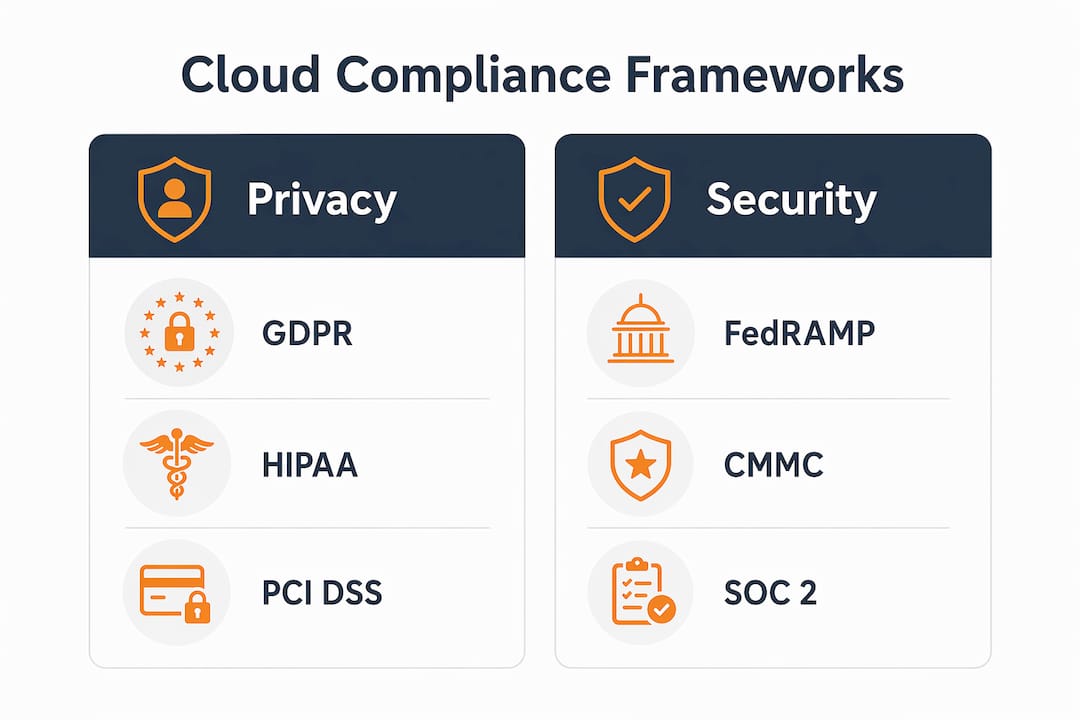
These frameworks share common ground: access control, encryption, logging, incident response, and vendor management. Where they diverge is in specificity and enforcement. HIPAA requires a signed BAA with every cloud provider touching protected health information (PHI). ISO/IEC 27001:2022 requires customers to define their ISMS scope and demonstrate conformity independently, even when running on a certified cloud infrastructure. A provider’s ISO certification does not transfer to the customer. That is a point most teams miss until their first external audit.
FedRAMP and CMMC are particularly relevant for organizations pursuing US government contracts. Both require third-party assessment and carry multi-year certification timelines. Starting compliance work after winning a contract is too late.
Pro Tip: Map every data type your cloud environment processes to its governing framework before you configure a single resource. A healthcare SaaS platform handling payments needs both HIPAA and PCI DSS controls, and the overlap is not automatic.
How does the shared responsibility model impact cloud compliance?
The shared responsibility model defines which security and compliance obligations belong to the cloud provider and which belong to the customer. AWS, Microsoft Azure, and Google Cloud all publish explicit responsibility matrices. The provider secures the physical infrastructure, hypervisor, and managed service layers. The customer owns data classification, identity and access management (IAM), network configuration, application security, and audit logging.
The operational reality is that 95% of cloud security failures result from customer misconfiguration, not provider issues. This statistic reframes the entire compliance conversation. Your AWS environment can run on infrastructure with a dozen certifications and still fail a HIPAA audit because an S3 bucket was publicly accessible or CloudTrail logging was disabled in one region.
Common customer responsibilities that teams frequently underestimate include:
- IAM policy enforcement: Least-privilege access must be configured and reviewed regularly, not set once at deployment.
- Encryption key management: Providers offer encryption services, but customers control key policies and rotation schedules.
- Audit log retention: Enabling logging is not enough. Logs must be retained for the period required by each applicable framework, often one to seven years.
- Patch management for customer-managed workloads: EC2 instances, containers, and self-managed databases are the customer’s responsibility to patch.
- Network segmentation: Security groups and VPC configurations that isolate regulated data from general workloads are customer-defined.
Mapping the shared responsibility model precisely to each cloud service in your environment is a step most teams skip. The model shifts depending on whether you use infrastructure as a service (IaaS), platform as a service (PaaS), or software as a service (SaaS). A managed database service like Amazon RDS shifts OS patching to AWS. A self-managed database on EC2 does not. Documenting these distinctions in your compliance program is not optional.
Pro Tip: Build a responsibility assignment matrix (RACI) that maps each compliance control to either the provider or your team, by service type. Review it every time you add a new cloud service to your architecture.
What are best practices for maintaining continuous cloud compliance?
Continuous compliance means your environment satisfies regulatory requirements at any point in time, not just during scheduled audits. Achieving this requires operational discipline across four areas.
-
Automate compliance checks in CI/CD pipelines. Policy-as-Code integrations in CI/CD pipelines prevent non-compliant resources from reaching production. Tools like AWS Config, HashiCorp Sentinel, and Open Policy Agent (OPA) enforce configuration rules before deployment. This approach catches violations in minutes rather than weeks, and eliminates the manual remediation backlog that accumulates in reactive compliance programs.
-
Test backup and disaster recovery quarterly. Quarterly testing of backup and disaster recovery plans is the industry standard for demonstrating recovery readiness to auditors. Annual testing is insufficient. Auditors want to see a pattern of regular validation, not a single successful test conducted the month before the audit.
-
Centralize logging and monitoring. Every compliance framework requires audit trails. AWS CloudTrail, Amazon GuardDuty, and AWS Security Hub aggregate events across accounts and regions. The goal is not just detection but retrieval: when an auditor or incident responder asks for access logs from a specific date range, you need to produce them in minutes.
-
Conduct vulnerability scanning and patch management on a defined schedule. Unpatched systems are a compliance violation under PCI DSS 4.0 and HIPAA. Automated scanning tools like Amazon Inspector identify vulnerabilities across EC2 instances and container images. Patch cadence should be documented in your security policy and tracked for evidence.
-
Enforce governance through documented policies. Effective compliance management requires collaboration between IT, legal, security, governance, and risk teams. Policies that live only in a security team’s wiki do not satisfy auditors. Policies must be formally approved, version-controlled, and distributed to all relevant stakeholders.
-
Generate compliance reports on a regular cadence. AWS Audit Manager and third-party platforms like Drata and Vanta automate evidence collection and map it to specific framework controls. Generating reports monthly rather than quarterly gives your team time to remediate gaps before they become audit findings.
For teams managing cloud security best practices across multiple accounts, a landing zone architecture with centralized logging and guardrails is the most defensible starting point.
What challenges complicate cloud compliance and how to overcome them?
Cloud compliance programs fail in predictable ways. Recognizing these failure patterns early saves significant remediation effort.
-
Misunderstanding shared responsibility. Teams assume that running on a compliant cloud provider makes their workloads compliant. It does not. Provider certifications cover infrastructure. Customer workloads require independent controls and documentation.
-
Shadow IT and ungoverned resources. Development teams that spin up cloud resources outside the approved provisioning process create compliance gaps that are invisible to security and audit teams. Enforcing infrastructure-as-code (IaC) and account-level guardrails through AWS Organizations and Service Control Policies (SCPs) closes this gap.
-
Insufficient audit evidence. Compliance gaps often signal underlying security weaknesses like misconfigurations or missing network controls. When auditors ask for evidence and teams cannot produce it, the problem is usually that evidence collection was never operationalized. Logging was enabled but not retained. Scans were run but not documented. Fixes were applied but not tracked.
-
Multi-cloud and hybrid complexity. Each cloud platform has its own compliance tooling, logging format, and configuration model. A control that is automated on AWS may require manual configuration on Azure. Organizations operating across multiple providers need a unified compliance posture management platform, such as Wiz, Orca Security, or AWS Security Hub with cross-account aggregation.
-
Compliance erosion over time. A compliant environment at launch drifts out of compliance as infrastructure changes accumulate. New services are added, IAM policies expand, and logging configurations are modified. Without continuous validation, the gap between documented controls and actual configuration grows silently. Automated drift detection, reviewed weekly, is the only reliable countermeasure.
Understanding cloud forensics challenges is also relevant here. When a security incident occurs in a non-compliant environment, the absence of proper logging and evidence retention makes both investigation and regulatory response significantly harder.
Key takeaways
Cloud compliance requires continuous, documented proof that controls are active, not a one-time configuration exercise.
| Point | Details |
|---|---|
| Compliance is proof, not just security | Auditors need time-stamped evidence of active controls, not just technical configurations. |
| Shared responsibility is customer-owned | 95% of cloud failures stem from customer misconfiguration, not provider issues. |
| Frameworks vary by industry and geography | GDPR, HIPAA, PCI DSS 4.0, and ISO 27001 each impose distinct, non-transferable obligations. |
| Automation reduces compliance drift | Policy-as-Code in CI/CD pipelines catches violations before they reach production. |
| Cross-team collaboration is required | Legal, risk, governance, and IT must align on compliance ownership and evidence collection. |
Why compliance is a proof problem, not a security problem
After working through hundreds of cloud environments with IT-Magic, the pattern I see most often is this: teams build genuinely strong security controls and then fail audits anyway. The reason is almost always the same. They treated compliance as a byproduct of good security rather than as a separate discipline with its own evidence requirements.
Security asks: “Is this control in place?” Compliance asks: “Can you prove this control was in place, continuously, for the past 12 months?” Those are different questions with different operational answers. A well-configured environment with no logging history cannot answer the second question.
The teams that handle this best treat compliance as an operational function, not a project. They automate evidence collection from day one, assign ownership of each control to a named individual, and review compliance posture weekly rather than quarterly. When an auditor arrives, they are not scrambling to reconstruct history. They are pulling a report that has been building itself for months.
The other shift I recommend is integrating compliance requirements into your cloud migration strategy before the first workload moves. Retrofitting compliance controls onto a production environment is significantly more expensive and disruptive than building them in from the start. In 2026, with regulatory scrutiny increasing across healthcare, fintech, and public sector, the cost of that retrofit is no longer theoretical.
— Oleksandr
How IT-Magic helps you migrate to AWS with compliance built in
IT-Magic’s AWS migration practice is built specifically for environments where compliance is not optional. As an AWS Advanced Tier Partner with 700+ completed migrations, IT-Magic takes full ownership of compliance-aligned architecture from the initial infrastructure audit through post-migration validation.
Every migration engagement includes security configuration review, IAM policy design, logging and monitoring setup, and documentation structured for audit readiness under HIPAA, PCI DSS, SOC 2, and ISO 27001. For fintech and eCommerce teams where a compliance gap translates directly into lost revenue or contract termination, this execution depth matters. Explore IT-Magic’s AWS migration services to see how a compliance-first migration is structured, or review the AWS migration best practices guide for a detailed framework your team can apply immediately.
FAQ
What is the cloud compliance definition?
Cloud compliance is the practice of ensuring that a cloud environment meets all applicable regulatory, legal, and organizational security requirements, supported by documented evidence that controls are active and enforced.
Is cloud compliance necessary for small businesses?
Yes. Any organization that handles patient data, processes payments, or holds government contracts must meet the same compliance standards as large enterprises, regardless of company size.
What are the most common cloud compliance frameworks?
The most widely applied frameworks are GDPR, HIPAA, PCI DSS 4.0, SOC 2, ISO/IEC 27001:2022, FedRAMP, and CMMC. The applicable frameworks depend on your industry, geography, and the type of data you process.
How does the shared responsibility model affect compliance?
The cloud provider secures the underlying infrastructure; the customer is responsible for data, access controls, logging, and application security. Assuming provider certifications cover customer workloads is the leading cause of compliance failures.
How do you ensure continuous cloud compliance?
Continuous compliance requires automated Policy-as-Code checks in deployment pipelines, centralized logging with defined retention periods, quarterly disaster recovery testing, and regular cross-team reviews of control ownership and evidence collection.