TL;DR:
- Serverless computing allows cloud providers to manage infrastructure while users pay only for actual compute time used. It emphasizes event-driven functions that scale automatically and operate without servers, transforming traditional application architectures. Cost savings, reduced operational overhead, and faster deployment are key benefits, but careful design is essential to avoid latency and failure risks.
Serverless computing is a cloud execution model where the provider manages all infrastructure, and you pay only for the compute time your code actually uses. The term is misleading. Servers still exist. You just never see, provision, or patch them. Platforms like AWS Lambda, Google Cloud Functions, and Azure Functions handle the runtime, scaling, and availability automatically. For IT teams under pressure to ship faster and spend less, this model changes the math on what a small team can build and operate.
What is serverless computing and how does it differ from traditional cloud?
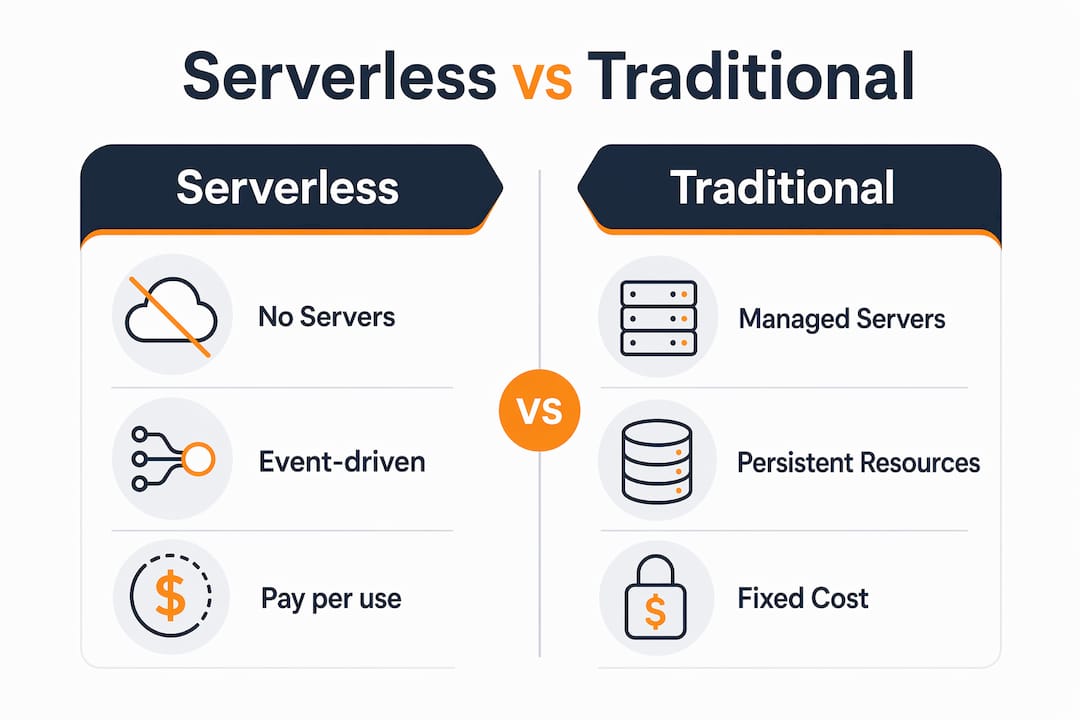
Serverless computing is an operational model, not an absence of servers. In traditional cloud or on-premises setups, you provision virtual machines, configure capacity, and pay for uptime regardless of whether your application is doing anything. Serverless flips that contract entirely. You write a function, define what triggers it, and the cloud provider handles everything else.

The industry term for the compute layer is Function as a Service (FaaS). AWS Lambda is the most widely deployed FaaS platform, but Google Cloud Functions and Azure Functions follow the same model. Each function is a discrete, stateless unit of code that runs in response to an event and exits when the work is done.
The billing model is the sharpest contrast with traditional infrastructure. AWS Lambda’s free tier covers 1 million requests and 400,000 GB-seconds monthly. Beyond that, you pay per invocation and per millisecond of execution. A function that sits idle costs nothing. That is a fundamentally different economic relationship than a reserved EC2 instance running at 10% utilization.
How does serverless computing work under the hood?
Serverless execution is event-driven by design. A function does not run on a schedule or sit waiting for traffic. It wakes up when something triggers it, executes, and terminates. Common triggers include:
- HTTP requests via API Gateway or application load balancers
- Storage events such as a file upload to Amazon S3
- Message queue events from Amazon SQS or Azure Service Bus
- Scheduled timers using cron-style rules in AWS EventBridge
- Database stream events from DynamoDB Streams or Firestore
The execution environment lifecycle has two states developers need to understand. A cold start happens when no warm container exists for your function. The provider spins up a new environment, loads your runtime and code, then executes. This adds latency, typically 100–500 milliseconds depending on the runtime and package size. A warm start reuses an existing container, which is nearly instant.
Cold starts matter most for latency-sensitive user-facing APIs. For background processing, event pipelines, or scheduled tasks, they are rarely a problem. AWS offers provisioned concurrency on Lambda to keep containers warm for critical paths, at an additional cost.
Pro Tip: Keep your Lambda deployment packages small. A Node.js function under 5 MB cold-starts significantly faster than a 50 MB Java bundle. Use Lambda Layers to share dependencies across functions without bloating individual packages.
What are the benefits of serverless vs. traditional infrastructure?
The cost advantage is the most cited reason teams adopt serverless. Switching to serverless typically yields 60–90% lower infrastructure bills by charging only for consumed compute time. That range is wide because it depends heavily on traffic patterns. Workloads with spiky, unpredictable demand see the largest savings. Workloads with constant, high-throughput traffic may see smaller gains.
“Serverless democratizes enterprise-grade infrastructure for smaller organizations by automating compute and enabling focus on business logic.” — Serverless Framework
Beyond cost, the operational benefits are significant:
- Zero idle capacity. Functions scale to zero when not in use. You never pay for standby.
- Automatic scaling. AWS Lambda scales from one invocation to thousands concurrently without any configuration change.
- Faster deployment cycles. Serverless enables deployment in hours or days versus weeks or months for traditional infrastructure, because patching, scaling, and security are managed by the provider.
- Reduced operational overhead. Your team stops managing OS patches, runtime upgrades, and capacity planning. That time goes back to building product.
- Smaller team footprint. The shift reduces the need for dedicated DevOps staff for infrastructure management. A two-person team can run production-grade systems that previously required a full platform engineering group.
For startups and SMBs, this is the most consequential benefit. You get the same infrastructure primitives as a Fortune 500 company without the headcount to match.
Key architectural considerations for serverless application design
Serverless architecture rewards careful design and punishes shortcuts. The most common mistakes come from applying traditional web application patterns to a model that requires a different approach.
Design for statelessness. Functions must not store state in memory between invocations. Use external state stores: Amazon DynamoDB, ElastiCache, or S3 for persistent data. A function that assumes local state will fail unpredictably at scale.
Avoid synchronous Lambda chaining. Invoking Lambda functions synchronously from other Lambda functions creates tight coupling, cascading failures, and wasted costs. If Function A calls Function B directly and B times out, A also fails and you pay for both. Use Amazon SQS for queuing or AWS EventBridge for event routing instead. Asynchronous patterns decouple your services and make failures recoverable.
Split by business domain, not HTTP method. Monolithic Lambda functions bundling many routes reduce the benefits of serverless. A single function handling all order operations cannot scale its payment processing independently from its inventory lookup. Map functions to bounded contexts: orders, payments, notifications, and so on. This enables granular deployment and independent scaling.
| Pattern | Recommended approach | Why it matters |
|---|---|---|
| Function chaining | Use SQS or EventBridge | Prevents cascading failures |
| Monolithic functions | Split by business domain | Enables independent scaling |
| In-memory state | Use DynamoDB or ElastiCache | Survives cold starts and concurrency |
| Cold start latency | Use provisioned concurrency | Keeps critical paths fast |
| Observability | Use AWS X-Ray and structured logs | Makes distributed tracing possible |
Cold starts, vendor lock-in, and debugging complexity are the three trade-offs teams consistently underestimate. Vendor lock-in is real. AWS Lambda functions written with SDK-specific patterns do not port cleanly to Google Cloud Functions. The Serverless Framework and AWS SAM reduce this risk by abstracting deployment, but the underlying service bindings remain provider-specific.
Pro Tip: Instrument every function with AWS X-Ray from day one. Distributed tracing across Lambda, SQS, and DynamoDB is difficult to retrofit. Structured JSON logging to CloudWatch Logs Insights makes debugging production issues orders of magnitude faster.
How does serverless fit into modern cloud workflows?
Serverless does not replace every part of your stack. It fits specific workload shapes and integrates with the broader cloud ecosystem. Serverless architecture combines FaaS with storage, messaging, and orchestration services that all scale to zero when idle. Understanding where it fits saves you from forcing it where it does not belong.
The strongest use cases for serverless in 2026 are:
- REST and GraphQL APIs. API Gateway plus Lambda handles millions of requests per day with no capacity planning. This is the most common production pattern.
- Event processing pipelines. S3 upload triggers image resizing, document parsing, or data transformation. Lambda handles each file independently and in parallel.
- Scheduled automation. Nightly reports, database cleanup jobs, and health checks run on EventBridge schedules without a dedicated cron server.
- IoT data ingestion. Device telemetry arrives unpredictably. Lambda scales to match burst traffic without pre-provisioned capacity.
- Workflow orchestration. AWS Step Functions coordinates multi-step processes across Lambda functions, handling retries, branching, and error states without custom glue code.
Stateful or long-running workloads are better suited for containers or dedicated infrastructure. A Lambda function has a maximum execution time of 15 minutes. A machine learning training job, a video transcoding pipeline, or a persistent WebSocket server belongs on Amazon ECS or EC2, not Lambda.
Developer tooling has matured significantly. The Serverless Framework provides a provider-agnostic deployment layer. AWS SAM (Serverless Application Model) offers native CloudFormation integration. Both support local testing, which was a major pain point in earlier serverless adoption. For cloud security best practices in serverless environments, granular IAM permissions per function are non-negotiable. Each function should have the minimum permissions it needs and nothing more.
Key Takeaways
Serverless computing is the most cost-effective model for event-driven, variable-traffic workloads, but it requires deliberate architectural decisions to avoid latency, coupling, and observability failures.
| Point | Details |
|---|---|
| Serverless is an operational model | The cloud provider manages servers; you manage triggers, permissions, and external state. |
| Cost savings are real but conditional | Teams see 60–90% lower bills on spiky workloads; constant high-throughput traffic sees smaller gains. |
| Stateless design is mandatory | Functions must store all state externally in DynamoDB, ElastiCache, or S3 to work reliably. |
| Avoid synchronous function chaining | Use SQS or EventBridge to decouple functions and prevent cascading failures. |
| Not every workload fits | Long-running or stateful jobs belong on containers or EC2, not Lambda. |
Serverless is a paradigm shift, not a deployment shortcut
I have seen teams adopt serverless for the wrong reasons and pay for it later. The pitch is compelling: no servers, automatic scaling, pay per use. So teams migrate a monolithic application by wrapping each route in a Lambda function and calling it serverless. It is not. It is a monolith with extra latency and a harder debugging story.
The real shift is architectural. Serverless forces you to think in events, not requests. It forces you to externalize state, decompose by domain, and instrument everything from the start. Teams that do this work upfront build systems that are genuinely cheaper to run and easier to scale. Teams that skip it end up with distributed monoliths that are harder to operate than what they replaced.
The vendor lock-in concern is legitimate but often overstated. If you are building on AWS already, Lambda, SQS, DynamoDB, and EventBridge are the right tools. Abstracting them away to stay “cloud-agnostic” usually means building worse versions of managed services yourself. Pick your cloud, commit to its primitives, and invest in observability. That is the practical path.
Serverless also does not eliminate the need for infrastructure expertise. It changes what that expertise looks like. You need people who understand IAM, event-driven patterns, distributed tracing, and cost modeling. The ceiling is lower for getting started. The ceiling for doing it well is just as high.
— Oleksandr
Ready to move your workloads to AWS serverless?
Adopting serverless is straightforward in theory. Executing it correctly in a production environment, especially in eCommerce or fintech, is a different challenge. IT-Magic has completed 700+ AWS migrations as an AWS Advanced Tier Partner, including serverless refactoring projects that cut infrastructure spend by 40% or more.
If your team is evaluating a move to AWS Lambda, Step Functions, or a fully serverless architecture, IT-Magic takes full ownership of the migration lifecycle: audit, design, implementation, and post-migration optimization. You can explore our AWS migration services or review how we approach AWS cost optimization to see what measurable outcomes look like in practice.
FAQ
What is serverless computing in simple terms?
Serverless computing is a model where you write and deploy code without managing servers. The cloud provider handles infrastructure, scaling, and availability, and you pay only for the compute time your code uses.
What is a cloud function in serverless architecture?
A cloud function is a single, stateless unit of code that runs in response to a trigger such as an HTTP request, a file upload, or a queue message. AWS Lambda, Google Cloud Functions, and Azure Functions are the leading platforms.
When should you not use serverless?
Serverless is a poor fit for long-running or stateful workloads such as video transcoding, ML training, or persistent WebSocket connections. These belong on containers or dedicated compute like Amazon ECS or EC2.
How does serverless reduce infrastructure costs?
Serverless charges only for actual execution time and request count. Functions scale to zero when idle, eliminating the cost of standby capacity that traditional VM-based infrastructure always carries.
What are the main serverless platform options?
The three dominant platforms are AWS Lambda, Google Cloud Functions, and Azure Functions. For deployment tooling, the Serverless Framework and AWS SAM are the most widely used options across teams of all sizes.