TL;DR:
- The AWS Migration Acceleration Program helps organizations migrate to AWS quickly using a phased, structured approach. It emphasizes thorough assessment, strategic migration sequencing, and post-migration governance to maximize cost savings and performance. IT-Magic, as a certified partner, supports these migrations by executing end-to-end projects tailored to high-load environments.
The AWS Migration Acceleration Program (MAP) is a structured, partner-led initiative that combines proven methodology, financial incentives, and expert support to accelerate enterprise cloud migration. MAP draws on hundreds of enterprise migrations to give organizations a repeatable, lower-risk path to AWS. For IT decision-makers and business leaders, the program addresses the three biggest migration obstacles: cost overruns, extended timelines, and post-migration performance gaps. IT-Magic, as an AWS Advanced Tier Partner with 700+ completed projects, applies the MAP framework to deliver predictable outcomes across complex, high-load environments in eCommerce and fintech.
What are the core phases of the AWS Migration Acceleration Program?
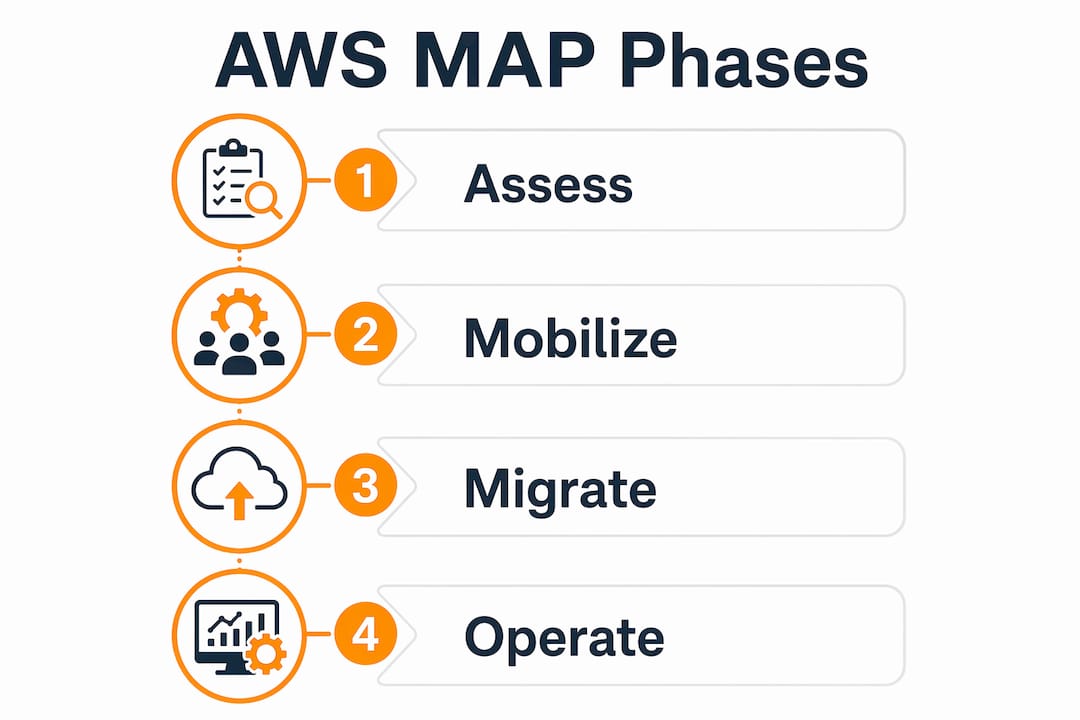
MAP structures migration into four sequential phases: Assess, Mobilize, Migrate, and Operate. Each phase has defined outputs, and skipping any one of them is the fastest route to a failed migration.

Assess is where most projects either win or lose before a single workload moves. The goal is a complete inventory of your infrastructure, including workload dependencies, licensing constraints, and compliance requirements. Thorough discovery consistently outperforms superior execution built on incomplete data. Teams that invest here avoid the expensive surprises that derail migrations mid-wave.
Mobilize prepares your organization for execution. This phase establishes a Cloud Center of Excellence (CCoE), configures your AWS landing zone, and trains the teams who will own the environment post-migration. Without this foundation, even technically sound migrations create operational debt that compounds over time.
Migrate is where workloads actually move, organized into prioritized waves. MAP recommends the 7 Rs framework for classifying each workload:
- Rehost (lift and shift): move as-is to AWS EC2 or equivalent
- Replatform: make targeted changes to use managed services, such as moving to Amazon RDS
- Refactor: re-architect for cloud-native capabilities
- Repurchase: switch to a SaaS alternative
- Retire: decommission workloads with no business value
- Retain: keep on-premises temporarily
- Relocate: move VMware workloads to AWS VMware Cloud
Operate covers post-migration optimization. This is where you right-size instances, implement tagging governance, and tune security controls. Migration timelines vary significantly by scale: small environments typically complete in 4–8 weeks, medium in 8–16 weeks, large in 16–26 weeks, and enterprise-scale in 26–52 weeks. Budgets range from $15,000 to $250,000+ depending on complexity.
How does AWS MAP funding and partner network accelerate migration?
MAP funding directly offsets migration costs, which removes the budget friction that stalls most cloud transition projects. Financial investment and partner services are core MAP components, not optional add-ons. That distinction matters because organizations that treat funding as a bonus rather than a planning input consistently underutilize it.
The MAP partner network gives you access to vetted firms that bring automation tools, pre-built migration patterns, and hands-on execution capacity. Partners reduce the time your internal team spends on undifferentiated migration work, which frees them to focus on business-critical decisions. The network also provides training paths that up-skill your engineers during the migration, so you exit the program with a more capable team, not just a new environment.
Key benefits the MAP partner ecosystem delivers:
- Pre-validated migration runbooks that reduce planning time
- Automation for discovery, wave planning, and cutover
- Access to AWS Migration Hub for centralized tracking
- Training credits and certification paths for internal teams
- Post-migration cost governance frameworks
Pro Tip: When selecting a MAP partner, ask specifically for case studies in your industry vertical. A partner with fintech or eCommerce experience will have already solved the compliance and performance edge cases your team will face.
Effective resource tagging is a MAP program requirement, not a best practice suggestion. AWS provides tagging guidelines and automation to support this, and proper tagging is what makes cost tracking, migration progress reporting, and program compliance possible. Teams that skip tagging governance in the Mobilize phase spend weeks reconstructing it during Operate.
What are the best practices for migrating workloads with AWS MAP?
The single most important strategic decision in any MAP engagement is sequencing: what moves first, and what gets modernized later. AWS endorses a migrate-first approach at scale, recommending rehosting or replatforming before any refactoring. Rehosting and replatforming represent 35–50% of migrations, while refactoring accounts for roughly 10%. That ratio reflects a deliberate choice to prioritize speed and stability over architectural perfection.
The logic is straightforward. Every week your workloads remain on-premises, you pay for infrastructure you are trying to exit. Rehosting gets you to AWS fast. Replatforming captures quick wins, like moving a self-managed database to Amazon RDS, without a full re-architecture. Refactoring comes later, applied selectively to systems where the ROI justifies the effort.
Choosing the right migration strategy
| Strategy | Speed | Complexity | ROI timeline |
|---|---|---|---|
| Rehost | Fast | Low | Immediate cost reduction |
| Replatform | Moderate | Medium | Short-term efficiency gains |
| Refactor | Slow | High | Long-term competitive advantage |
| Retire | Immediate | None | Instant cost elimination |
Modernization should target customer-facing applications that drive competitive advantage. The ROI of refactoring internal commodity tools is often negligible. Spend your modernization budget where customers feel the difference.
Zero-downtime techniques are non-negotiable for production workloads. Blue-green deployments and weighted DNS enable gradual traffic shifting and instant rollback if a cutover fails. These techniques add planning time upfront but eliminate the catastrophic downtime risk that makes executives nervous about migration projects.
Pro Tip: Run your first migration wave with a non-critical workload. The lessons you learn on a low-stakes system will protect your most revenue-sensitive applications in later waves.
For a deeper look at AWS migration best practices, IT-Magic has documented the patterns that consistently produce clean, on-time migrations across complex environments.
How do you measure business value and cost savings from AWS MAP?
Infrastructure cost savings from migration range from 40% to 60%, driven primarily by eliminating on-premises colocation costs, reducing hardware refresh cycles, and replacing over-provisioned servers with right-sized cloud instances. That range is wide because the actual savings depend heavily on how well you execute post-migration optimization. Organizations that migrate but never right-size their instances capture only a fraction of the available savings.
The metrics that matter most fall into three categories:
- Cost metrics: total infrastructure spend before vs. after, AWS bill by service, reserved instance coverage rate
- Performance metrics: application response time, error rate, availability percentage, throughput under peak load
- Operational metrics: mean time to recovery (MTTR), deployment frequency, change failure rate
Rightsizing is where most of the post-migration savings actually materialize. AWS Cost Explorer and AWS Compute Optimizer identify over-provisioned instances automatically. Acting on those recommendations within the first 90 days post-migration is the fastest path to reducing IT costs without touching application performance.
Cloud governance prevents cost creep from undoing your savings. Tagging policies, budget alerts, and regular cost reviews are the three controls that separate organizations that sustain their savings from those that watch their AWS bill grow back toward their old on-premises spend. The enterprise cloud migration pattern that consistently delivers long-term value combines aggressive initial migration with disciplined post-migration governance.
AWS migration experts recommend focusing modernization budgets on customer-facing applications that drive competitive advantage, rather than commoditized internal tools. This principle applies directly to how you prioritize your post-migration optimization roadmap. Spend engineering cycles where customers and revenue feel the impact.
Key Takeaways
The AWS Migration Acceleration Program delivers the fastest, lowest-risk path to AWS when organizations follow its phased methodology, use MAP funding strategically, and apply post-migration governance from day one.
| Point | Details |
|---|---|
| Discovery determines outcomes | Thorough workload and dependency mapping prevents the failures that derail migrations mid-wave. |
| Migrate first, modernize later | Rehosting and replatforming 35–50% of workloads first gets you to AWS fast and cuts costs immediately. |
| MAP funding offsets real costs | Financial incentives and partner services reduce total migration cost and lower the risk of failure. |
| Post-migration governance is mandatory | Rightsizing, tagging, and cost reviews within 90 days determine whether savings hold long-term. |
| Target modernization by ROI | Refactor customer-facing systems that drive revenue; leave commodity internal tools on rehost or replatform. |
What I’ve learned from 700+ migrations about MAP’s real value
The AWS Migration Acceleration Program is genuinely well-designed. After working through it across hundreds of projects, I can say that its structure reflects hard-won lessons from real migrations, not theoretical frameworks built in a conference room.
The part most organizations underestimate is the Assess phase. Teams consistently want to skip ahead to moving workloads. Every time they do, they pay for it later, usually in the form of broken dependencies discovered mid-cutover or compliance gaps found during a post-migration audit. The discovery investment is not overhead. It is the work that makes everything else predictable.
MAP funding is also more valuable than most IT leaders initially realize. Organizations that treat it as a reimbursement mechanism rather than a planning input leave money on the table. The partner network compounds that value. A partner who has already solved your specific compliance or performance challenge saves you weeks of trial and error.
The modernization question is where I see the most strategic mistakes. Teams get excited about refactoring everything and end up with a multi-year project that delivers value slowly. The migrate-first discipline is counterintuitive but correct. Get to AWS, stabilize, then modernize the systems where it actually matters. For legacy system modernization, the ROI calculation should drive every decision, not architectural preference.
Post-migration optimization is not a phase you complete. It is an ongoing practice. The organizations that sustain their cost savings and performance gains are the ones that build governance into their operating model from the start, not as an afterthought.
— Oleksandr
IT-Magic’s MAP-aligned migration services
IT-Magic executes AWS migrations aligned with the MAP framework, covering the full lifecycle from infrastructure audit through post-migration cost optimization. With 700+ completed projects as an AWS Advanced Tier Partner, IT-Magic takes ownership of execution and outcomes, not just planning documents.
For eCommerce and fintech environments where downtime translates directly into lost revenue, IT-Magic applies rehost and replatform strategies for speed, then targets modernization where it drives measurable business value. The team handles wave planning, zero-downtime cutovers, and post-migration rightsizing so your internal team stays focused on the business. Contact IT-Magic through awsmigrationservices.com to scope your migration and understand exactly what MAP funding can offset for your project.
FAQ
What is the AWS Migration Acceleration Program?
The AWS Migration Acceleration Program is a structured cloud migration initiative that combines methodology, partner services, automation tools, training, and financial incentives to help organizations migrate to AWS faster and with lower risk.
Who qualifies for AWS MAP funding?
Organizations migrating a qualifying workload volume to AWS through a vetted MAP partner are eligible for financial incentives. Eligibility requirements and funding amounts depend on migration scope and are confirmed during the Assess phase with your AWS partner.
How long does an AWS MAP migration take?
Migration timelines range from 4–8 weeks for small environments to 26–52 weeks for enterprise-scale projects. Complexity, workload count, and dependency depth are the primary factors that determine timeline.
What is the migrate-first approach in AWS MAP?
The migrate-first approach prioritizes rehosting and replatforming workloads before any refactoring. AWS recommends this sequence because it delivers cost savings faster and reduces the risk of extended, high-complexity projects that delay value realization.
How does IT-Magic support AWS MAP migrations?
IT-Magic is an AWS Advanced Tier Partner that executes MAP-aligned migrations end to end, including infrastructure audit, wave planning, hands-on implementation, and post-migration optimization, with a specialization in high-load eCommerce and fintech environments.