Cloud resilience is the ability of cloud systems, applications, and services to withstand disruptions, absorb failures, and recover quickly while keeping services operational. It goes well beyond backup or failover. A resilient cloud infrastructure combines infrastructure design, intelligent automation, and distributed architecture to keep your workloads running even when hardware fails, traffic spikes, or a cyberattack hits.
The core attributes of cloud resilience include:
- Recovery speed: How fast a system returns to normal after a disruption
- Failure absorption: The ability to degrade gracefully rather than collapse entirely
- Continuous operation: Keeping critical services available during, not just after, an incident
- Shared responsibility: Cloud providers like AWS, Amazon Web Services, DigitalOcean, and Stackscale manage physical infrastructure resilience; customers architect fault tolerance and test recovery in their own applications
That last point is where most teams underestimate their exposure. AWS documents this clearly: the provider handles the physical layer, and you own everything built on top of it.
What are the real benefits of cloud resilience for your organization?
Cloud resilience pays off across several dimensions that matter directly to the business.
- Uptime and availability: Automated failover and redundant systems keep services accessible during hardware failures or regional outages, preserving customer trust and operational continuity
- Reduced downtime costs: Every minute of outage carries a financial cost; resilient systems cut recovery time from hours to seconds in well-designed architectures
- Security posture: Resilient designs integrate attack detection and mitigation, so a DDoS event or ransomware attempt does not cascade into a full outage
- Compliance support: Regulated industries, especially financial services, require documented recovery capabilities; resilience architecture directly satisfies those requirements
- Automation efficiency: Self-healing systems reduce the manual intervention burden on your operations team, freeing engineers for higher-value work
Cloud-based architectures also give organizations the ability to scale for peak traffic without pre-provisioning expensive on-premises hardware that sits idle most of the year. For eCommerce and fintech teams, that elasticity is inseparable from resilience.
What challenges make cloud resilience hard to implement?
Building a genuinely resilient cloud environment is harder than most architecture diagrams suggest. The obstacles are real and worth naming directly.
- Technical complexity: Multi-region, multi-zone architectures require careful design of data replication, traffic routing, and dependency mapping; a single misconfigured health check can defeat an otherwise sound failover plan
- Cost versus resilience trade-offs: Running resources across multiple zones and regions, maintaining replicated databases, and provisioning extra capacity for failover all increase cloud costs; teams must match resilience investment to actual business risk
- Shared responsibility gaps: Misconfigurations are the most common source of resilience failures in cloud environments; customers often assume the provider handles more than it does
- Data synchronization limits: Network latency creates a physical ceiling on how fast data can replicate across regions, making zero-downtime goals exponentially expensive for some workloads
- Organizational readiness: Technical architecture alone is not enough; teams need documented runbooks, practiced incident response, and a culture that treats resilience as an ongoing discipline rather than a one-time deployment
- Testing gaps: Overconfidence in untested recovery plans is a persistent risk; a disaster recovery procedure that has never been executed under realistic conditions is not a recovery procedure
Pro Tip: Prioritize workloads by recovery time objective (RTO) and recovery point objective (RPO) before designing your architecture. Not every service needs sub-second failover, and treating them all the same wastes budget and adds unnecessary complexity.
How does cloud resilience differ from cloud reliability?

These two terms get used interchangeably, but they describe different things, and the distinction shapes how you design systems.
Cloud reliability means a system performs as expected over time. Teams measure it with uptime percentages, error rates, and response time. A service with five-nines availability is highly reliable under normal conditions.
Cloud resilience is broader. It includes reliability but adds the ability to absorb failures, degrade gracefully, and recover quickly when things go wrong. A service can be highly available in normal conditions yet fail catastrophically under a bad deployment, a dependency outage, or a traffic surge it was not designed to handle.
The practical implication: reliability reduces the probability of failure. Resilience reduces the damage when failure happens anyway. A reliable application can still go down because of a regional cloud issue, a cyberattack, or a network cut. A resilient one has backups, alternate paths, tested recovery steps, and the automation to execute them without waiting for a human to notice the problem.
Design for reliability first, then layer resilience on top. The two are complementary, not competing.
How do you actually achieve cloud resilience?
The strategies that matter most in practice fall into five interconnected areas.
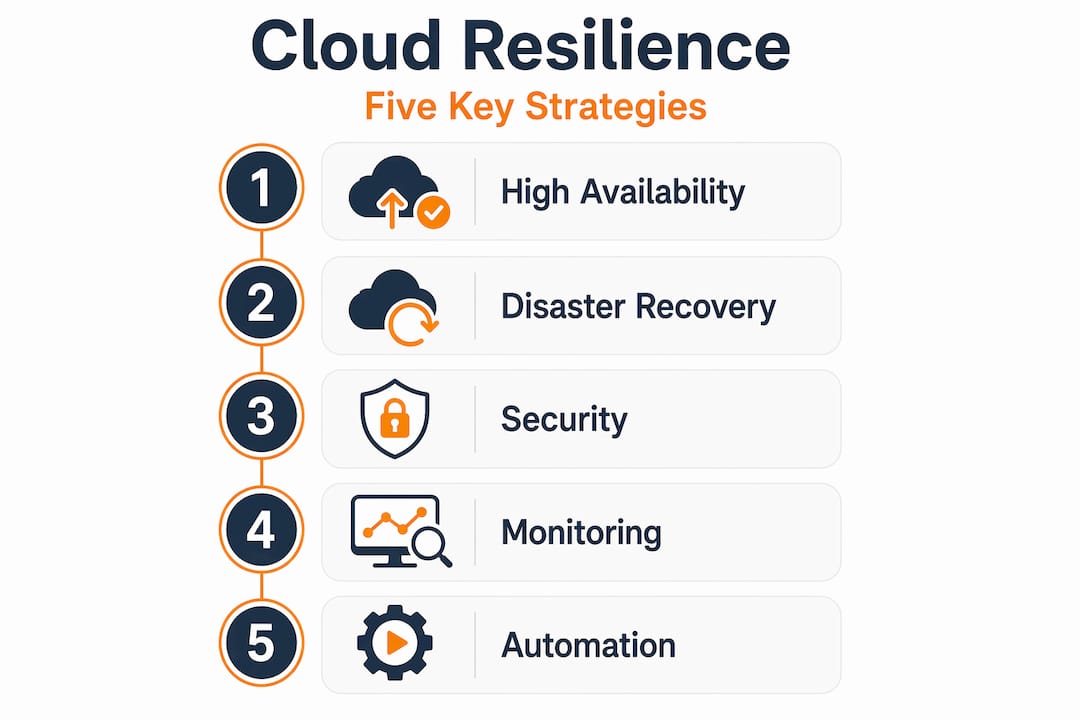
High availability and fault tolerance
Spread workloads across multiple availability zones and, for critical services, across regions. Use load balancers to distribute traffic and eliminate single points of failure. Automated failover and intelligent traffic routing let cloud applications detect and recover from outages across geographically distributed data centers without manual intervention.
Disaster recovery planning
Define RTO and RPO for each workload before you write a single line of infrastructure code. Then build and test the recovery mechanism that actually meets those targets. Automated backups, snapshots, and cross-region data replication are the technical foundation; a tested runbook is what makes them usable under pressure.
Security integration
Resilience and cloud security are not separate workstreams. Attack detection, rate limiting, and automated mitigation need to be embedded in the architecture so that a security incident does not automatically become a service outage.
Monitoring and observability
You cannot recover from what you cannot see. Continuous monitoring, distributed tracing, and alerting give your team the visibility to detect anomalies before they escalate. Pair this with automated recovery triggers so the system responds faster than any on-call engineer could.
Automation and AI
Automated recovery processes and intelligent failover are now standard components of modern cloud resilience. AI-driven observability tools go further, flagging degradation patterns before they cause visible failures. The goal is a self-healing system that handles routine failure scenarios without paging anyone at 2 AM.
Cloud providers also offer managed services, such as AWS Multi-AZ deployments and global load balancing, that build resilience into the platform layer. Choosing managed services over self-managed infrastructure shifts more of the resilience burden to the provider, which is worth factoring into your architecture decisions.
Operational resilience and the shared responsibility model
Operational resilience extends the technical concept into organizational practice. AWS defines it as the ability to provide continuous service through people, processes, and technology that are aware of and adaptive to constant change. That framing matters because it treats resilience as a real-time, execution-oriented norm, not a document that sits in a shared drive until something breaks.
In regulated sectors like financial services, operational resilience carries legal weight. Regulators require firms to identify critical functions, map dependencies across cloud and on-premises systems, and demonstrate that recovery capabilities actually work. IBM’s operational resilience framework describes this as anticipating, absorbing, adapting, and recovering from disruptions while continuously delivering critical business services.
The shared responsibility model defines where provider accountability ends and customer accountability begins:
- AWS, Amazon Web Services: Responsible for the resiliency of hardware, software, networking, and facilities that run AWS services
- Customers: Responsible for designing, testing, and deploying applications to achieve the availability and resiliency they need, including guest OS management, application configuration, and network security controls
- Service model dependency: Responsibility shifts as you move from IaaS to PaaS to SaaS; in SaaS, the provider handles far more of the resilience stack
Chaos engineering is the most underused tool for validating this. Running controlled failure experiments in production, or in a realistic staging environment, surfaces the gaps between your architecture diagrams and actual system behavior. Recovery drills and chaos engineering are what separate teams that know their plans work from teams that hope they do.
Last-mile connectivity is another dimension that often gets overlooked. Network path redundancy and secure access architecture matter as much as what happens inside the cloud region. A perfectly designed cloud workload is only as resilient as the network path between your users and that workload.
For organizations building or migrating to AWS, IT-Magic brings 700+ completed projects and AWS Advanced Tier Partner status to bear on exactly these challenges. Explore IT-Magic’s AWS migration services to see how resilient architectures get built in practice, not just on paper.
Key Takeaways
Cloud resilience requires combining technical architecture, automation, and organizational practice to keep services running through failures, not just after them.
| Point | Details |
|---|---|
| Resilience vs. reliability | Reliability reduces failure probability; resilience reduces damage when failure happens anyway. |
| Shared responsibility | AWS manages physical infrastructure; customers own application design, configuration, and recovery testing. |
| Cost trade-offs | Multi-zone resources, replicated databases, and extra monitoring all increase cloud costs; match investment to actual business risk. |
| Automation is core | Automated failover, self-healing systems, and AI-driven observability cut recovery time and reduce manual intervention. |
| Operational culture matters | Chaos engineering and practiced runbooks are what validate resilience plans before a real incident does it for you. |
FAQ
What is resilience in cloud computing?
Cloud resilience is the ability of cloud systems to withstand disruptions, absorb failures, and recover quickly while maintaining service availability. It combines infrastructure design, redundancy, automated failover, and tested recovery processes.
How does cloud resilience differ from high availability?
High availability focuses on minimizing downtime under normal conditions. Cloud resilience is broader: it includes high availability plus the ability to degrade gracefully and recover from failures like bad deployments, dependency outages, or traffic surges that high availability alone cannot handle.
What is operational resilience in cloud environments?
Operational resilience is the ability to provide continuous service through people, processes, and technology during constant change and disruption. It extends beyond technical architecture to include incident response culture, regulatory compliance, and regular testing of recovery capabilities.
Who is responsible for cloud resilience?
Cloud resilience operates under a shared responsibility model. The provider manages physical infrastructure and facility resilience; customers are responsible for designing fault-tolerant applications, configuring disaster recovery, and testing their own systems. Responsibility shifts toward the provider as you move from IaaS to SaaS.
What are the biggest risks to cloud resilience?
The most common risks are misconfiguration, untested recovery plans, and overlooked network path dependencies. Data replication latency also creates physical limits on how fast cross-region recovery can happen, requiring workload prioritization based on RTO and RPO targets.