TL;DR:
- Most enterprises lose cloud budgets gradually through idle resources, oversized instances, and scope drift rather than dramatic blowouts. True cloud cost optimization is an ongoing process focused on delivering business value at the lowest price, involving continuous refinement, right-sizing, and waste elimination. Effective management requires leadership engagement, cross-functional governance, and regular review of KPIs to prevent cost drift and maintain sustainable savings.
Most enterprises don’t lose cloud budget in dramatic blowouts. They lose it slowly, through idle resources left running, oversized instances nobody questioned, and workloads that drifted far from their original scope. According to the AWS Well-Architected Framework, cloud cost optimization is the ongoing ability to run workloads to deliver business value at the lowest price point. The word “ongoing” is doing a lot of work in that sentence. This article breaks down what optimization really means at the enterprise level, which AWS strategies deliver the most value, and how to build a methodology that keeps costs under control long after your migration is complete.
Table of Contents
- Defining cloud cost optimization: More than expense reduction
- Core AWS cloud cost optimization strategies
- A practical methodology: Enterprise cloud cost optimization in action
- The challenge of cost drift: Why optimization must be continuous
- Our take: Why cloud cost optimization is a leadership discipline, not just an engineering task
- Start optimizing your AWS cloud investment today
- Frequently asked questions
Key Takeaways
| Point | Details |
|---|---|
| Continuous process | Cloud cost optimization is an ongoing practice, not a one-time fix. |
| Multiple AWS strategies | Combining commitment purchasing, waste reduction, and monitoring delivers the best results. |
| Guard against cost drift | Regular reviews and strong governance are essential to avoid unchecked spending. |
| Cross-functional discipline | Effective optimization requires collaboration between IT, finance, and business leaders. |
| Measure what matters | Use KPIs and anomaly detection to ensure ongoing efficiency and proactive cost management. |
Defining cloud cost optimization: More than expense reduction
Many IT leaders approach cloud costs the same way they approached on-premises budgeting: review spending at year-end, identify the biggest line items, and negotiate better rates. That model doesn’t work in the cloud. AWS environments are dynamic, and costs shift daily based on resource consumption, scaling events, and configuration changes. Treating optimization as an annual finance exercise is exactly how organizations end up overspending by 30% or more without anyone noticing until the quarterly review.
True cost optimization means something broader. According to the AWS Well-Architected Framework:
“Cloud cost optimization is the ongoing ability to run workloads to deliver business value at the lowest price point, achieved through cost optimization techniques and continuous refinement.”
The key shift here is from cost reduction to value delivery. You’re not just looking to spend less. You’re making sure every dollar in your AWS bill is tied to a workload that earns its keep. That means:
- Right-sizing resources so compute, memory, and storage match actual demand, not worst-case assumptions
- Eliminating waste by decommissioning idle instances, orphaned snapshots, and unused reserved capacity
- Aligning spend with outcomes so engineering decisions are connected to business metrics, not just technical benchmarks
- Building governance structures that create accountability for cloud spend at the team or service level
Understanding AWS cost optimization essentials starts with acknowledging that it’s an operational discipline, not a procurement task. It requires governance, ongoing measurement, and a culture where engineers care about cost the same way they care about performance. Without that foundation, even the best technical strategies will erode over time. A solid approach to infrastructure optimization for AWS goes hand in hand with cloud optimization compliance, ensuring that cost-conscious decisions don’t inadvertently create security or regulatory gaps.
Core AWS cloud cost optimization strategies

AWS gives you a well-stocked toolkit for managing costs. The challenge isn’t finding options. It’s choosing the right option for each workload and knowing when to combine them. AWS Cost Optimization Hub groups actions into three main categories: commitment purchasing, purchase and placement options, and operational waste reduction.
Here’s a quick comparison of the primary strategies:
| Strategy | Best for | Commitment required | Potential savings |
|---|---|---|---|
| Savings Plans | Steady-state compute workloads | 1 or 3 years | Up to 72% vs. On-Demand |
| Reserved Instances | Predictable, fixed workloads (RDS, EC2) | 1 or 3 years | Up to 75% vs. On-Demand |
| Spot Instances | Fault-tolerant, interruptible workloads | None | Up to 90% vs. On-Demand |
| Rightsizing | All workloads with utilization data | None | Variable, 20-40% typical |
| Idle resource cleanup | Unused instances, unattached EBS volumes | None | Immediate recovery |
How to apply these in sequence:
- Audit first. Before committing to any savings plan, analyze 30 to 90 days of usage data. AWS Cost Explorer and Compute Optimizer provide the utilization baselines you need.
- Eliminate waste. Remove idle resources before purchasing any reservations. Committing to capacity you don’t use is just waste at a discount.
- Rightsize active workloads. Match instance types and sizes to actual CPU and memory utilization. Downsizing an m5.2xlarge to an m5.xlarge on a workload running at 15% utilization is low risk and high return.
- Purchase Savings Plans for baseline load. Cover your predictable minimum compute usage with a Savings Plan. This is more flexible than Reserved Instances and applies across instance families.
- Add Spot Instances for variable workloads. Batch processing, data transformation, CI/CD pipelines, and development environments are excellent candidates for Spot. Combine with Auto Scaling to handle interruptions gracefully.
- Set up automated enforcement. Use AWS Config rules, Lambda functions, or third-party tools to stop instances outside business hours and flag oversized resources automatically.
The connection between AWS scalability and agility and cost strategy is direct. When you build for scale from the start, you avoid the trap of permanently over-provisioned environments that were sized for a traffic spike that happened two years ago. A well-designed cost-effective cloud environment combines the right purchase strategy with architecture that can shrink and grow based on real demand.
Pro Tip: Rightsizing delivers the most consistent savings when paired with continuous monitoring. Running AWS Compute Optimizer alongside CloudWatch utilization metrics lets you catch over-provisioned instances within days, not months.
A practical methodology: Enterprise cloud cost optimization in action
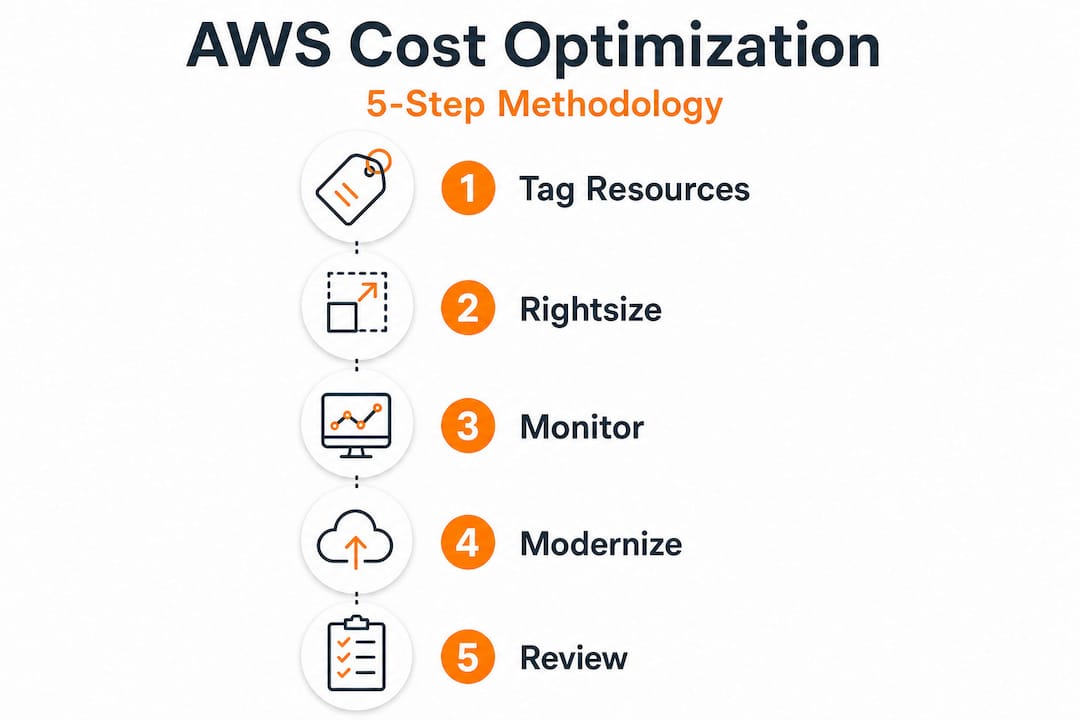
Knowing the strategies is one thing. Turning them into a repeatable process that scales across dozens of teams and hundreds of workloads is another challenge entirely. The AWS Well-Architected Cost Optimization Pillar outlines a practical methodology that enterprises can follow: establish cost policies and budgets, analyze workload components and usage, perform cost modeling, select resource types based on data, and continually monitor cost.
Here’s how that plays out in practice:
- Establish governance and cost policies. Define budget thresholds, tag standards (so every resource is attributed to a team, project, or cost center), and approval workflows for new deployments. Without tagging, cost attribution is guesswork.
- Analyze workload components and usage. Use AWS Cost Explorer, Trusted Advisor, and Compute Optimizer to map which services consume the most spend. Break it down by workload, not just service. An RDS bill that looks large may be perfectly efficient when normalized per transaction.
- Perform cost modeling before changes. Before migrating a new workload or refactoring an existing one, model the expected cost. The AWS Pricing Calculator is useful here. Cost surprises are always a governance failure, never a surprise.
- Select resource types and sizes based on data. Enable automated selection where possible. AWS Graviton instances, for example, often deliver better price-performance than equivalent x86 options. Let the data drive instance family decisions rather than engineering familiarity.
- Continually monitor and respond. Set up AWS Budgets with alert thresholds. Enable anomaly detection in Cost Explorer. Create dashboards that surface cost trends weekly, not just monthly.
Here’s a sample of the potential impact at each methodology stage:
| Methodology stage | Typical impact | Timeframe to realize savings |
|---|---|---|
| Governance and tagging setup | 5-10% (waste visibility) | 30-60 days |
| Rightsizing analysis | 15-25% on compute | 30-90 days |
| Savings Plans or Reserved Instance purchase | 20-40% on committed usage | Immediate upon purchase |
| Spot Instance adoption | 30-60% on variable workloads | 60-120 days |
| Continuous monitoring and anomaly response | Ongoing 5-15% annual improvement | Ongoing |
The process of modernizing legacy workloads often unlocks the highest optimization gains because legacy architectures carry years of accumulated over-provisioning. Combining methodology with real-world AWS cost reduction tips learned from actual migrations accelerates the path to measurable results. Integrating monitoring IT environments practices into your cost review process means anomalies surface in real time rather than showing up as a billing shock at month-end.
Pro Tip: Establish a cost KPI dashboard with at least three metrics: cost per workload, resource utilization rate, and the number of anomaly alerts triggered per week. Review this weekly with both engineering leads and finance stakeholders. The cadence matters as much as the metrics.
The challenge of cost drift: Why optimization must be continuous
You can execute a perfect migration, implement Savings Plans, rightsize every instance, and still watch your AWS bill climb 20% over the following year. That’s cost drift in action. And it’s more common than most IT leaders want to admit.
Cost drift in AWS environments happens when governance gaps and operational complexity allow spending to creep upward without any single decision being responsible. It’s not one big mistake. It’s a hundred small ones: a development environment that never got shut down, a data transfer path that bypasses a more efficient route, a new service deployed without a cost review.
“Costs can drift over time due to governance and operating model issues, including idle resources, overprovisioning, and fragmented ownership, meaning optimization must be embedded into day-to-day operations rather than treated as a one-time finance exercise.”
Common root causes of cost drift include:
- Idle resources left running after a project ends, including EC2 instances, load balancers, and NAT gateways that accumulate charges with no active traffic
- Overprovisioning driven by fear of performance issues, where teams consistently request larger instances than needed and nobody reviews utilization after launch
- Siloed decision making where engineering teams make resource allocation decisions without visibility into the cost impact, and finance teams don’t have the context to challenge them
- Shadow provisioning where individual developers or teams spin up resources outside standard procurement workflows, bypassing tagging requirements and budget controls
- Unreviewed data transfer costs that multiply as architectures grow more complex and traffic patterns change over time
The costs of fragmented IT governance amplify all of these problems. When ownership of cloud resources is spread across teams without a unified accountability model, nobody feels responsible for the total bill. Each team optimizes locally while the aggregate cost drifts upward. The solution is embedding cost responsibility into your standard enterprise AWS migration guide and operating model so it survives beyond the initial migration project.
Our take: Why cloud cost optimization is a leadership discipline, not just an engineering task
Here’s the uncomfortable truth we’ve learned from over 700 completed migration projects: the enterprises that achieve lasting cost optimization aren’t the ones with the best engineers. They’re the ones with the most engaged leadership.
When cost optimization lives exclusively in the engineering org, it gets deprioritized every time a feature request arrives. Engineers are incentivized to ship, not to save. And nobody blames them for that. The problem is structural. Cost decisions without business context produce technically correct but commercially irrelevant outcomes. Rightsizing a workload by 30% looks great in a report, but if that workload drives 60% of revenue, the risk calculus is completely different.
Real optimization happens when finance, engineering, and business stakeholders share the same data and the same accountability. That means bringing cost performance into executive business reviews, not just infrastructure team standups. It means giving product owners visibility into the AWS cost of the features they ship. It means measuring cost efficiency as a business metric, not just a technical one.
The focus on short-term savings often creates a different kind of problem. Optimizing aggressively for cost in a single quarter can degrade reliability, increase technical debt, or slow development velocity. The savings show up in Q2, and the consequences appear in Q4. Leadership that treats cost optimization as a long-term discipline avoids that trap by balancing cost reduction with performance, maintainability, and risk.
Our experience with managed AWS solutions consistently shows that enterprises with cross-functional cost governance structures outperform those with purely technical optimization programs. The pattern is consistent: the CIO who reviews cost efficiency monthly alongside business KPIs drives better outcomes than the cloud architect who reviews it alone.
Pro Tip: Schedule a quarterly cloud cost review that includes representation from IT, finance, and at least one business unit owner. Set a standing agenda: top cost drivers, optimization actions taken, and planned changes for the next quarter. Consistency matters more than perfection in these reviews.
Start optimizing your AWS cloud investment today
Reading about AWS cost optimization strategies is valuable. Executing them consistently across a large, complex environment is a different challenge. Most enterprises have the intent but lack the operational capacity and institutional knowledge to turn strategies into sustained savings.
At awsmigrationservices.com, we’ve helped enterprises across eCommerce, fintech, and other high-load industries reduce their AWS spend without sacrificing performance or reliability. Our approach covers everything from infrastructure audit and cost modeling to hands-on rightsizing and governance setup. We follow proven cloud migration best practices refined across 700+ projects, so you benefit from patterns that actually work in production. If you want a clear picture of where your AWS costs stand and a prioritized roadmap to optimize AWS costs, our team is ready to help you get there without adding operational burden to your existing team.
Frequently asked questions
What are the most effective AWS cost optimization strategies for large enterprises?
The most effective strategies combine commitment purchasing such as Savings Plans and Reserved Instances, operational waste reduction through rightsizing and idle resource cleanup, and Spot Instances for interruptible workloads. Pairing these with continuous monitoring ensures savings are maintained over time rather than eroding through cost drift.
How often should cloud costs be reviewed to avoid cost drift?
Cost drift accumulates through governance gaps and fragmented ownership, so reviews should happen at least monthly, with anomaly alerts set up for real-time detection between cycles. Organizations with frequent deployments benefit from per-sprint cost reviews tied directly to release activity.
What KPIs are important to track for cloud cost optimization?
AWS Well-Architected best practices highlight cost efficiency ratios, resource utilization rates, cost per workload, and anomaly detection rates as the most actionable metrics. These KPIs give both technical teams and business stakeholders a shared language for measuring and improving cost performance.
Is optimizing for cost a trade-off with performance or reliability in AWS?
Yes, and managing those trade-offs deliberately is part of the discipline. The AWS Well-Architected Framework explicitly notes that optimizing for lowest price may require explicit decisions about reliability, performance, and sustainability. Every cost decision should be evaluated in business context, with leadership sign-off on any trade-off that affects a production workload.