TL;DR:
- Large-scale AWS migrations often fail due to organizational misalignment rather than technology, resulting in delays and increased costs. A thorough readiness assessment using AWS CAF, combined with a standardized migration factory and proactive edge case management, is essential for predictable, efficient migration execution. Strong executive sponsorship and effective governance are critical for resolving scope disputes quickly and ensuring successful enterprise cloud transformations.
Large-scale AWS migrations fail far more often than they should, and the root cause is rarely the technology. When enterprises move dozens or hundreds of workloads to AWS without a repeatable process, the result is budget overruns, unexpected downtime, and security gaps that surface only after go-live. The consequences in high-load eCommerce or fintech environments are immediate and measurable: lost revenue per hour of disruption, compliance exposure, and eroded stakeholder confidence. This guide walks IT directors and cloud migration specialists through the proven steps that separate chaotic, ad hoc migrations from streamlined, factory-style executions designed to deliver predictable outcomes every time.
Table of Contents
- Assessing readiness: Frameworks and prerequisites
- Designing your migration factory and orchestrating automation
- Managing edge cases and mitigating migration bottlenecks
- Verification, handover, and measuring migration success
- Why migration “alignment” matters more than technology
- Get expert support for your AWS migration
- Frequently asked questions
Key Takeaways
| Point | Details |
|---|---|
| Start with CAF alignment | Use the AWS Cloud Adoption Framework to uncover readiness gaps before technical migration planning. |
| Leverage a migration factory | Standardize processes and centralize metadata to automate and accelerate complex migrations. |
| Validate edge cases early | Address licensing, tool, and process constraints in advance to avoid project delays. |
| Prioritize organizational alignment | Success depends on scope, strategy, and executive-level dispute resolution, not just technical tools. |
Assessing readiness: Frameworks and prerequisites
No migration should begin without an honest readiness assessment. Organizations that skip this step tend to discover critical gaps mid-flight, when course corrections are far more expensive. The good news is you don’t need to build an assessment model from scratch.
AWS recommends using its Cloud Adoption Framework (CAF) across business, people, governance, platform, security, and operations domains, pairing it with an agile approach through sprints and workstreams to streamline large enterprise migrations. Each domain maps to a concrete organizational prerequisite. Following AWS migration best practices from the start makes this mapping exercise far more efficient.
| CAF Domain | Key Enterprise Prerequisite | Common Gap Found |
|---|---|---|
| Business | Executive sponsorship and ROI alignment | Unclear business case |
| People | Cloud-trained team and change management | Skill shortage, resistance |
| Governance | Policies, compliance, cost controls | Undefined approval processes |
| Platform | Reference architectures, landing zones | Missing target state design |
| Security | Identity management, data classification | Inadequate IAM policies |
| Operations | Monitoring, runbooks, SLAs | No post-migration support model |
Looking at this table, you can see that business, people, and governance gaps are just as dangerous as technical ones. A migration with a well-designed landing zone but no executive sponsorship will stall the moment a difficult prioritization decision surfaces.
Key readiness indicators to validate before technical planning begins:
- Active executive sponsor with authority to resolve cross-functional disputes
- Agile-ready team structure with defined roles for migration waves
- Data discovery tooling deployed and producing accurate CMDB (Configuration Management Database) data
- Cloud literacy baseline for operations and development teams
- Documented compliance requirements covering data residency, encryption, and audit logging
For scalability guidance on how your target architecture supports future growth, that work starts here, not after migration.
Pro Tip: Run CAF as a gap-analysis exercise in a two-day workshop format with business and technical stakeholders together. The business and governance findings typically surprise the technical team, and vice versa. Gaps identified here cost almost nothing to fix before migration starts but can cost months and significant budget to resolve during execution.
Many teams believe that strong cloud engineers can compensate for organizational unreadiness. They cannot. Cloud migration approaches that emphasize organizational preparation consistently produce better outcomes than those that treat readiness as a checkbox.
Establishing a solid readiness foundation is essential before touching the technical process. Once your organization is prepared, the next challenge is selecting the right methodology and tools for the migration itself.
Designing your migration factory and orchestrating automation
The migration factory model is what separates enterprises that finish on time from those that drift into multi-year projects. The concept is simple: treat your migration like a manufacturing process. Each workload enters a defined pipeline with known steps, owners, tools, and exit criteria. Variation is the enemy. Standardization is the goal.

At the core of a migration factory is a centralized metadata store that tracks every application, server, migration wave, owner, status, and planned date. AWS migration strategy guidance explicitly advises treating scope, strategy, and timeline as aligned building blocks and using automated ETL (extract, transform, load) of migration metadata to reduce time and effort in both discovery and execution.
Here is what a sample migration wave structure looks like in practice:
| Field | Example Value | Purpose |
|---|---|---|
| Application | Order Management System | Identifies the workload |
| Server(s) | app-srv-01, db-srv-02 | Maps to physical or virtual assets |
| Owner | Platform Engineering Team | Accountable stakeholder |
| Status | In Progress | Current pipeline position |
| Planned Migration Date | 2026-07-15 | Schedule anchor |
| CMDB Flag | Validated | Confirms discovery accuracy |
This table lives in a shared tool, updated automatically where possible, and reviewed in weekly wave ceremonies. Without it, migration programs default to spreadsheet chaos and verbal status updates.
Critical note from AWS guidance: Scope, strategy, and timeline must be treated as interdependent. Changing one without adjusting the others creates technical debt and schedule overruns that compound across migration waves. Time-based constraints carry very low tolerance for overrun in enterprise programs.
Follow these steps to design and implement your migration factory:
- Define team roles clearly. Assign a wave lead, a technical migration engineer, a business owner, and a testing coordinator per workload group. Ambiguity in ownership is where migrations die.
- Build or configure your metadata store. Use AWS Migration Hub or a purpose-built CMDB integration to centralize all application and server data. Automate data ingestion from existing asset management tools wherever possible.
- Automate metadata ETL. Write scripts or configure pipelines that pull discovery data from tools like AWS Application Discovery Service and push validated records into your central store.
- Build orchestration scripts for standard migration steps. Rehost migrations should have scripted agents, replication jobs, cutover steps, and rollback procedures. Manual steps introduce variance and human error.
- Run a pilot wave. Select two to three non-critical workloads for the first wave. Document every deviation, update your runbooks, and refine the factory before scaling.
- Implement a sprint-based wave cadence. Two-week sprints with defined entry/exit criteria per wave keep velocity high and make status visible to stakeholders.
Following migration factory best practices helps you configure automation that scales across hundreds of workloads without proportionally scaling headcount. For specific infrastructure optimization steps post-migration, that work is far easier when your factory produced clean, well-documented environments.
Pro Tip: Automate metadata extraction during the discovery phase, before wave planning begins. Teams that wait until wave execution to validate server data spend 30 to 40 percent of their time correcting inventory errors instead of migrating workloads.
With your prerequisites addressed and migration factory principles defined, it’s time to operationalize your migration and identify the edge cases that create costly bottlenecks.
Managing edge cases and mitigating migration bottlenecks
Every enterprise migration surfaces surprises. The teams that handle them well are the ones that anticipated them in advance. The most damaging bottlenecks are rarely technical. They are process, licensing, and documentation failures.
Recurring migration issues include unsupported licensing models in AWS, tool licensing constraints that delay validation, and undocumented custom workloads that fail standard migration tooling. Each of these can stop a wave in its tracks and ripple forward into subsequent waves.
The most common edge cases you should plan for:
- Licensing model incompatibility. Some on-premises software licenses don’t transfer to cloud-based virtual machines, particularly for database engines and middleware. Bring Your Own License (BYOL) support varies by vendor and AWS instance type.
- Tool license shortages. Migration tools with per-server pricing can hit capacity limits during peak wave activity. A bottleneck at the validation stage delays the entire wave.
- Poorly documented custom workloads. Applications built in-house years ago often have undocumented dependencies, hardcoded IP addresses, and environment-specific configurations that only emerge during testing.
- Executive alignment gaps mid-program. Late-stage disagreements between business units about priorities can freeze wave sequencing for weeks.
Numbered troubleshooting actions for the three most common bottleneck types:
Licensing model issues:
- Catalog all third-party software licenses during the discovery phase, before wave planning begins.
- Conduct proof-of-concept testing with each licensing vendor in an AWS environment at least six weeks before the first affected wave.
- Maintain a dynamic licensing inventory that updates as servers are migrated and licenses are released or reassigned.
- Identify AWS Marketplace alternatives for any license that cannot transfer, and budget for the transition cost.
Tool license shortages:
- Map your migration wave calendar to tool license peaks and model the concurrent server load per sprint.
- Pre-purchase additional tool capacity for peak wave periods and release unused licenses after each wave closes.
- Negotiate burst licensing terms with your migration tooling vendors as part of the program setup.
Undocumented workloads:
- Flag any application with incomplete CMDB data as high-risk during wave sequencing and schedule it for deep discovery before its wave begins.
- Run automated dependency mapping tools two sprints before the target migration date.
- Document all findings in your centralized metadata store with a “discovery complete” gate before the workload can enter the migration pipeline.
Pro Tip: Align your tool licensing renewal or expansion events with peak migration periods on your calendar. Running out of concurrent agent licenses the week of a major cutover is entirely avoidable and entirely common in programs that didn’t plan ahead.
Looking at enterprise migration success stories confirms a consistent pattern: programs that invested time in edge case planning during the design phase moved through execution two to three times faster than those that treated problems as they arose.
Solving for bottlenecks and edge cases improves migration reliability, but how do you measure and ensure overall process success?
Verification, handover, and measuring migration success
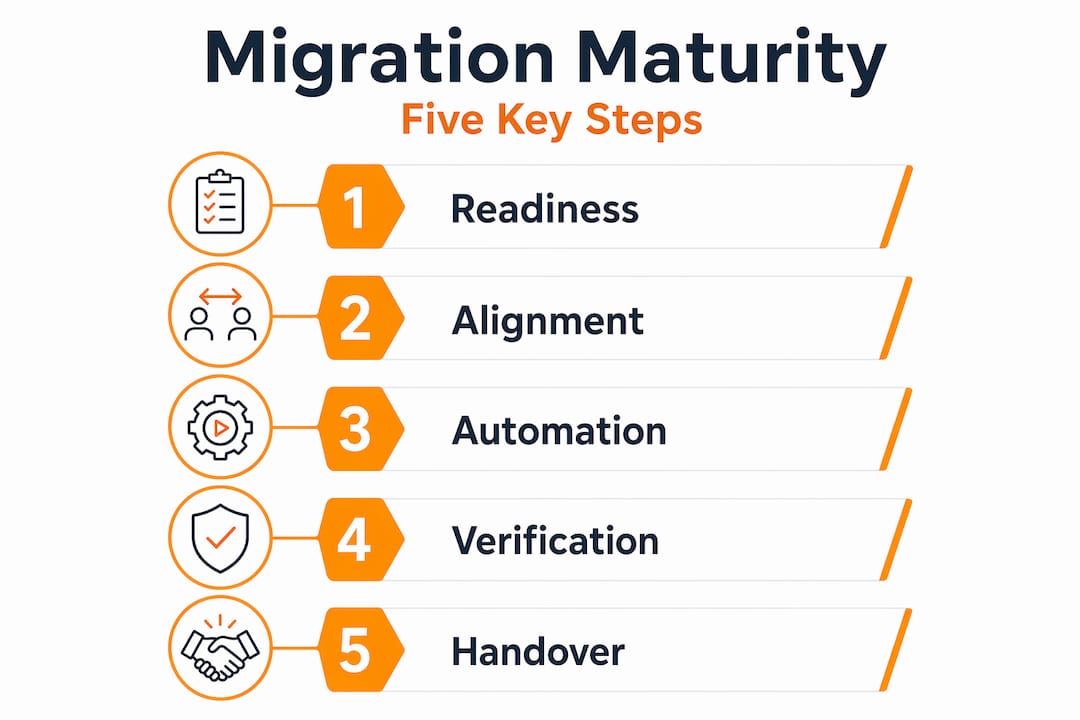
Migration execution is only half the work. What happens after cutover determines whether you truly succeed or just technically moved a workload. Verification and handover quality are where many enterprise programs fall apart, and where centralized metadata stores and standardized datasets in a migration factory approach pay their most important dividends.
Essential verification steps for each migrated workload:
- Technical validation: Confirm network connectivity, application performance baselines, and security configuration match the agreed target state.
- Business process sign-off: The application owner validates that all business workflows operate correctly in the new environment.
- Operational readiness: The receiving operations team confirms monitoring, alerting, backup, and recovery processes are active and tested.
- Security posture review: IAM roles, encryption settings, and compliance controls are verified against the baseline defined in the security domain of your CAF assessment.
Key migration success metrics to track across every wave:
- Cutover time per workload (target vs. actual)
- Error rate during replication and cutover
- Unplanned business downtime during migration window
- User acceptance test pass rate
- Time to operational handover completion
- Rollback events triggered and root causes
A mature handover process looks very different from an ad hoc one. The contrast matters significantly when you have 200 workloads to migrate and an operations team that needs to absorb each one without disruption:
| Dimension | Mature handover | Ad hoc handover |
|---|---|---|
| Documentation | Runbooks, architecture diagrams, dependency maps | Verbal briefings, incomplete notes |
| Roles | Defined ownership with sign-off process | Ambiguous, often falls to migration engineers |
| Automation | Monitoring and alerting configured via IaC (infrastructure as code) | Manual alert setup post-migration |
| Post-migration SLA | Defined hypercare period with escalation path | No formal support window |
| Lessons learned | Captured in metadata store, fed back to factory | Informal, not systematized |
Post-migration reviews should happen within two weeks of each wave close. Runbooks should be updated with findings before the next wave begins. This iterative improvement loop is what makes large enterprise migration programs genuinely accelerate over time rather than slow down as complexity accumulates.
You can learn more about building resilient environments in cloud infrastructure fundamentals that support long-term operational stability after migration.
With verification and success measurement in place, let’s step back for a broader, hard-won perspective on what truly enables streamlined migration at enterprise scale.
Why migration “alignment” matters more than technology
Here is an uncomfortable truth that most migration guides skip: the technology is the easy part. We have seen programs with excellent tooling, well-configured factories, and skilled engineers grind to a halt because of unresolved scope disputes at the leadership level.
AWS explicitly warns that large enterprise migration outcomes depend heavily on alignment across scope, strategy, and timeline, and that time-based constraints carry limited tolerance for overrun. This isn’t a soft people-management insight. It’s a hard operational reality backed by program data.
The pattern we see repeatedly is this: a business unit changes its mind about which applications are in scope during wave 3 of a 10-wave program. This triggers a cascade of rescheduling, metadata updates, and licensing reconfigurations that consumes weeks of capacity. The factory slows. The timeline extends. Costs climb. And everyone points at the tools.
The actual failure point was the absence of a governance structure that could resolve that scope dispute in 48 hours instead of three weeks.
Fast dispute resolution at the steering committee level is a technical performance requirement, not just good project management. Programs that invest in this governance infrastructure early, with clear decision rights, escalation paths, and weekly leadership reviews, move through migration waves significantly faster than those that treat governance as an afterthought.
Invest as much energy in cross-functional alignment as you do in automation. Think of executive sponsorship and rapid decision-making as the most important tools in your migration stack. For teams working toward strategic cloud adoption, this framing changes how you structure your program from day one.
Get expert support for your AWS migration
Applying CAF frameworks, building a migration factory, managing licensing edge cases, and running airtight verification processes is achievable. It is substantially easier with a partner who has done it hundreds of times before.
At AWS Migration Services, we bring 700+ completed migrations and AWS Advanced Tier Partner credentials to every engagement. We take full ownership of execution, from infrastructure audit through post-migration optimization, so your team stays focused on running the business. Whether your environment needs rehosting, replatforming, or refactoring, we apply the right strategy for your specific context. Explore our migration best practices and see how we approach scalability and cost optimization for complex, high-load environments in eCommerce and fintech.
Frequently asked questions
What is a migration factory in cloud migration?
A migration factory is a standardized, repeatable process built around automation and a centralized metadata store, designed to accelerate large-scale workload migrations to AWS by eliminating variance and manual steps.
How does AWS CAF improve the cloud migration process?
AWS CAF helps organizations identify readiness gaps across business, people, governance, platform, security, and operations domains before migration begins, making the overall process more predictable and reducing mid-migration surprises.
What are common bottlenecks in enterprise cloud migrations?
Unsupported licensing models and tool licensing constraints that delay validation are among the most frequent bottlenecks, alongside poorly documented workloads that fail standard migration tooling during testing.
Why is executive alignment crucial for cloud migration success?
Scope and timeline disputes that escalate to the steering committee level can stall migration waves for weeks, making fast executive decision-making a direct factor in on-time, on-budget delivery.
How do you measure the success of a cloud migration?
Success is tracked through a combination of business downtime, cutover time accuracy, technical validation pass rates, and operational readiness sign-off, all captured through post-migration metrics and structured wave reviews.