TL;DR:
- Zero downtime migration allows database or application transfer without service interruption by running continuous data replication. It involves a bulk load followed by real-time CDC streaming, ensuring active users experience no significant downtime. Operational discipline, testing, and validation are essential for success, especially in high-criticality environments.
Zero downtime migration is the process of moving databases or applications to new infrastructure without interrupting active user access or service availability. The industry also calls this approach live migration or online migration, and both terms describe the same core method: continuous data replication running in the background while the source system stays fully operational. Tools like Oracle Zero Downtime Migration (Oracle ZDM) and Change Data Capture (CDC) make this possible by keeping source and target environments in sync until the final cutover. That cutover window typically lasts less than 15 minutes, and with CDC it can shrink to seconds. For eCommerce and fintech teams where every minute of downtime translates directly into lost revenue, that difference is not academic.
What is zero downtime migration and how does it work?
Zero downtime migration keeps systems available by separating data movement from service interruption. The process runs in two distinct phases: a bulk load that copies existing data to the target, followed by continuous replication that captures every change made to the source after the bulk load begins.

Oracle ZDM integrates Oracle Data Guard, RMAN, Oracle GoldenGate, and Data Pump to support both online and offline migration paths. Each tool handles a different layer of the migration, from physical data movement to logical change capture. This layered approach gives teams flexibility to match the migration method to the workload type.
CDC is the engine behind most online migrations. It streams database changes in real time from source to target, so the target stays current even as users continue writing to the source. CDC cutover takes seconds of maintenance window because only a brief write pause is needed before the final traffic redirect. That brief pause is what separates online migration from a full outage.
Blue/green deployments extend this logic to the application layer. Blue/green infrastructure maintains two identical environments and switches traffic between them at will, enabling instant rollback if the new environment fails validation. This pattern is especially useful when schema changes or application updates accompany a database migration.
| Method | Downtime | Rollback | Complexity |
|---|---|---|---|
| Online migration (CDC) | Seconds to under 15 min | Possible before cutover | High |
| Blue/green deployment | Near zero | Instant traffic switch | High |
| Offline migration | Full source downtime | Limited | Low |
Pro Tip: Run your first migration job in evaluation mode before touching production. Oracle ZDM’s evaluation mode surfaces configuration errors without moving a single byte of real data.
How does zero downtime migration ensure service continuity?
Service continuity during migration depends on one technical detail that most teams underestimate: the consistency boundary between the bulk load phase and the CDC streaming phase. Defining and validating this alignment point prevents silent data mismatches where the target appears current but is actually missing rows written during the transition between phases. Silent mismatches are worse than visible errors because they pass initial validation checks.
Reversibility is the defining property of a well-designed migration. Zero downtime migration designs treat failures as survivable events rather than catastrophic stops. The goal is not to eliminate failures but to contain them so users never notice. That requires rollback paths at every phase, not just at cutover.
Observability is equally critical. Running old and new environments in parallel creates infrastructure and operational complexity that teams must actively monitor. Replication lag, schema drift, and connection pool behavior all need dashboards and alerts before the migration starts, not after.
Operational practices that protect continuity include:
- Evaluation mode runs: Catch configuration issues before production exposure.
- Pause and resume controls: Oracle ZDM lets teams pause migrations after phases and resume by job ID, reducing pressure during long-running jobs.
- Rehearsal cutovers: Simulate the full cutover sequence in a staging environment at least twice before production.
- Replication lag monitoring: Set hard thresholds. If lag exceeds your tolerance, pause and investigate before proceeding.
Pro Tip: Treat your migration rehearsal as a production event. Assign the same people, use the same runbook, and time every step. Surprises during rehearsal are free. Surprises during production are not.
Comparing zero downtime migration strategies
Choosing the right zero downtime migration strategy depends on four variables: application criticality, data volume, latency tolerance, and rollback requirements. No single approach fits every workload.
CDC with tools like Oracle GoldenGate or Streamkap suits high-volume transactional databases where writes never stop. The trade-off is setup complexity. CDC requires schema compatibility between source and target, careful handling of DDL changes during replication, and a validated consistency boundary. Teams that skip boundary validation often discover data parity issues days after cutover.
Blue/green deployments work best when the migration includes application changes alongside data movement. The cloud migration strategy for blue/green requires maintaining two full environments simultaneously, which doubles infrastructure cost during the migration window. That cost is acceptable for critical production systems where rollback speed matters more than short-term spend.
Offline migration is the simplest path but carries the highest availability risk. Offline migration requires stopping source database updates, which means planned downtime. For non-critical systems with low traffic windows, offline migration is often the right call. Applying online migration complexity to a low-criticality workload wastes engineering time.
| Strategy | Best for | Downtime risk | Rollback speed | Infrastructure cost |
|---|---|---|---|---|
| CDC online migration | High-volume transactional DBs | Very low | Moderate | High |
| Blue/green deployment | App + data migrations | Near zero | Instant | Very high |
| Oracle ZDM online | Oracle database workloads | Very low | Moderate | High |
| Offline migration | Low-criticality systems | High | Limited | Low |
Choosing between these strategies also requires assessing migration strategy fit based on your specific architecture. A fintech platform processing real-time payments needs CDC with Oracle GoldenGate. A development database being moved to AWS can tolerate an offline window scheduled at 2 a.m.
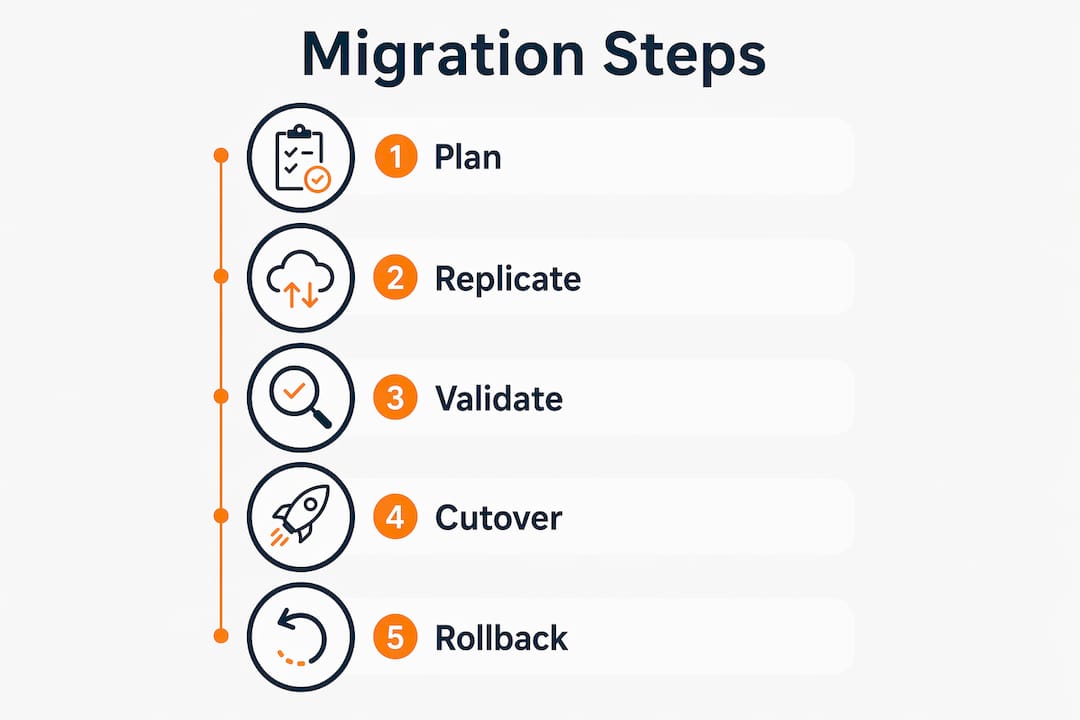
How to achieve zero downtime migration: a step-by-step process
A repeatable zero downtime migration process follows five phases. Skipping any phase increases the probability of a failed cutover.
- Evaluation and planning. Run the migration job in evaluation mode first. Oracle ZDM’s evaluation mode validates source and target configurations, network connectivity, and prerequisite checks without moving data. Fix every error before proceeding.
- Bulk data load. Copy the full dataset from source to target. This phase runs while the source stays live. Record the exact log sequence number or SCN (System Change Number) at the point the bulk load completes. This number defines your consistency boundary.
- Continuous replication. Start CDC streaming from the consistency boundary forward. Monitor replication lag continuously. The target must stay within your defined lag threshold before you schedule cutover.
- Cutover execution. Stop writes to the source briefly. Allow replication to drain completely. Redirect application traffic to the target. Validate data integrity on the target before releasing the source write lock.
- Post-migration validation. Run automated data comparison checks between source and target. Monitor application error rates, query latency, and connection behavior for at least 24 hours. Keep the source available in read-only mode as a fallback.
Multiple dry runs and pause/resume controls reduce the risk of unexpected production issues and shrink the blast radius if something goes wrong. Oracle ZDM’s ZDMCLI commands let operators pause a migration after any phase and resume it later by job ID. This is not just a convenience feature. It is a risk management tool for migrations that span maintenance windows or hit unexpected replication lag spikes.
Application-layer coordination runs in parallel with data replication. Traffic rerouting and schema compatibility rehearsals must be tested before cutover, not assumed. A database that replicates perfectly can still cause application failures if the target schema has a column type mismatch or a missing index.
Pro Tip: Set a hard go/no-go decision point 30 minutes before your scheduled cutover. If replication lag is above threshold, connection counts are abnormal, or any validation check is red, abort and reschedule. A postponed cutover costs nothing. A failed one costs everything.
For teams planning AWS cloud migrations, these same phases apply regardless of the source database engine. AWS Database Migration Service (AWS DMS) supports CDC-based online migration for most major database engines, making the five-phase process directly applicable to AWS target environments.
Key Takeaways
Zero downtime migration succeeds when continuous replication, consistency boundary validation, and rehearsed cutover procedures work together as a single coordinated process.
| Point | Details |
|---|---|
| Define the consistency boundary | Validate the alignment point between bulk load and CDC streaming to prevent silent data mismatches. |
| Use evaluation mode first | Run Oracle ZDM or equivalent tools in evaluation mode to catch configuration errors before production. |
| Monitor replication lag actively | Set hard lag thresholds and pause migration if the target falls behind before cutover. |
| Design for reversibility | Build rollback paths at every phase, not just at the final cutover step. |
| Rehearse cutover as a production event | Run at least two full dry runs with the same team and runbook used in production. |
The complexity cost nobody budgets for
After working through dozens of cloud migrations, the pattern I see most often is this: teams budget for tools and infrastructure but not for operational complexity. Zero downtime migration is not just a technical method. It is an operational discipline that requires people, processes, and observability infrastructure to be in place before the first replication job starts.
The tools have matured significantly. Oracle ZDM, AWS DMS, and CDC platforms like Streamkap handle the mechanics well. What still fails migrations is the human layer: no rehearsed runbook, no defined go/no-go criteria, no one assigned to watch replication lag at 2 a.m. I have seen teams with excellent tooling lose hours at cutover because nobody had authority to make the abort call.
The other thing I would push back on is the framing of “zero” downtime. Online migrations typically incur under 15 minutes of downtime in realistic conditions. That is genuinely close to zero for most business contexts, but planning as if it will be exactly zero sets teams up for a bad surprise. Plan for a 15-minute window, execute for seconds. That gap gives you room to breathe.
The importance of reversibility cannot be overstated. Every migration I have seen go wrong had one thing in common: no tested rollback path. Build the rollback before you build the migration. Test it before you test the migration. That sequence sounds backwards, but it is the right order. Knowing you can get back to safety changes how confidently your team executes the forward path.
— Oleksandr
AWS migration support for production-grade cloud moves
IT-Magic has completed 700+ AWS migrations as an AWS Advanced Tier Partner, with deep specialization in high-load eCommerce and fintech environments where downtime directly affects revenue.
For teams that need to move to AWS without risking availability, IT-Magic covers the full migration lifecycle: infrastructure audit, strategy selection, hands-on execution, and post-migration validation. Whether your workload calls for CDC-based online migration, a blue/green deployment pattern, or a phased rehost approach, the AWS migration services team takes full ownership of outcomes, not just planning. If you are also thinking about long-term scalability after migration, IT-Magic’s post-migration optimization work addresses that directly.
FAQ
What is the difference between online and offline migration?
Online migration keeps the source system running during data transfer using continuous replication, resulting in near-zero downtime. Offline migration requires stopping source database updates, which causes planned downtime for the duration of the move.
How long does a zero downtime migration cutover take?
With CDC-based replication, the cutover window can be measured in seconds because only a brief write pause is needed before redirecting traffic. Oracle ZDM documentation puts the typical online migration downtime at under 15 minutes in production conditions.
What is a consistency boundary in CDC migration?
The consistency boundary is the exact log position where the bulk data load ends and CDC streaming begins. Validating this alignment point prevents silent data mismatches where rows written during the phase transition are missed on the target.
Can zero downtime migration be reversed if something goes wrong?
Yes, reversibility is a core design requirement. Zero downtime migration designs treat failures as survivable events, which means rollback paths must be built and tested at every phase before the migration begins.
What tools support zero downtime database migration?
Oracle ZDM integrates Oracle Data Guard, Oracle GoldenGate, RMAN, and Data Pump for Oracle workloads. AWS DMS supports CDC-based online migration for most major database engines. Blue/green deployment patterns, as described in the HashiCorp Well-Architected Framework, handle application-layer zero downtime alongside database moves.