TL;DR:
- Effective cloud migration depends on careful wave planning, empirical autoscaling design, and continuous security governance. Most failures stem from sequencing mistakes and unvalidated assumptions rather than technical issues. Building a DevOps culture ensures durable success through automation, ongoing validation, and shared team ownership.
Scalable infrastructure migration is the process of moving workloads to a cloud environment designed to grow or shrink with demand, without requiring manual intervention or architectural rework. For IT professionals and decision-makers, getting the scalable infrastructure migration steps right from the start determines whether you end up with a production-grade system or an expensive mess to untangle later. Tools like Terraform, Kubernetes, and AWS services are the building blocks, but the sequence and discipline around each step matter just as much as the tools themselves. This guide covers every phase, from discovery through post-migration governance, with the specificity your team needs to execute with confidence.
What are the essential prerequisites for scalable infrastructure migration?
Preparation is not optional. Teams that skip the discovery phase consistently hit avoidable problems during cutover, from missing dependencies to undersized compute.
The discovery and assessment phase runs weeks 1 through 6 in a typical engagement. During this window, you catalog every workload, map dependencies, and profile resource consumption. The cloud foundation build runs in parallel from weeks 4 through 10, which compresses the overall timeline without adding risk. Running both tracks simultaneously is one of the highest-leverage decisions you can make before a single server moves.
After assessment, assign a migration strategy to each workload using the 6 R’s framework: Rehost, Replatform, Repurchase, Refactor, Retire, or Retain. Each R carries a different cost, timeline, and complexity profile. Matching the right strategy to each workload prevents over-engineering low-priority systems and under-investing in critical ones.
The tooling layer needs to be in place before execution begins. Key tools and frameworks include:
- Terraform for Infrastructure as Code (IaC): version-controlled provisioning supports repeatable deployments, rollback, and CI/CD integration.
- Kubernetes for container orchestration: manages workload scheduling, health checks, and horizontal pod scaling.
- CI/CD pipelines: automate testing, deployment, and rollback under monitored approval gates, reducing manual error.
- Load and stress testing tools: establish empirical baselines for CPU, memory, and request latency before you define autoscaling policies.
- NIST CSF and NIST SP 800-53: provide the security control framework you will map to cloud-native implementations.
| Tool or Framework | Primary Role | Migration Phase |
|---|---|---|
| Terraform | Infrastructure provisioning and rollback | Foundation build and ongoing |
| Kubernetes | Container orchestration and scaling | Execution and post-migration |
| CI/CD pipelines | Automated deployment and testing | Execution and post-migration |
| NIST CSF / SP 800-53 | Security controls and compliance mapping | All phases |
| Load testing tools | Workload profiling for autoscaling | Pre-migration and validation |
How to plan and execute migration waves effectively
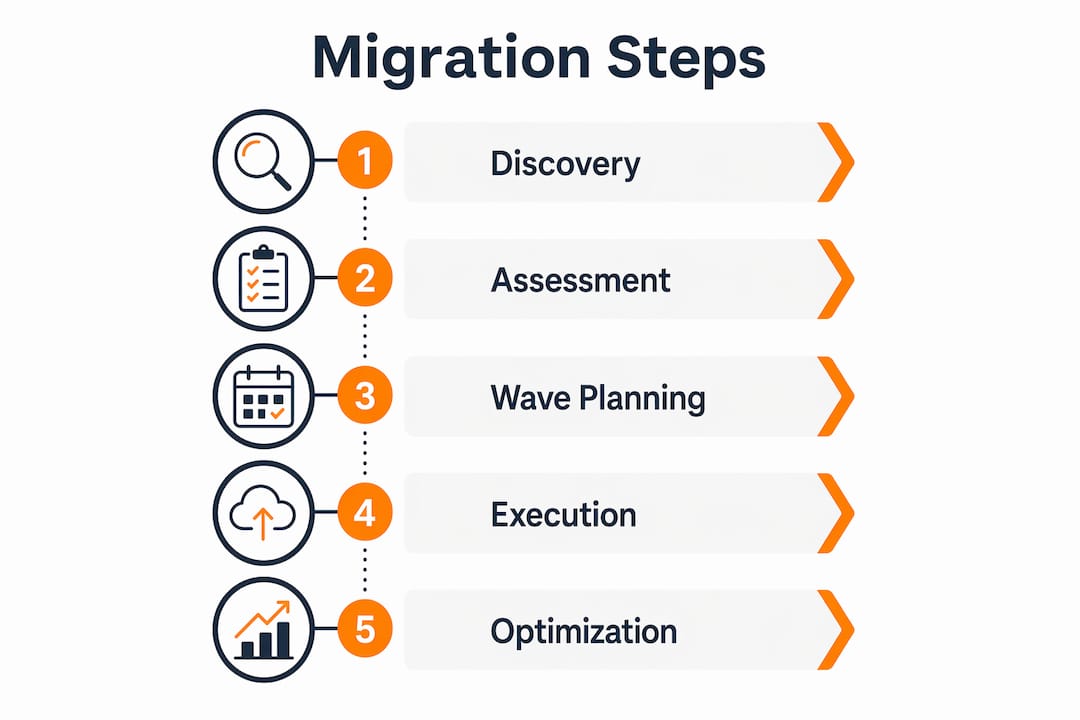
Wave planning is the practice of sequencing workloads into groups based on risk, dependency, and business priority. Teams that treat migration as a single cutover event almost always face extended downtime or rollback failures.

Start wave sequencing with the lowest-risk, lowest-dependency workloads. Dev and test environments, internal tools, and archived data are ideal first candidates. Moving these first lets your team validate the cloud foundation, test rollback procedures, and build operational confidence before touching revenue-generating systems.
A structured wave execution follows this sequence:
- Validate the cloud foundation. Confirm networking, IAM roles, logging, and monitoring are all operational before any workload moves.
- Execute the pilot wave. Move one or two non-critical workloads. Validate performance, security controls, and cost against your baseline.
- Run a phased cutover for each subsequent wave. Use blue/green or canary deployment patterns to shift traffic gradually. Never cut over 100% of traffic at once for production systems.
- Test rollback procedures before each wave. A rollback plan that has never been tested is not a rollback plan.
- Conduct post-wave retrospectives. Document what broke, what slowed down, and what the next wave needs to account for.
- Repeat with increasing workload complexity. Move toward stateful, high-load, and compliance-sensitive systems only after earlier waves are stable.
Pro Tip: Set a hard go/no-go checklist for each wave cutover. Include smoke tests, latency benchmarks, and a confirmed rollback path. Teams that skip this step spend more time recovering than they saved by moving fast.
Parallel workstreams reduce total migration duration significantly. While one team executes wave one, another team should be completing the dependency mapping and IaC templates for wave two. This overlap is how cloud migration strategies at scale stay on schedule without compressing quality.
Post-migration optimization is part of the wave plan, not an afterthought. Fine-tuning resource allocation and applying cost governance after each wave can deliver meaningful additional savings beyond the initial migration. Treat optimization as a standing sprint, not a one-time task.
How do you design for autoscaling and horizontal scale?
Architecture decisions made during migration determine whether your system actually scales under load or just runs in the cloud. The two are not the same.
Applications built for horizontal scale rely on stateless compute and externalized data. Stateless means no session data lives on the server itself. Externalized data means sessions, caches, and state live in services like Amazon ElastiCache or Amazon DynamoDB, not on the instance. This design makes autoscaling effective and keeps tail latency low under burst traffic.
Autoscaling policies must be grounded in empirical data. Workload profiling through load and stress tests defines the CPU, memory, and connection thresholds that trigger scale-out and scale-in events. Policies built on assumptions rather than measured data create bottlenecks at exactly the wrong moment.
| Scaling Approach | Best For | Key Requirement |
|---|---|---|
| Horizontal scaling | Stateless web and API tiers | Stateless app design, shared session store |
| Vertical scaling | Stateful databases (short term) | Instance type flexibility, maintenance window |
| Autoscaling groups | Variable traffic workloads | Empirical load test baselines |
| CDN and caching | Static assets, read-heavy APIs | Cache invalidation strategy |
Load balancers sit in front of every autoscaling group. AWS Application Load Balancer handles HTTP/HTTPS routing and health checks. Network Load Balancer handles TCP workloads requiring ultra-low latency. Choosing the wrong load balancer type for your traffic pattern adds latency and complicates troubleshooting.
Monitoring key metrics like CPU utilization, memory pressure, database connection pool usage, and request latency enables preemptive scaling before thresholds are breached. Reactive scaling, where you wait for an alert before acting, always arrives too late for high-traffic events.
Pro Tip: Build your autoscaling policies with a 20% headroom buffer above your measured peak load. Real traffic spikes are rarely as predictable as your load tests suggest, and the cost of over-provisioning by 20% is far lower than the cost of a degraded user experience.
How to structure security and governance for cloud migration
Security integrated at the start of a migration costs a fraction of what it costs to retrofit after go-live. Governance built as a continuous process, not a one-time audit, is what keeps you compliant at scale.
NIST CSF and NIST SP 800-53 provide structured control models that map directly to cloud-native service configurations. They also enable continuous compliance evidence generation, which is what auditors actually require. A one-time checklist does not satisfy FedRAMP, SOC 2, or PCI DSS. Continuous evidence does.
The AWS shared responsibility model defines the boundary between what AWS secures and what your team owns. AWS secures the physical infrastructure, hypervisor, and managed service internals. Your team owns OS configuration, application security, IAM policies, data encryption, and network controls. Misunderstanding this boundary is the most common source of compliance gaps in cloud migrations.
Key governance controls to implement from day one:
- IAM least-privilege policies: every service account and human user gets only the permissions required for their specific function.
- AWS CloudTrail and Config: log all API calls and track configuration changes across every resource.
- Automated compliance checks: use AWS Config Rules or tools like AWS Security Hub to flag policy violations in real time.
- Encryption at rest and in transit: enforce TLS 1.2 or higher for all data in transit; use AWS KMS for key management.
- Vulnerability scanning in CI/CD: integrate tools like Amazon Inspector into your pipeline so security checks run on every deployment, not just at launch.
Compliance in cloud migration is not a phase you complete. It is a control plane you operate continuously. Teams that treat it as a checkbox activity discover gaps during audits, not before them.
Key Takeaways
Successful cloud migration requires structured wave planning, empirical autoscaling design, and continuous security governance from day one.
| Point | Details |
|---|---|
| Run discovery and foundation in parallel | Overlapping these phases compresses total migration time without adding execution risk. |
| Use the 6 R’s to assign workload strategies | Match each workload to the right migration approach based on complexity and business priority. |
| Base autoscaling on measured load data | Policies built on assumptions create bottlenecks; use load and stress test results instead. |
| Design stateless compute from the start | Stateless apps with externalized state make autoscaling effective and reduce tail latency. |
| Treat security as a continuous control plane | Continuous evidence generation satisfies auditors; one-time checklists do not. |
What I have learned from 700+ migrations about what actually breaks
Most migration failures are not technical. They are sequencing failures. Teams move the wrong workload at the wrong time, skip the rollback test, or assume the autoscaling policy they wrote on paper will behave correctly under real traffic.
The wave planning section of any migration plan looks clean in a slide deck. Reality is messier. Dependencies that were not visible during discovery surface during cutover. A database that appeared stateless turns out to have session affinity baked into the application layer. These are not edge cases. They are the norm in any environment that has been running for more than three years.
The fix is not more planning time. The fix is empirical validation at every step. Run your load tests. Test your rollback. Validate your IAM policies against real API calls, not theoretical ones. The teams that execute cleanly are the ones that treat every wave as a production incident waiting to happen, and prepare accordingly.
Security is the area where I see the most overconfidence. Teams map their controls to NIST CSF, check the box, and move on. Six months later, a misconfigured S3 bucket or an over-permissioned IAM role surfaces in an audit. Continuous monitoring through cloud security best practices is not a nice-to-have. It is the only way to stay ahead of drift in a dynamic cloud environment.
The teams that succeed long-term are the ones that build a DevOps culture around their cloud infrastructure. Automation, continuous validation, and shared ownership between development and operations are what make a migration durable, not just complete.
— Oleksandr
AWS migration expertise that goes beyond the plan
IT-Magic has completed 700+ AWS migrations across eCommerce and fintech environments where downtime translates directly into lost revenue. The work does not stop at strategy. IT-Magic takes full ownership of execution, from infrastructure audit through post-migration optimization, so your team is not carrying the operational burden of a complex transition.
As an AWS Advanced Tier Partner, IT-Magic applies the right migration approach, whether rehost, replatform, or refactor, based on your specific workload profile and business constraints. Every engagement is built around measurable outcomes: reduced AWS spend, improved system performance, and architectures that hold up under real load. If you are ready to move to AWS without the guesswork, explore IT-Magic’s migration services and see what a fully managed migration looks like in practice.
FAQ
What are the first steps in a scalable infrastructure migration?
Start with a discovery and assessment phase to catalog workloads, map dependencies, and profile resource usage. Run the cloud foundation build in parallel to compress the overall timeline.
How does the 6 R’s framework apply to migration wave planning?
The 6 R’s framework assigns each workload a migration strategy based on complexity and business priority. This determines which workloads enter early waves and which require deeper refactoring before moving.
Why does autoscaling fail after migration?
Autoscaling fails when policies are based on assumptions rather than measured load data. Empirical workload profiling through load and stress tests is the prerequisite for reliable autoscaling behavior.
What security frameworks apply to cloud infrastructure migration?
NIST CSF and NIST SP 800-53 provide structured control models that map to cloud-native service configurations and support continuous compliance evidence generation for audits.
How long does a typical cloud migration take?
Timeline varies by environment complexity, but discovery typically runs weeks 1 through 6, with the cloud foundation build overlapping from weeks 4 through 10. Production workload migration follows in sequenced waves after the foundation is validated.