What is application modernization?
Application modernization is the process of updating legacy software systems to modern architectures, infrastructure, and codebases that meet current business, security, and performance requirements. That typically means moving away from monolithic, on-premises systems toward cloud-native, distributed designs that can scale on demand.
The scope is broader than most teams initially expect. Application modernization can include rehosting workloads on cloud infrastructure, refactoring code to eliminate technical debt, replatforming to a managed service, rebuilding an application from scratch, or retiring systems that no longer justify their maintenance cost. The right move depends on each application’s business value and technical condition.

One distinction worth locking in early: modernization is not the same as a lift-and-shift migration. Lift-and-shift reduces hosting costs but leaves legacy technical debt intact. Modernization requires deeper architectural changes that actually change how the software behaves, scales, and integrates.
Key aspects of application modernization:
- Updating programming languages, frameworks, and runtime environments
- Breaking monolithic applications into microservices or modular components
- Migrating from on-premises infrastructure to public, private, or hybrid cloud
- Adopting CI/CD pipelines and DevOps practices for faster, safer releases
- Improving security posture and compliance alignment
- Enabling integration with modern APIs, data platforms, and AI tooling
Table of Contents
- Why modernizing legacy applications is worth the investment
- Common modernization strategies: the 6 R’s explained
- Key technologies that power modern application architectures
- Measured business impact: what the data shows
- Challenges and risks you need to plan for
- How to plan and execute a modernization project
- How modernization changes your organization, not just your tech
- What modernization actually costs and how to budget for it
- Real-world modernization outcomes worth knowing
- IT-Magic handles the execution so your team doesn’t have to
- Key Takeaways
- FAQ
Why modernizing legacy applications is worth the investment
Legacy systems accumulate technical debt the way old buildings accumulate deferred maintenance. The longer you wait, the more expensive the fix. Common pain points include high maintenance costs, security vulnerabilities that vendors no longer patch, inability to scale under load, and friction integrating with modern SaaS tools or data pipelines.
The business case for modernization goes well beyond cost reduction. Organizations that modernize gain faster release cycles, better developer experience, and the ability to adopt cloud-native capabilities like auto-scaling and managed AI services. Modernization also shifts spending from capital expenditures on owned hardware to predictable operational expenses using PaaS models, which matters a lot to CFOs managing budget predictability.
One benefit that often gets underestimated: refactoring legacy applications recovers engineering capacity. Teams that spent most of their time on maintenance and firefighting can redirect that effort toward shipping product. That shift turns a cost-avoidance project into a revenue-generating one.
Pro Tip: Before building the business case, audit how your engineering team actually spends its time. If more than half of sprint capacity goes to keeping old systems alive, that number is your most persuasive argument for modernization funding.
Key reasons organizations modernize:
- Eliminate security vulnerabilities in unsupported software stacks
- Reduce infrastructure and licensing costs
- Improve system reliability and uptime
- Enable cloud and AI readiness
- Accelerate time-to-market for new features
- Free engineering teams from maintenance overhead
Common modernization strategies: the 6 R’s explained
The most widely used framework for application modernization strategies is the 6 R’s, adopted by both AWS and Azure as a structured way to categorize decisions at the portfolio level.
- Rehost (“lift-and-shift”): Move the application to cloud infrastructure with no code changes. Fast and low-risk, but preserves existing technical debt.
- Replatform: Make targeted optimizations during migration, such as moving to a managed database service, without changing core architecture.
- Refactor: Restructure the application’s code and architecture to take full advantage of cloud-native capabilities. Highest effort, highest long-term value.
- Rebuild: Rewrite the application from scratch using modern frameworks and cloud-native patterns. Justified when the existing codebase is beyond repair.
- Retire: Decommission applications that no longer serve a business purpose. Reduces portfolio complexity and frees budget.
- Retain: Keep certain applications in place, usually because they are stable, low-risk, or tied to a near-term replacement plan.
Selecting the right strategy requires scoring each application by business value and technical health. High-value, high-debt applications typically warrant refactoring or rebuilding. Low-value, low-debt systems are candidates for retention or retirement. This portfolio-level approach prevents teams from spending modernization budget on “zombie” applications that will never generate meaningful ROI.
AWS prescriptive guidance recommends starting with an MVP in roughly 12–16 weeks to deliver early business value before scaling the program across the full portfolio.
Key technologies that power modern application architectures
Modern applications are built on a stack of enabling technologies that work together. Understanding them helps you evaluate what your current environment is missing.
- Cloud infrastructure (IaaS/PaaS): The foundation. IaaS gives you virtual compute and storage; PaaS abstracts the underlying infrastructure so teams focus on code, not servers.
- Microservices: Decomposing a monolith into independently deployable services lets teams release, scale, and update components without touching the whole system.
- Containers and Kubernetes: Docker containers package application code with its dependencies; Kubernetes orchestrates them at scale. Together they make deployments portable and repeatable.
- Serverless computing: Functions-as-a-service (AWS Lambda, Azure Functions) eliminate server management entirely for event-driven workloads.
- CI/CD pipelines: Automated build, test, and deploy pipelines (GitHub Actions, AWS CodePipeline) compress release cycles from weeks to hours.
- API-driven integration: Modern applications expose and consume APIs, enabling clean integration with third-party services, data platforms, and AI models.
- Observability tooling: Distributed tracing, structured logging, and metrics dashboards (AWS CloudWatch, Datadog) give teams visibility into production behavior that legacy monitoring tools simply cannot provide.
Application modernization also involves updating programming languages and frameworks, which directly affects developer productivity and security patch availability. Critically, infrastructure modernization must accompany application changes. Modernizing code while leaving legacy infrastructure in place typically produces higher costs and worse performance.
Measured business impact: what the data shows
The business case for modernization is well-supported by survey data. Over 50% of IT leaders reported improvements in security posture, scalability, and system reliability following their modernization programs. Those three outcomes directly address the most common failure modes of legacy systems.
Cloud-native applications built on modern architectures can scale globally and respond within milliseconds, supporting millions of concurrent users. That kind of performance headroom is simply not achievable on a legacy monolith running on-premises hardware.
Additional business outcomes organizations typically see:
- Reduced infrastructure spend through right-sizing and managed services
- Faster feature delivery, compressing competitive response time
- Improved developer retention (engineers prefer modern stacks)
- Compliance readiness for frameworks like SOC 2, HIPAA, and PCI DSS
- Foundation for adopting AI and machine learning workloads
Challenges and risks you need to plan for
Modernization projects fail more often from underestimated complexity than from bad technology choices. The most common risks:
Scope creep is the biggest budget killer. Teams start with a targeted refactor and end up rewriting adjacent systems that were never in scope. A strict portfolio prioritization process prevents this.
Data migration risk is often more dangerous than application changes. Moving production databases without a tested rollback plan has ended more than a few modernization programs. Plan data migration as a separate workstream with its own validation gates.
Skill gaps slow execution significantly. Cloud-native development, Kubernetes operations, and CI/CD tooling require skills that many legacy-focused teams do not have in-house. Budget for training or bring in specialists early.
Organizational resistance is real and often underestimated. Teams that built and maintain legacy systems have institutional knowledge and, sometimes, institutional attachment. Change management is not optional.
Dependency mapping failures cause production outages. Legacy systems often have undocumented integrations. Discovering them mid-migration is expensive. A thorough discovery phase before any code changes is non-negotiable.
How to plan and execute a modernization project
A structured approach reduces risk and accelerates time to value. The steps that consistently produce better outcomes:
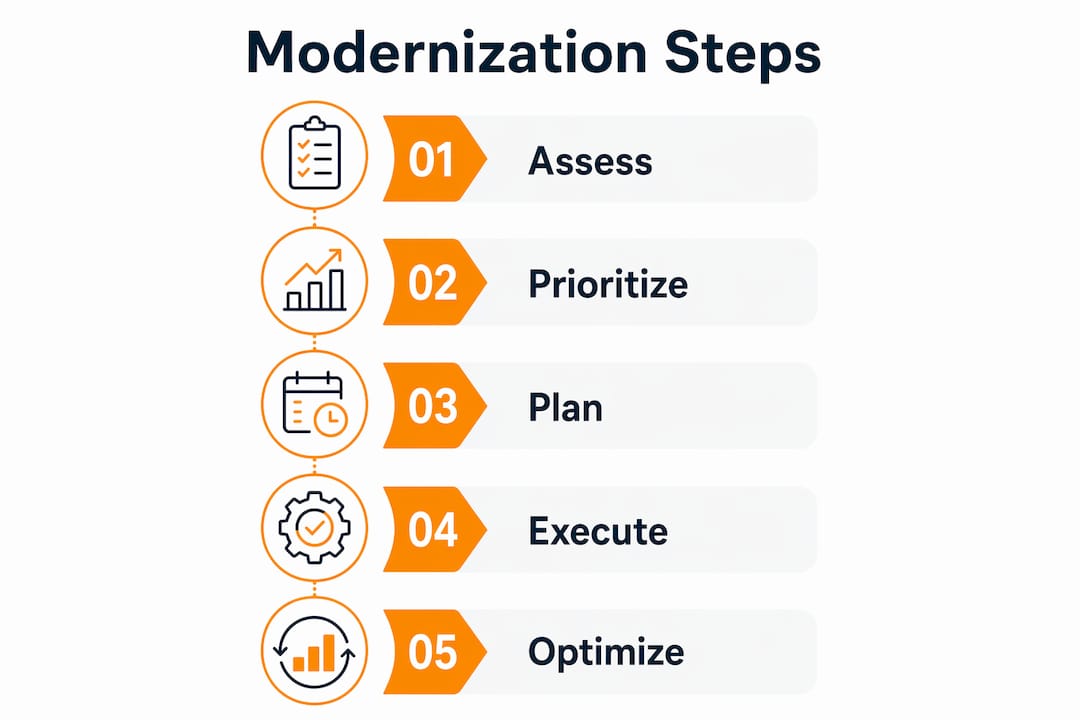
- Audit your portfolio. Score every application by business value and technical health. This tells you what to modernize, what to retire, and what to leave alone.
- Define success metrics upfront. Deployment frequency, mean time to recovery, infrastructure cost per transaction. Without baseline measurements, you cannot prove the program worked.
- Select strategies per application. Apply the 6 R’s framework. Not every application needs a full refactor.
- Start with a pilot. Pick one high-value, medium-complexity application. Deliver an MVP in 12–16 weeks. Use it to validate your tooling, process, and team capability before scaling.
- Modernize infrastructure in parallel. Leaving legacy infrastructure under modernized applications undermines the entire effort.
- Execute in waves. Incremental modernization programs executed in waves reduce risk and improve the odds of delivering measurable outcomes. Each wave builds on the last.
- Establish a cloud operating model. Governance, cost management, and security controls need to be in place before workloads go live, not after.
A solid AWS migration checklist covers the infrastructure and security prerequisites that teams frequently skip in the rush to migrate.
How modernization changes your organization, not just your tech
Application modernization reshapes how teams work, not just what they build on. The shift from quarterly release cycles to continuous delivery changes the relationship between development, operations, and the business. Product teams get faster feedback loops. Operations teams move from reactive firefighting to proactive reliability engineering.
That transition requires deliberate change management. Training programs, updated job descriptions, and new team structures (platform engineering, SRE) often accompany large modernization programs. Organizations that treat modernization as purely a technical project and skip the people side consistently struggle with adoption and long-term sustainability.
The cloud-first mindset that drives the most successful modernization programs is as much cultural as technical. Teams need to own their services end-to-end, which means accountability structures have to change alongside the architecture.
What modernization actually costs and how to budget for it
Modernization costs vary widely based on application complexity, chosen strategy, and team capability. A rehost is cheap and fast. A full rebuild of a core business system can run for 12–18 months and require significant investment in both people and tooling.
The more useful framing is total cost of ownership over a 3–5 year horizon. Legacy systems carry hidden costs: licensing fees for unsupported software, manual processes that compensate for missing automation, security incidents, and the opportunity cost of engineering time spent on maintenance. Those costs rarely appear in a single budget line, which is why modernization proposals often face skepticism.
Budget categories to account for:
- Discovery and assessment (portfolio scoring, dependency mapping)
- Migration and refactoring labor (internal or contracted)
- Training and upskilling
- Tooling and platform costs during transition
- Testing, validation, and rollback planning
- Post-migration optimization (right-sizing, cost governance)
Cloud platforms shift spending from CapEx to OpEx, which helps budget predictability. But cloud costs can grow unexpectedly without proper governance. Build cost monitoring and tagging standards into the program from day one, not as an afterthought. Resources on reducing IT costs without sacrificing performance can help frame the financial conversation with leadership.
Real-world modernization outcomes worth knowing
The patterns that show up repeatedly in successful modernization programs:
A mid-size financial services firm running a monolithic Java application on aging on-premises hardware refactored to microservices on AWS over 14 months. The result: deployment frequency went from monthly releases to multiple deploys per week, and infrastructure costs dropped materially after right-sizing on managed services.
An e-commerce platform facing seasonal traffic spikes that regularly caused outages replatformed its order management system to AWS, adopting auto-scaling and managed RDS.
The next peak season ran without a single availability incident.
These outcomes are not exceptional. They reflect what happens when modernization is executed with clear portfolio prioritization, phased delivery, and infrastructure changes running alongside application changes. The IT-Magic case studies page documents similar patterns across eCommerce and fintech environments where downtime translates directly into lost revenue.
IT-Magic handles the execution so your team doesn’t have to
Most modernization programs stall not because of bad strategy, but because execution is harder than planning. IT-Magic is an AWS Advanced Tier Partner with 700+ completed migration and modernization projects, specializing in the high-load, high-stakes environments where getting it wrong is expensive: eCommerce and fintech.
The difference from a typical consulting engagement is ownership. IT-Magic covers the full lifecycle, from infrastructure audit and strategy through hands-on implementation and post-migration optimization, applying rehost, replatform, or refactor based on what each workload actually needs. Your team stays focused on the business while the migration runs.
If your organization is carrying legacy technical debt and needs a clear path to AWS without downtime risk or cost overruns, start with a migration assessment to see what the right approach looks like for your specific environment.
Key Takeaways
Application modernization delivers the most value when portfolio prioritization, phased execution, and infrastructure changes run together from the start.
| Point | Details |
|---|---|
| Modernization vs. migration | Lift-and-shift cuts hosting costs but preserves technical debt; true modernization requires architectural changes. |
| The 6 R’s framework | Rehost, Replatform, Refactor, Rebuild, Retire, and Retain give teams a structured way to assign the right strategy per application. |
| Proven business impact | Over 50% of IT leaders reported improvements in security, scalability, and reliability after modernization programs. |
| Start with a phased MVP | AWS prescriptive guidance recommends delivering an MVP in 12–16 weeks to prove value before scaling the program. |
| IT-Magic for execution | IT-Magic manages the full modernization lifecycle on AWS, with 700+ completed projects in eCommerce and fintech environments. |
FAQ
What is application modernization in simple terms?
Application modernization is the process of updating legacy software to run on modern, cloud-native infrastructure using current architectures, languages, and practices. The goal is better performance, security, and scalability.
How is modernization different from cloud migration?
Cloud migration (lift-and-shift) moves an application to the cloud without changing its code or architecture. Modernization goes further, restructuring the application itself to eliminate technical debt and take advantage of cloud-native capabilities.
What are the most common application modernization strategies?
The 6 R’s: Rehost, Replatform, Refactor, Rebuild, Retire, and Retain. The right choice depends on each application’s business value and technical health, assessed at the portfolio level.
How long does an application modernization project take?
A focused pilot delivering an MVP typically takes roughly 12–16 weeks, per AWS prescriptive guidance. Full portfolio modernization programs usually run in waves depending on scope and complexity.
Can IT-Magic help with application modernization on AWS?
Yes. IT-Magic is an AWS Advanced Tier Partner that manages the full modernization lifecycle, from discovery and strategy through implementation and post-migration optimization, with 700+ completed projects across eCommerce and fintech.