For enterprise CIOs, the right AWS migration partner is an AWS Advanced Tier Partner that takes full ownership of secure, zero-downtime cutover and post-migration DevOps — not a vendor that hands you a plan and walks away. The distinction matters because large migrations fail at execution, not at planning. Before reading further, the fastest next step is to request a free infrastructure audit from IT-Magic at Awsmigrationservices to get a prioritized wave plan and TCO estimate within days.
What separates a capable cloud service reseller from a risky one comes down to three signals:
- A documented migration factory with published runbooks and wave plans
- AWS Advanced Tier Partner status with verifiable large-migration project history
- Measurable outcomes in case studies (cost reduction percentages, uptime metrics, cutover windows)
Key Takeaways
Hiring an AWS Advanced Tier Partner with a documented migration factory, 700+ completed projects, and fixed-price accountability is the most reliable path to a secure, zero-downtime AWS migration.
| Point | Details |
|---|---|
| Migrate-first sequencing | Rehost 35–50% and replatform ~20% first; reserve refactoring for the ~10% that drives competitive advantage. |
| Three-phase structure | Every engagement must map to Assess, Mobilize, and Migrate & Modernize with documented deliverables at each gate. |
| Runbook as proof of capability | Ask for a redacted sample runbook before shortlisting; a partner who cannot share one likely does not have a mature factory. |
| Fixed-price accountability | Fixed-price engagements align vendor incentives with your outcomes; use MAP-funded assessments to validate scope first. |
| IT-Magic’s audit | IT-Magic delivers a free audit covering security posture, wave plan, TCO estimate, and a sample runbook as the first step. |
Table of Contents
- Why should you hire a specialist AWS migration reseller?
- What does an enterprise migration engagement actually cover?
- How do zero-downtime migrations actually get executed?
- How do you evaluate and select the right AWS migration vendor?
- What IT-Magic delivers and why 700+ projects matter
- How are enterprise migration engagements priced?
- What does good post-migration operations look like?
- What most CIOs get wrong about large AWS migrations
- IT-Magic’s free audit gets you a wave plan in days
- Sources
- FAQ
Why should you hire a specialist AWS migration reseller?
Internal IT teams are built to run systems, not to migrate hundreds of workloads under deadline pressure. The operational model for a large migration is fundamentally different: it requires a parallel workstream structure, dedicated runbook authors, and tooling that most internal teams have never configured at scale.
The Migration Lens of the AWS Well-Architected Framework explicitly recommends engaging AWS Professional Services or certified Migration Competency Partners when enterprises need to accelerate readiness. That recommendation exists because the six Well-Architected pillars (security, reliability, performance efficiency, cost optimization, operational excellence, and sustainability) each require active attention during migration phases, not just post-cutover.
Key benefits of hiring a specialist over running migration internally:
- Reduced downtime risk: Specialists run blue/green and canary cutovers routinely; internal teams typically do it once.
- Runbook and automation depth: A mature partner brings pre-built runbooks for common workload types, cutting wave setup time significantly.
- Security and compliance coverage: Regulated industries (fintech, healthcare) need Well-Architected alignment baked into the landing zone from day one.
- Speed to value: A migration factory operating model compresses timelines that would otherwise stretch across years.
- Measurable outcomes: Experienced partners can commit to cost-reduction targets because they have the data from prior engagements.
Common migration risks — security gaps, skills shortages, and runaway FinOps spend — are well-documented challenges that specialist partners are specifically structured to absorb.
Pro Tip: During vendor screening, ask to see a sample runbook for a workload type similar to yours. A mature partner will share a redacted version immediately. If they hesitate or describe it as proprietary, that is a signal their runbooks may not exist in the form they claim.
What does an enterprise migration engagement actually cover?
AWS Prescriptive Guidance defines three phases for enterprise cloud migration: Assess, Mobilize, and Migrate & Modernize. Each phase has concrete deliverables a procurement team should verify before signing.
| Phase | Duration | Key Deliverables |
|---|---|---|
| Assess | 2–6 weeks | Discovery report, complexity scoring, business case, TCO model |
| Mobilize | 1–3 months | Landing zone, security baseline, wave plan, runbook templates, test plan |
| Migrate & Modernize | Varies by scope | Wave execution, cutover runbooks, post-migration validation, optimization |
The migration factory operating model structures execution into an initialize stage (runbook creation, landing zone validation, team training) followed by an implement stage (wave-by-wave execution with continuous improvement loops). Four workstreams run in parallel: portfolio, migration, governance, and foundation.

For a typical enterprise portfolio, AWS guidance favors a migrate-first approach with roughly 35–50% of workloads rehosted, ~20% replatformed, and ~10% refactored. The remaining workloads are retired, retained, or repurchased. Trying to refactor everything upfront is the single most common reason enterprise migrations stall.
Procurement checklist for the Mobilize phase deliverables:
- Automated discovery report with metadata and dependency mapping
- Complexity scoring per workload (using tools like AWS Application Migration Service)
- Prioritized wave plan with sequencing rationale
- Security and compliance evidence (IAM baseline, encryption standards, regulatory controls)
- Cutover runbooks with rollback criteria
- Test plan covering UAT, performance, and disaster recovery scenarios
How do zero-downtime migrations actually get executed?
Zero-downtime is an outcome of process discipline, not a feature you toggle on. The Cloud Migration Factory pattern documents an automation-first approach to rehosting at scale, with AWS MGN as the primary replication engine and a project management layer that tracks wave status, blockers, and cutover readiness.
Core tooling in a mature migration factory:
- AWS Application Migration Service (AWS MGN): Continuous block-level replication with sub-second RPO for rehost scenarios
- AWS Database Migration Service (AWS DMS): Schema conversion and ongoing CDC replication for database cutovers with minimal downtime
- Cloud Migration Factory pattern: Orchestration layer for wave management, runbook execution, and status tracking
- Discovery tools (AWS Application Discovery Service, third-party agents): Automated dependency mapping and complexity scoring
Cutover sequence for a zero-downtime wave:
- Shadow testing: run the migrated environment in parallel for 48–72 hours under production load
- Pre-cutover health check: validate latency, transactions per second, error rate, and data consistency against baseline
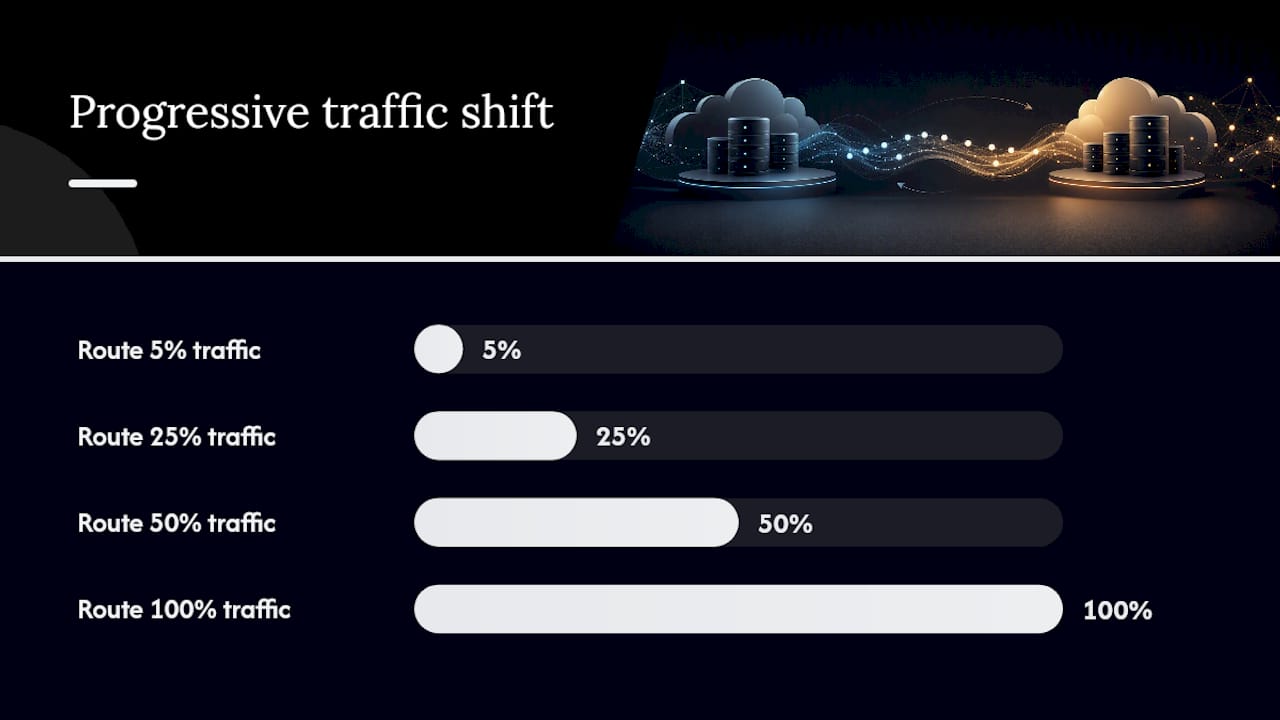
- Progressive traffic shift: route 5% → 25% → 50% → 100% using weighted routing or load balancer rules
- Final sync and cutover gate: confirm replication lag is under threshold, then execute final sync
- Post-cutover validation: run the health-check matrix for 2–4 hours before decommissioning source
Health-check matrix (pre/during/post cutover):
| Metric | Pre-Cutover Baseline | Cutover Gate | Post-Cutover Target |
|---|---|---|---|
| API latency | Measured from source | Within 10% of baseline | Within 5% of baseline |
| Transactions per second | Measured from source | No degradation | Equal or better |
| Error rate | Measured from source | Below 1% | Below source baseline |
| Data consistency | 100% | Replication lag under 5 sec | Verified via checksums |
Rollback criteria should be defined in writing before cutover begins. If any health-check gate fails, the runbook must specify the exact trigger condition and the responsible engineer.
How do you evaluate and select the right AWS migration vendor?
Vendor selection is where most CIOs spend too little time. A polished deck and a reference from a different industry vertical are not sufficient evidence of large-migration capability.
Evaluation checklist:
- Confirm AWS Advanced Tier Partner status (or higher) directly on the AWS Partner Network directory
- Ask for a count of completed large-migration projects (100+ workloads) with named industry verticals
- Request a sample wave plan and a redacted cutover runbook
- Verify toolchain: do they use AWS MGN and AWS DMS, or are they proposing manual lift-and-shift?
- Ask how they handle security and compliance during migration (landing zone design, IAM, encryption, audit logging)
- Confirm Well-Architected review cadence and who owns remediation
- Ask for two references from migrations of comparable scale and complexity
RFP questions worth including verbatim:
- “Describe your migration factory operating model and how you size and sequence waves.”
- “What is your documented rollback procedure if a cutover fails at 3 AM?”
- “How do you handle CDC replication lag for databases during the cutover window?”
- “What SLAs do you commit to for post-migration incident response?”
- “Can you provide a case study showing cost reduction and uptime metrics from a migration in our industry?”
Red flags to watch for:
- Runbooks described as “customized per engagement” with no sample available
- No measurable outcomes in case studies (only narrative descriptions)
- Proposed toolchain relies entirely on manual scripts rather than AWS MGN or DMS
- No references for migrations above 50 workloads
- Vague answers about security controls during the migration window
Selecting the right partner reduces risk and accelerates outcomes; documented runbooks and a clear operations handoff are the two criteria that most reliably separate capable partners from those who will struggle at scale.
What IT-Magic delivers and why 700+ projects matter
IT-Magic operates as a focused AWS migration reseller with an execution model built around the migration factory pattern. The approach runs from discovery through post-migration DevOps: infrastructure audit, complexity scoring, wave planning, runbook-driven cutover, and an optional DevOps-as-a-Service retainer for ongoing optimization.
Credentials and proof points:
- AWS Advanced Tier Partner with verified migration competency
- 700+ completed migration projects across eCommerce, fintech, SaaS, and healthcare
- Specialization in high-load, regulated environments where downtime translates directly to revenue loss
- Published case studies with measurable outcomes: reduced AWS spend, improved throughput, and resilient architectures
What an initial audit from IT-Magic includes:
- Current security posture assessment against Well-Architected standards
- TCO estimate with right-sizing recommendations
- Prioritized wave plan with complexity scoring per workload
- Sample runbook for your most representative workload type
The migrate-first approach IT-Magic applies keeps the initial migration scope focused on rehost and replatform, reserving refactoring budget for the ~10% of workloads that genuinely drive competitive advantage.
How are enterprise migration engagements priced?
| Model | Best For | What You Get | Risk Profile |
|---|---|---|---|
| Fixed-price project | Defined scope, clear wave plan | Predictable cost, vendor owns outcomes | Low for buyer |
| Time-and-materials | Exploratory or rapidly changing scope | Flexibility, but cost can drift | Higher for buyer |
| Retainer / MSP | Post-migration ops and DevOps-as-a-Service | Ongoing optimization, SLA-backed support | Shared |
Primary cost drivers in any migration engagement:
- Portfolio size and workload complexity (number of servers, databases, dependencies)
- Data transfer volume and network architecture changes
- Security and compliance requirements (PCI-DSS, HIPAA, SOC 2 scope)
- Refactoring scope within the portfolio
- Timeline pressure (compressed timelines require more parallel resources)
Vendor/consultant estimates suggest mid-complexity enterprise migrations commonly run 6–18 months and can reduce operating costs 20–30% after right-sizing, per Cleveroad’s migration cost analysis.
Pro Tip: Before committing to a fixed-price engagement, use a MAP-funded assessment (available through the AWS Migration Acceleration Program) to validate scope and complexity. It de-risks the fixed-price commitment for both sides and often surfaces workloads that would have blown the original estimate.
What does good post-migration operations look like?
Cutover is not the finish line. The 90 days after go-live determine whether the migration delivers its promised economics or quietly drifts back toward the cost and reliability profile of the old environment.
Post-migration services a mature partner should provide:
- Managed monitoring with defined alert thresholds and escalation paths
- Incident response with documented MTTR targets (typically under 30 minutes for P1)
- Automated backups and tested restore procedures
- Patch management and security scanning cadence
- FinOps and cost optimization (Reserved Instance coverage, Savings Plans, right-sizing reviews)
- Continuous performance tuning against the Well-Architected baseline
First 90 days operations checklist:
| Activity | Cadence | Owner |
|---|---|---|
| Cost anomaly review | Weekly | FinOps / MSP |
| Security posture audit | Monthly | Security / MSP |
| Performance baseline review | Bi-weekly | DevOps / MSP |
| Backup restore test | Monthly | MSP |
| Well-Architected review | 90-day post-cutover | Partner + CIO |
Applying the AWS Well-Architected Framework post-migration as a structured review at the 90-day mark catches the gaps that cutover pressure inevitably leaves behind. The decision to transition from MSP to internal ops typically makes sense when the team has absorbed the new architecture, runbooks are documented, and cost optimization has plateaued.
What most CIOs get wrong about large AWS migrations
The conventional wisdom says the hard part is the technical execution. It is not. The hard part is scope discipline.
Every large migration I have analyzed that ran over budget and over schedule had the same root cause: the team tried to modernize too much, too early. Refactoring a legacy monolith while simultaneously migrating 300 other workloads is not a migration. It is two programs running in parallel with one budget and one deadline.
The migrate-first principle is not a compromise. It is the correct sequencing. Get the portfolio to a stable cloud foundation first. That sequencing gives you a working cloud environment in months, not years, and it gives your team the operational experience to make better refactoring decisions.
The other pitfall is treating the cutover runbook as a formality. A runbook that has never been rehearsed is a wish list. The partners worth hiring are the ones who insist on dry runs, who define rollback triggers before the cutover window opens, and who have a named engineer on call for every wave. That level of process discipline is what “zero-downtime” actually means in practice.
IT-Magic’s free audit gets you a wave plan in days
Zero-downtime AWS migration at enterprise scale requires more than good intentions. IT-Magic delivers fixed-price migration engagements backed by 700+ completed projects, AWS Advanced Tier Partner credentials, and a migration factory model that has been tested across eCommerce, fintech, and regulated healthcare environments.
A free introductory audit from IT-Magic includes:
- Security posture assessment against Well-Architected standards
- Prioritized wave plan with complexity scoring
- Estimated TCO savings with right-sizing recommendations
- Sample runbook for your most representative workload
Schedule your audit at Awsmigrationservices and get a concrete migration plan, not a slide deck.
Sources
FAQ
What does an AWS migration reseller actually do?
An AWS migration reseller (more precisely, an AWS migration services partner) plans and executes the full migration lifecycle: infrastructure audit, wave planning, runbook-driven cutover, and post-migration DevOps. They take ownership of outcomes, not just deliverables.
How long does an enterprise AWS migration take?
The initialize stage typically runs 1–3 months; implementation varies by portfolio size and complexity. Mid-complexity enterprise migrations commonly run 6–18 months end to end, per vendor and consultant estimates.
What is the AWS Migration Acceleration Program (MAP)?
MAP is an AWS-funded program that provides assessment credits and incentives to enterprises migrating to AWS. It can fund the initial discovery and assessment phase, reducing the financial risk of a fixed-price commitment.
How do I verify an AWS partner’s migration credentials?
Check the AWS Partner Network directory directly for Advanced Tier status and migration competency designations. Then ask the partner for a project count, industry verticals, and two references from migrations of comparable scale.
What should the first 90 days post-migration include?
Weekly cost anomaly reviews, bi-weekly performance baseline checks, monthly security audits and backup restore tests, and a formal Well-Architected review at the 90-day mark. IT-Magic’s DevOps-as-a-Service retainer covers all of these with defined SLAs.