Application dependency mapping (ADM) is the automated process of discovering and visualizing how application code, services, infrastructure, and third-party systems connect to each other, using signals like distributed traces, network flows, and configuration data. Done right, it shortens root-cause analysis during outages, makes change deployments safer, and turns cloud migrations from guesswork into sequenced, predictable waves. A solid map typically pulls from:
- Runtime traces and network flow logs
- Code and configuration repositories
- CI/CD deployment metadata
- Cloud provider inventories (EC2, containers, load balancers)
Key Takeaways
Application dependency mapping works because it replaces assumptions about how systems connect with evidence from actual runtime behavior, code, and traffic data.
| Point | Details |
|---|---|
| Combine static and dynamic signals | Code and config data alone miss what’s happening in production; pair them with runtime traces and flow logs. |
| Match method to environment | Use agent-based or sweep-and-poll for legacy systems, tracing and top-down mapping for cloud-native microservices. |
| Correlation is the hard part | Standardize tags for application, environment, and owner at build time to simplify matching across tools. |
| Validate with SMEs regularly | Assign ownership and a refresh cadence so maps don’t drift silently between incidents. |
| Use mapping for migration waves | IT-Magic groups applications by real dependencies to sequence AWS migrations without unexpected breakage. |
Table of Contents
- What Does Application Dependency Mapping Actually Cover?
- Which Dependency Mapping Method Fits Your Environment?
- How Are Dependency Maps Actually Built?
- What Business Outcomes Does ADM Actually Deliver?
- How Do You Keep a Dependency Map Accurate?
- What Tools Actually Support Dependency Mapping?
- How Does ADM Drive Successful AWS Migrations?
- A Practitioner’s View on What Actually Breaks Migrations
- Get a Zero-Downtime AWS Migration Built on Real Dependency Data
- Sources
- FAQ
What Does Application Dependency Mapping Actually Cover?
ADM is not the same as an asset inventory. A spreadsheet listing your servers tells you what exists. A dependency map tells you what talks to what, how often, and under what conditions it breaks. That distinction covers three layers: app-to-app calls (a checkout service calling a payments API), app-to-infrastructure links (a service tied to a specific database instance or load balancer), and external dependencies (third-party APIs, SaaS tools, licensed data feeds).
The harder distinction is between what your architecture diagram says should happen and what actually happens in production. A retailer’s documented architecture might show the order service calling inventory directly. In reality, six months of undocumented changes routed that call through a caching layer nobody updated the diagram for. Only runtime data catches that gap.
Effective mapping accounts for:
- Documented (static) relationships from code and config
- Observed (dynamic) relationships from live traffic
- Drift between the two, which is usually where incidents originate
Which Dependency Mapping Method Fits Your Environment?
Five methods dominate practice, and picking the wrong one for your environment wastes weeks. ServiceNow groups the main approaches into sweep-and-poll, network traffic analysis, agent-based instrumentation, and orchestration-driven top-down mapping, and static code analysis rounds out a fifth.
- Sweep-and-poll queries devices and services on a schedule. It’s low-friction but can miss short-lived connections between polls.
- Network/flow analysis watches traffic patterns passively. It catches real communication but struggles to identify what’s actually running inside each connection.
- Agent-based instrumentation installs collectors on hosts for granular, application-aware data. It’s precise but adds deployment overhead and isn’t always welcome in locked-down environments.
- Top-down/orchestration mapping uses container or cluster metadata (Kubernetes labels, for example) to infer structure. It works well for mission-critical services with consistent tagging, though it needs extra rules for anything that doesn’t follow the pattern.
- Static/code analysis reads source and manifest files to surface declared dependencies before anything runs.
Legacy data centers often lean on agent-based and sweep-and-poll methods. Cloud-native microservices tend to favor tracing and top-down mapping. Hybrid environments usually need two or three methods running together.
Pro Tip: Don’t pick one method and stop. Static analysis catches what’s declared; runtime traces catch what’s actually happening. Neither alone gives you the full picture.
How Are Dependency Maps Actually Built?
Building a usable map follows a consistent pipeline: discover assets, collect signals, correlate identifiers, visualize the result, then validate it against reality.
Discovery starts with an inventory pass across cloud accounts, on-prem hosts, and container clusters. Signal collection layers in code and config repositories, CI/CD deployment metadata, runtime traces, network flow logs, and cloud provider inventories. AWS combines X-Ray traces with CloudWatch Application and Container Insights and Migration Hub data to build exactly this kind of layered view, where traces show service-to-service call paths, CloudWatch adds infrastructure metrics, and Migration Hub visualizes dependencies for migration planning.

The hardest part in practice is correlation. Matching hostnames, resource IDs, container IDs, and trace or span metadata across tools requires normalization and heuristics, which is why teams that instrument consistent tags for application, environment, and owner at build time save themselves enormous pain later.
Visualization typically takes one of three forms: service maps showing live topology, call graphs tracing request paths through code, or searchable inventories for audit and compliance work.
Two pitfalls sink most first attempts:
- Naming drift, where the same service gets different labels across tools
- Incomplete traces from sampling, which can hide low-frequency but high-impact calls
What Business Outcomes Does ADM Actually Deliver?
The payoff shows up fastest in incident response. When a service degrades, an accurate map tells you immediately which downstream systems are affected instead of forcing an on-call engineer to page through service owners one by one. Runtime traces are described as the richest signal for service-to-service timing and relationship data, which is exactly what root-cause analysis depends on.
Beyond incidents, four use cases show up repeatedly:
- Migration planning: grouping applications into waves based on shared dependencies, so you don’t move a front-end service to AWS while its database stays on-prem
- Security and compliance: identifying transitive vulnerabilities and understanding blast radius when a shared library or service gets compromised, an approach Sonatype ties directly to software supply-chain risk management
- Change impact analysis: knowing what breaks before you deploy, not after
- Capacity and cost planning: seeing which services actually drive load on shared infrastructure
Teams that skip mapping before a migration routinely discover a “standalone” service still has three hardcoded connections to systems nobody remembered.
How Do You Keep a Dependency Map Accurate?
A map that’s accurate on day one and stale by month three is worse than no map, because people keep trusting it. Four practices keep it usable:
- Assign ownership. Someone specific, not a team in the abstract, is accountable for map accuracy, with a defined refresh SLA.
- Combine signal types on a schedule. Static analysis and runtime telemetry each catch what the other misses, and pairing them with subject-matter expert validation produces maps that reflect operational reality rather than architectural intent.
- Prioritize by blast radius. Fix mapping gaps for high-traffic, high-dependency services first. A stale map of a rarely used internal tool is a low priority; a stale map of your payment gateway is not.
- Wire updates into CI/CD. Every deployment is a chance for the map to drift, so treat map refreshes as part of the pipeline instead of a quarterly cleanup project.
Pro Tip: Set a recurring 30-minute review with service owners every quarter. It sounds small, but it’s usually the single highest-leverage habit for catching drift before an incident does.
What Tools Actually Support Dependency Mapping?
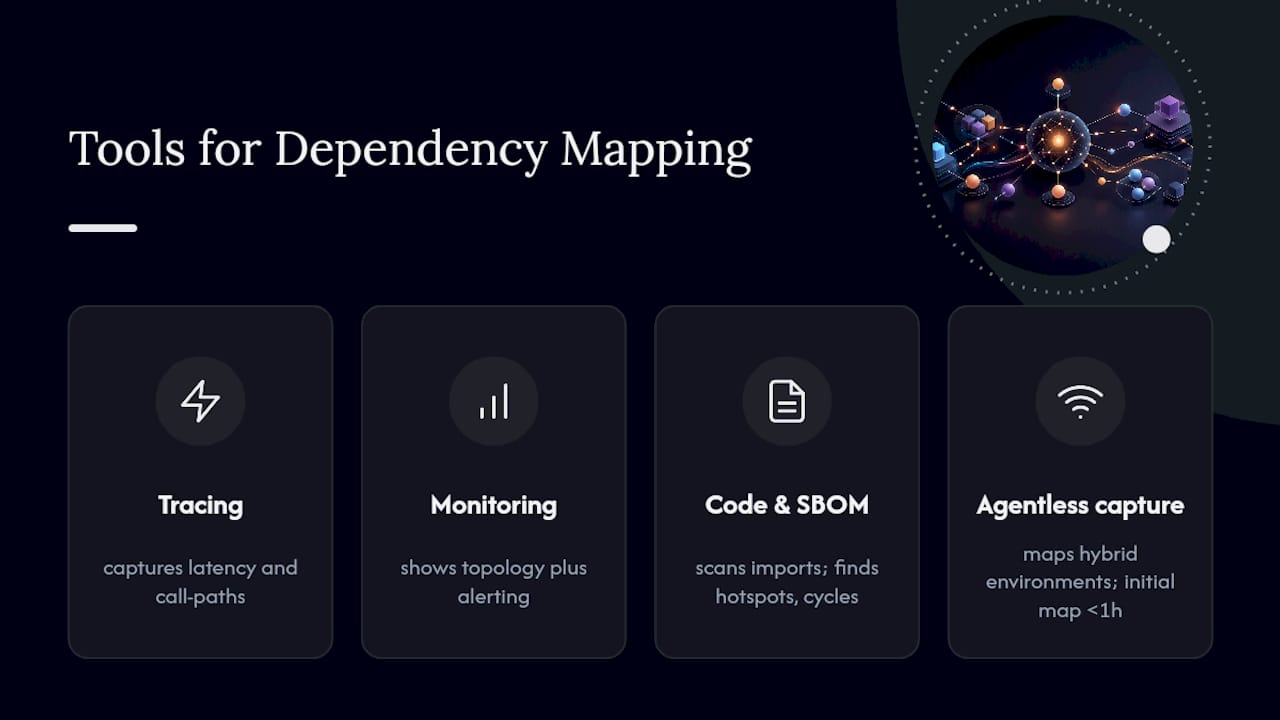
No single tool covers every layer, so most mature setups run four categories together. Distributed tracing tools capture latency and call-path data across services in real time, showing exactly where a request slows down. Monitoring platforms surface topology alongside alerting, so a spike and a dependency change show up in the same view. Code-level and SBOM tools, including project-level dependency visualizers that scan imports to surface hotspots and circular dependencies, give visibility into your software supply chain before code ever reaches production. Agentless traffic-capture tools round things out for hybrid environments, with some vendors able to produce an initial map in under an hour without touching every host.
The integration pattern matters as much as tool choice. Maps that live in a dashboard nobody checks during an incident are decorative. Wire dependency data into your incident response runbooks and change management approvals, so the map surfaces automatically when someone files a change ticket or an alert fires. Also worth building in: a link between your ITSM or CMDB and your dependency data, so configuration records stop drifting from what’s actually running.
How Does ADM Drive Successful AWS Migrations?
IT-Magic builds dependency maps as the first real step of every AWS migration, not an afterthought. Grouping applications by their actual dependencies, not their org chart, is what prevents the classic migration failure: moving a service to AWS only to discover it still needs a synchronous call to a database that stayed on-prem.
That mapping work does two things simultaneously. It groups applications into migration waves that can move together without breaking, and it gives you a baseline to validate against post-migration, so you can confirm the new environment behaves the way the old one did before cutting over traffic.
IT-Magic has extensive experience running this process across high-load eCommerce and fintech environments where an overlooked dependency can cause an outage. It causes a compliance incident or a lost transaction window.
A Practitioner’s View on What Actually Breaks Migrations
Most failed migrations don’t fail on infrastructure. They fail because someone trusted a dependency diagram that hadn’t been true in eight months. The lesson that holds up across every large migration: validate the map with the people running the service, every time, no exceptions.
Get a Zero-Downtime AWS Migration Built on Real Dependency Data
Reading about dependency mapping is one thing. Running a migration where an overlooked connection takes down checkout at 2 a.m. is another. IT-Migration builds every migration plan on top of a real dependency map, not a best guess from an old architecture diagram, which is exactly why we can commit to zero-downtime moves for high-load environments.
As an AWS Advanced Tier Partner with over 700 completed projects, we handle the full lifecycle: infrastructure audit, dependency discovery, wave sequencing, hands-on execution, and post-migration optimization. For teams running eCommerce or fintech workloads where downtime has a real dollar cost, that dependency work upfront is what keeps a migration boring instead of eventful. If you’re planning a move and want to know exactly which services depend on what before you touch anything, start with a free infrastructure audit from IT-Magic and see your migration waves mapped out before committing to a date.
Sources
- What is dependency mapping? — AWS
- What is dependency mapping? — ServiceNow
- Dependency mapping: a beginner’s guide — Sonatype
- Application dependency mapping: Definition, Process & Tools 2026 — CloudAware
- Dependency Visualizer (tool) — GitHub
FAQ
What Is Application Dependency Mapping?
Application dependency mapping is the automated discovery and visualization of how application code, services, infrastructure, and external systems connect, using signals like runtime traces, network flows, and code analysis to support incident response and migration planning.
What Are the Main Types of Application Dependencies?
Application dependencies generally fall into four categories: app-to-app connections (service calls), app-to-infrastructure links (databases, load balancers), data dependencies, and third-party or external service dependencies.
What Mapping Methods Do IT Teams Use Most?
The four primary approaches are sweep-and-poll, network traffic analysis, agent-based instrumentation, and orchestration or top-down mapping, often combined with static code analysis for a complete picture.
How Does ADM Help With AWS Migration Planning?
Dependency maps group applications into migration waves based on real, observed relationships, which helps teams like IT-Magic sequence moves without stranding a service from a database or API it still needs.
How Often Should Dependency Maps Be Updated?
Maps should refresh continuously through CI/CD integration for high-traffic services, with a quarterly manual validation cycle involving subject-matter experts to catch drift automated collection misses.