TL;DR:
- Cloud governance is a framework of policies and controls that guide secure, compliant, and cost-effective cloud resource use. It automates continuous compliance, enforces policies at account creation, and aligns cloud adoption with business goals for faster, safer operations. Implementing governance as an engineering discipline ensures scalability, consistency, and measurable ROI within a few months.
Cloud governance is defined as the framework of policies, controls, and processes that guide how an organization uses cloud resources to maintain security, compliance, cost control, and operational consistency. The role of cloud governance has grown from a compliance checkbox into the operational backbone of any serious cloud program. Without it, self-service provisioning and elastic scaling create unchecked resource sprawl, security gaps, and budget overruns that compound faster than any team can manually track. Platforms like Azure Policy, AWS Control Tower, and Google Cloud’s Adaptive Governance Framework exist precisely because manual oversight does not scale. This guide breaks down how governance works, what a sound framework looks like, and why IT leaders who treat it as an enabler rather than a constraint move faster and spend less.
What is the role of cloud governance in mitigating cloud risks?
Cloud governance addresses the specific risks that come with cloud elasticity and self-service provisioning. When any developer can spin up a virtual machine or storage bucket in minutes, the attack surface and cost exposure grow in parallel. Cloud governance establishes guardrails that prevent unchecked resource growth, cost spikes, security vulnerabilities, and compliance violations before they occur.
The risks governance must contain fall into three categories:
- Security exposure. Misconfigured storage buckets, overly permissive IAM roles, and unencrypted data at rest are the most common cloud breach vectors. Governance enforces baseline security controls at the account level so no workload launches without them.
- Cost overruns. Without spending limits and tagging requirements, cloud bills become unpredictable. Governance applies budget alerts, resource quotas, and mandatory cost allocation tags so finance and engineering share the same picture.
- Compliance violations. Regulations like HIPAA, PCI DSS, and SOC 2 require documented controls and audit trails. Governance automates evidence collection so compliance is continuous, not a quarterly scramble.
Microsoft’s Azure landing zone guidance treats identity and access management as the first governance design area, recognizing that access control failures are the root cause of most cloud security incidents. Scality similarly frames governance as the mechanism that converts cloud flexibility from a liability into a controlled asset.
Pro Tip: Start governance enforcement at account creation, not after workloads are running. Retrofitting controls onto existing environments costs three to five times more effort than building them into the landing zone from day one.

How does cloud governance automate continuous compliance?
Continuous compliance is the practice of validating controls in real time rather than during periodic audits. The mechanism that makes this possible is policy as code, where governance rules are written as machine-readable definitions and enforced automatically by the platform.
Here is how a mature continuous compliance pipeline works:
- Policy authoring. Engineers write policies in tools like Azure Policy, Open Policy Agent, or Terraform Sentinel. Policies define what is allowed, what is denied, and what triggers an alert.
- Automated enforcement. The platform evaluates every resource change against active policies. Non-compliant resources are either blocked at creation or flagged for remediation, depending on the policy mode.
- Evidence collection. Automated evidence pipelines capture configuration states, access logs, and change records on a defined cadence. This replaces manual screenshot collection before audits.
- Audit-ready reporting. Dashboards in tools like AWS Security Hub, Azure Compliance Manager, or Google Cloud Security Command Center aggregate findings into reports auditors can consume directly.
Google Cloud’s Adaptive Governance Framework applies software engineering principles to policy authoring, including global policy repositories, automated tests, and version control. That approach reduces enforcement errors and makes policy changes traceable. The GitHub compliance-automation-framework takes a similar position, treating evidence freshness and repeatability as first-class requirements rather than afterthoughts.
“Manual governance processes do not scale for large multi-account cloud estates. Automatic enforcement at account creation is the only reliable way to prevent controls from being bypassed.” — Cloud Governance Frameworks: Compliance and Control, Cloudmagazin
The shift from manual reviews to automated enforcement is not just about efficiency. It removes the human bottleneck that slows cloud adoption. Teams can deploy faster when they know guardrails will catch violations automatically, rather than waiting for a change advisory board to review each request.
What are the core components of a cloud governance framework?
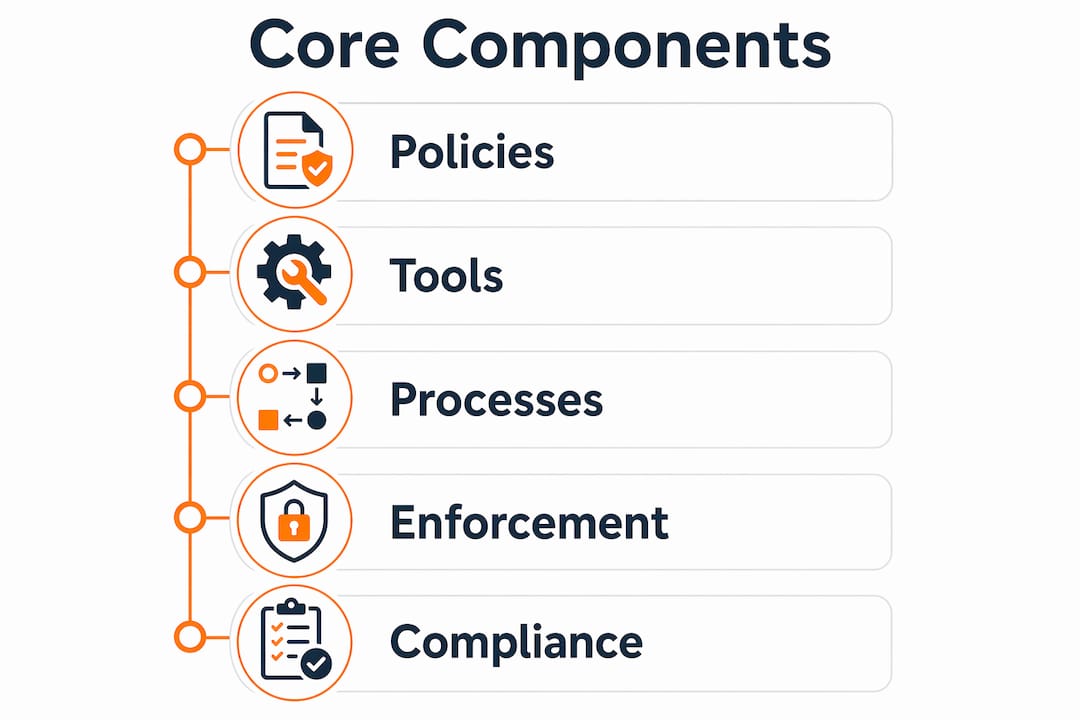
A cloud governance framework is the structured set of policies, tools, and processes that operationalize governance across an organization’s cloud estate. Governance frameworks include three core pillars that must be balanced to avoid both under-governance and over-governance.
| Governance Pillar | Primary Focus | Key Tools |
|---|---|---|
| Security governance | Access control, encryption, threat detection | Azure Policy, AWS IAM, Google Cloud SCC |
| Cost governance | Budget enforcement, tagging, rightsizing | AWS Cost Explorer, Azure Cost Management |
| Operational governance | Monitoring, logging, change management | CloudWatch, Azure Monitor, Cloud Logging |
Beyond the pillars, two structural elements determine whether a framework holds up at scale.
Landing zones as the enforcement foundation
A landing zone is a pre-configured cloud environment that embeds governance controls before any workload is deployed. Microsoft’s Azure landing zone guidance and AWS Control Tower both use this pattern. The landing zone defines network baselines, logging requirements, identity federation, and mandatory tagging at the account level. Every new account inherits these controls automatically, which means governance coverage scales with the organization without additional manual work.
Tagging standards as the governance backbone
Tagging standards are foundational for cost transparency, resource allocation, compliance reporting, and automation. A resource without a cost center tag cannot be attributed to a business unit. A workload without an environment tag cannot be excluded from production security policies. Spacelift and Cloudmagazin both identify tagging as the single highest-leverage governance practice for organizations managing more than a handful of accounts.
Pro Tip: Enforce a small set of mandatory tags at account creation rather than publishing a long tagging guide that teams ignore. Five enforced tags deliver more value than fifty recommended ones.
How does cloud governance align cloud adoption with business goals?
Governance is not just a technical control layer. It is the mechanism that connects cloud decisions to business outcomes. Governance aligns cloud adoption with business objectives by standardizing technology, enabling cross-team collaboration, and ensuring consistent operational and security controls across the entire estate.
The business benefits of a mature governance program include:
- Cost transparency. Finance teams can see exactly what each product line, team, or environment spends on cloud resources. This makes budget conversations factual rather than estimated.
- Audit preparedness. Automated evidence collection means compliance audits take days instead of weeks. Organizations with continuous compliance programs spend significantly less time preparing for SOC 2, ISO 27001, or PCI DSS reviews.
- Risk reduction. Governance controls reduce the frequency and severity of security incidents. Enterprises achieve ROI within 3–6 months by reducing security incidents, lowering cloud costs, and accelerating compliance audits.
- Faster innovation. This is the counterintuitive benefit. When guardrails are automated, developers do not need to wait for manual approvals. Microsoft explicitly advocates replacing change advisory boards with policy automation to improve deployment agility.
- Stakeholder alignment. A shared governance framework gives engineering, security, finance, and legal teams a common language for cloud decisions. Disputes about what is allowed are resolved by policy, not by escalation.
The importance of cloud governance becomes clearest when you look at what happens without it. Resource sprawl, shadow IT, and untracked spending are not signs of a technology problem. They are signs of a governance gap. Organizations that treat governance as a foundation rather than a constraint build cloud programs that scale without losing control. You can explore how compliance shapes cloud migration to see how governance principles apply directly to migration projects.
Key takeaways
Effective cloud governance requires automated policy enforcement, structured frameworks, and business alignment to deliver security, cost control, and compliance at scale.
| Point | Details |
|---|---|
| Governance starts at account creation | Embedding controls in landing zones prevents retrofitting costs and coverage gaps. |
| Policy as code scales compliance | Automated enforcement replaces manual reviews and keeps audit evidence current. |
| Tagging is the highest-leverage practice | Five enforced tags deliver more value than a long tagging guide no one follows. |
| Governance accelerates, not slows, teams | Automated guardrails remove change advisory bottlenecks and speed up deployments. |
| ROI arrives within 3–6 months | Reduced incidents, lower cloud spend, and faster audits deliver measurable returns quickly. |
Governance is an engineering problem, not a policy document
I have worked through enough cloud migrations to say this plainly: most governance failures are not failures of intent. Organizations write detailed governance policies. They publish tagging standards and security baselines. Then those documents sit in a wiki while engineers provision resources however they need to in the moment.
The shift that actually works is treating governance as an engineering discipline. Policy engineering with global repositories, automated tests, and version control is not overhead. It is the only way to make governance real at scale. When a policy change goes through a pull request and a test suite before it hits production, you get the same reliability guarantees you expect from application code.
The other thing I have seen consistently is that multi-cloud and hybrid environments expose governance gaps faster than single-cloud setups. When you have workloads across AWS, Azure, and on-premises infrastructure, the temptation is to manage each environment separately. That approach creates inconsistent controls and audit nightmares. The organizations that handle this well build a governance abstraction layer, using tools like Terraform and Open Policy Agent, that enforces consistent policy regardless of the underlying platform.
Governance maturity is not a destination. The best programs I have seen treat it as a continuous improvement cycle, reviewing policy coverage quarterly and adjusting as the cloud estate evolves. Start narrow, enforce consistently, and expand from there.
— Oleksandr
Migrate to AWS with governance built in from day one
Cloud governance best practices mean nothing if they are bolted on after migration. IT-Magic builds governance controls directly into every AWS migration, covering identity and access management, cost tagging, security baselines, and compliance monitoring before the first workload goes live.
As an AWS Advanced Tier Partner with 700+ completed projects, IT-Magic takes full ownership of migration execution and post-migration governance setup. Whether you are moving eCommerce infrastructure or fintech workloads where compliance gaps translate directly into lost revenue, the approach is the same: no shortcuts on governance, no surprises after go-live. Explore IT-Magic’s AWS migration services to see how governance-driven migration works in practice, or review the AWS migration best practices that underpin every project.
FAQ
What is cloud governance in simple terms?
Cloud governance is the set of policies, controls, and processes that define how an organization uses cloud resources. It covers security, cost management, compliance, and operational standards across all cloud accounts and services.
Why focus on cloud governance before migration?
Governance controls are far cheaper to implement before workloads are deployed than after. Retrofitting security baselines, tagging standards, and compliance monitoring onto an existing cloud estate multiplies the effort required and leaves coverage gaps in the interim.
What tools enforce cloud governance automatically?
Azure Policy, AWS Control Tower, Google Cloud Security Command Center, and Open Policy Agent are the primary enforcement tools. Each evaluates resource configurations against defined policies and blocks or flags non-compliant resources in real time.
How does a cloud governance framework differ from a cloud policy?
A cloud policy is a single rule, such as “all storage must be encrypted.” A cloud governance framework is the full system of policies, enforcement mechanisms, monitoring tools, and review processes that make those rules operational and auditable across the entire cloud estate.
How long does it take to see ROI from cloud governance?
Enterprises typically see measurable returns within 3–6 months through reduced security incidents, lower cloud spend from enforced tagging and budgets, and faster compliance audits driven by automated evidence collection.