TL;DR:
- Reducing IT costs by 20 to 40 percent is achievable through waste elimination, rightsizing, and ongoing governance. Cloud overprovisioning, unused SaaS licenses, and orphaned infrastructure are the main sources of unnecessary spending that can be fixed without major projects. Continuous visibility, attribution, and automation are essential for maintaining savings and preventing cost creep over time.
IT cost reduction is the practice of eliminating waste, rightsizing resources, and embedding financial accountability into your technology operations. Most organizations can cut 20–40% of their IT spend without touching a single strategic initiative. The savings are already sitting in unused SaaS licenses, overprovisioned cloud instances, and infrastructure that runs around the clock for no good reason. Knowing how to reduce IT costs means targeting those specific waste categories first, then building the governance to keep them from coming back.
Where are your biggest IT cost leaks?
The three largest sources of unnecessary IT spend are cloud overprovisioning, SaaS license waste, and orphaned infrastructure. Each one is measurable, and each one is fixable without a major project.
Cloud overprovisioning is the most common offender. Many cloud instances run at 15–20% utilization, meaning you are paying for 80–85% of capacity that delivers zero business value. Teams provision for peak load and never revisit the allocation.
SaaS license waste is equally damaging. Around 25% of provisioned software licenses go unused, and a basic audit typically surfaces that waste within the first hour. Tools like Zylo, Torii, or Productiv can pull usage data across your entire SaaS portfolio and flag licenses with zero logins in the past 30 days.
Orphaned infrastructure includes storage volumes, load balancers, reserved IP addresses, and snapshots attached to nothing. These resources accumulate silently during migrations and project shutdowns. A quarterly inventory reconciliation against active workloads is the fastest way to find them.
- Run a SaaS audit against active login data, not just provisioned seats
- Cross-reference cloud resource tags with active project lists
- Track renewal dates 90 days out to create negotiation windows
- Flag non-production environments running outside business hours
Pro Tip: Set auto-shutdown schedules for all dev, test, and staging environments. This single change costs almost nothing to implement and delivers immediate results.
How to reduce IT costs: a step-by-step approach
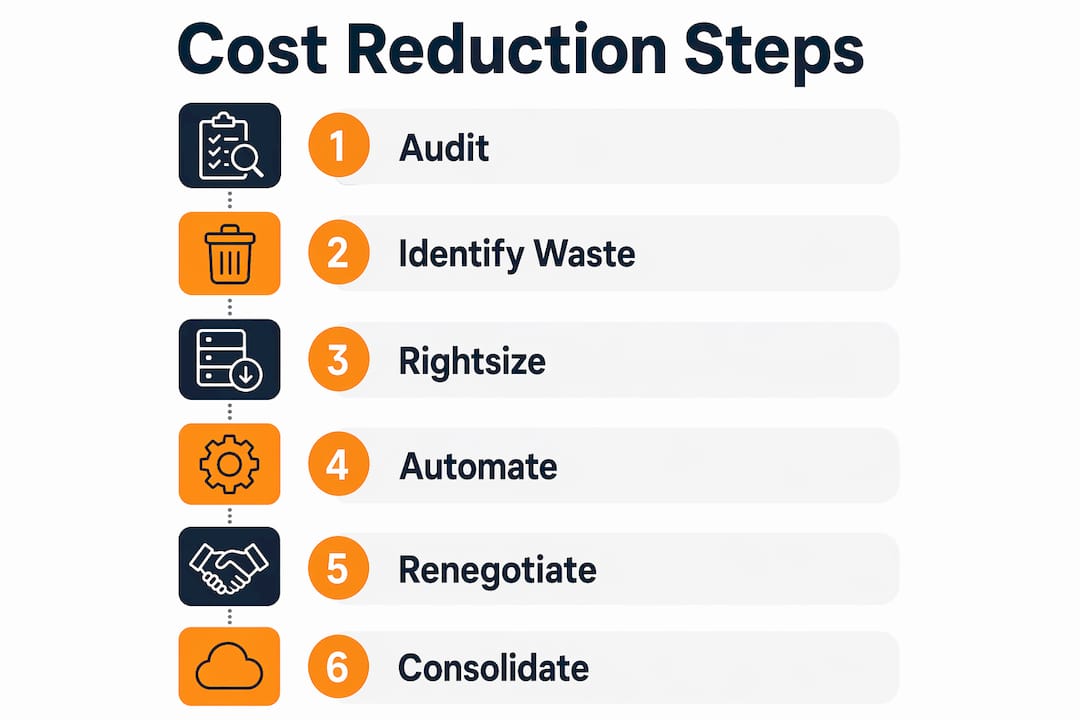
Reducing technology costs requires a structured sequence. Jumping straight to vendor negotiations without first understanding your actual usage data produces weak results. Follow this order.

Step 1: Audit your SaaS and cloud spend. Pull invoices, usage reports, and license assignments for the past 90 days. Use AWS Cost Explorer for cloud spend and a SaaS management platform for software licenses. The goal is a single view of what you are paying for and what is actually being used.
Step 2: Identify and quantify waste. Categorize findings into three buckets: eliminate (zero usage), rightsize (underused), and optimize (used but inefficient). Assign a dollar value to each bucket. This step converts a vague cost problem into a prioritized list.
Step 3: Rightsize cloud resources. Match resource allocation to actual utilization data. Rightsizing cloud resources based on real usage avoids performance degradation because you are removing unused capacity, not active capacity. Start with the largest instances first. AWS Compute Optimizer and Azure Advisor both generate rightsizing recommendations automatically.
Step 4: Automate non-production environment shutdowns. Dev, test, and staging environments do not need to run at 2 a.m. on a Saturday. Automating these shutdowns cuts non-production environment costs by more than 50%. That is a meaningful reduction with no engineering risk.
Step 5: Renegotiate vendor contracts before auto-renewal. Negotiating 60 days before expiration can yield discounts of 10% or more. Vendors would rather discount than lose a renewal. Come to the table with usage data showing underutilization. That data is your leverage.
Step 6: Consolidate overlapping tools. Eliminating redundant SaaS subscriptions reduces both direct spend and the administrative overhead of managing multiple vendors. A common example is organizations running Slack, Microsoft Teams, and Google Chat simultaneously across different departments.
Pro Tip: Build a cost reduction tracker in a shared spreadsheet or tool like Notion. Log every identified saving, its status, and the owner. Visibility creates accountability.
| Action | Effort | Typical Savings |
|---|---|---|
| SaaS license audit | Low | 15–25% of SaaS spend |
| Cloud rightsizing | Medium | 20–40% of compute spend |
| Non-production auto-shutdown | Low | 50%+ of dev/test costs |
| Vendor contract renegotiation | Medium | 10%+ per contract |
| Tool consolidation | High | Variable, often 20%+ |
Does IT cost optimization require ongoing governance?
Yes. A one-time audit produces a one-time result. Without a governance framework, cost creep returns within two to three quarters. IT cost optimization is a continuous cycle of visibility, attribution, rightsizing, and governance. Each stage builds on the last.
Visibility means knowing what you spend, broken down by team, product, and environment. Without this, no one can be held accountable. Tools like CloudZero, Apptio, or AWS Cost and Usage Reports provide the granularity you need.
Attribution connects spending to business outcomes. This is where showback and chargeback models become useful. Showback reports costs to each team without billing them internally. Chargeback actually allocates costs to business units. Both approaches make engineers and product managers aware of the financial impact of their infrastructure decisions.
Rightsizing is not a one-time event. Resource usage changes as products evolve. A quarterly rightsizing review prevents overprovisioning from accumulating again.
Governance embeds cost accountability into engineering workflows. This means setting budget alerts, requiring cost estimates in architecture reviews, and flagging anomalies in real time.
“Successful IT cost reduction treats the effort as a continuous accountability and governance-driven discipline rather than a one-time cut project.” Source: CloudZero
Embedding accountability in engineering is the difference between a cost reduction that lasts and one that reverses itself by Q3.
What tools and vendor strategies cut costs during cloud migration?
Cloud migration is one of the best opportunities to reset your cost baseline. The transition forces a full infrastructure inventory, which surfaces waste that has accumulated for years. The key is capturing those savings during the migration rather than replicating your existing inefficiencies in a new environment.
AWS offers several mechanisms to reduce baseline costs immediately. Reserved Instances and Savings Plans lock in discounted rates in exchange for one or three year commitments. For predictable workloads, this alone can reduce compute costs by 30–40% compared to on-demand pricing. Migration phases are prime moments for applying these commitment-based pricing models because you are already analyzing workload patterns.
Resource tagging is a governance tool that pays dividends during and after migration. Tags that identify the owning team, environment, and project make cost attribution automatic. Without tags, cloud bills become unreadable at scale.
AI-powered automation scales resources based on actual demand and handles routine operational tasks. During migration, this means right-sized infrastructure from day one rather than inheriting the overprovisioning of your legacy environment.
Shadow IT is another cost driver that migration exposes. Teams that have been running unauthorized cloud accounts or SaaS tools outside IT oversight represent both a security risk and a budget leak. Consolidating accounts during migration eliminates duplicate spend and restores visibility.
| Migration Strategy | Primary Cost Benefit | Best For |
|---|---|---|
| Reserved Instances | 30–40% compute savings | Stable, predictable workloads |
| Auto-scaling with tagging | Eliminates idle capacity | Variable traffic workloads |
| Account consolidation | Removes shadow IT costs | Multi-team organizations |
| Replatforming to managed services | Reduces operational overhead | Legacy app modernization |
For a detailed breakdown of cutting AWS migration costs without harming performance, the approach matters as much as the tools you choose. An IT budget planning framework can also help you set realistic targets before the migration begins.
Key takeaways
Reducing IT costs by 20–40% is achievable through targeted waste elimination, rightsizing, and continuous governance rather than blunt budget cuts.
| Point | Details |
|---|---|
| Audit before cutting | Identify unused licenses and idle resources before making any changes to avoid harming performance. |
| Rightsize with data | Match cloud resource allocation to actual utilization to cut compute costs without degrading systems. |
| Automate non-production shutdowns | Scheduling off-hours shutdowns for dev and test environments cuts those costs by more than 50%. |
| Negotiate before renewal | Approach vendors 60 days before contract expiration with usage data to secure 10%+ discounts. |
| Govern continuously | Build visibility, attribution, and budget alerts into engineering workflows to prevent cost creep. |
The part most IT leaders get wrong about cost reduction
I have worked through enough migrations and infrastructure audits to say this plainly: the fear of rightsizing is almost always bigger than the actual risk.
Teams resist downsizing cloud instances because they remember the one time a traffic spike caused an outage. That memory shapes every future decision. But the data tells a different story. When you rightsize based on 90 days of utilization data and keep auto-scaling enabled, you are not removing headroom. You are removing waste. Those are not the same thing.
The other mistake I see regularly is treating cost reduction as a one-time project. A team runs an audit, cuts $200,000 in annual spend, and declares victory. Six months later, the savings have eroded because no one built the governance to hold them. Cost reduction and cost optimization are not the same discipline. Reduction is a snapshot. Optimization is a system.
The organizations that sustain savings are the ones that embed cost accountability into how engineers work, not just how finance reports. That means budget alerts in Slack, cost estimates in pull requests, and quarterly rightsizing reviews on the calendar. It sounds like overhead. In practice, it takes less time than the quarterly scramble to explain why the cloud bill went up again.
One more thing: do not cut your way into technical debt. Blunt budget reductions that eliminate monitoring tools, security tooling, or observability platforms save money for one quarter and create incidents for the next four. The goal is to spend less on waste so you can spend more on capability.
— Oleksandr
How IT-Magic helps you cut cloud costs during migration
IT-Magic has completed 700+ AWS migrations for eCommerce and fintech organizations where downtime and cost overruns are not acceptable outcomes. The approach starts with a full infrastructure audit that identifies waste before a single workload moves.
During migration, IT-Magic applies the right strategy for each workload, whether rehost, replatform, or refactor, always with cost efficiency as a design constraint. Reserved Instance planning, resource tagging, and non-production automation are built into every engagement. Clients consistently see 30–40% reductions in AWS spend after migration, with performance metrics that meet or exceed their pre-migration baselines. If you are planning a cloud transition and want to use it as an opportunity to reset your cost structure, explore IT-Magic’s AWS migration services to see what that looks like in practice.
FAQ
How much can organizations realistically save on IT costs?
Most organizations can reduce IT costs by 20–40% by targeting waste such as unused licenses, overprovisioned cloud resources, and idle infrastructure. The exact figure depends on how much waste has accumulated and how aggressively governance is applied afterward.
What is the fastest way to cut IT expenses?
A SaaS license audit is the fastest way to cut IT expenses. Audits typically surface 15–25% waste within the first hour by identifying licenses with no active usage in the past 30 days.
Does rightsizing cloud resources hurt application performance?
Rightsizing based on actual utilization data does not hurt performance. Cloud instances often run at only 15–20% utilization, so removing unused capacity leaves active workloads fully supported.
How do you prevent IT costs from creeping back up after a reduction?
Sustained savings require a continuous governance framework covering visibility, attribution, and budget alerts. Without ongoing accountability, cost creep typically returns within two to three quarters after an initial reduction.
When is the best time to renegotiate software vendor contracts?
The best time to renegotiate is 60 days before a contract auto-renews. Approaching vendors at this window with usage data showing underutilization gives you clear leverage to negotiate discounts of 10% or more.