Cloud-native architecture is an approach to designing, building, and operating software that fully exploits cloud computing models rather than simply hosting traditional applications on cloud servers. The Cloud Native Computing Foundation (CNCF) defines it around four pillars: containers, microservices, dynamic orchestration (Kubernetes), and continuous delivery via CI/CD pipelines. The outcome is faster feature delivery, resilience by design, and infrastructure that scales horizontally without manual intervention.
What separates a genuinely cloud-native system from a cloud-hosted one:
- Microservices — independently deployable services with bounded contexts and well-defined APIs
- Containers — immutable, portable runtime artifacts (Docker-style images) that package code and dependencies together
- Orchestration — Kubernetes managing scheduling, self-healing, and scaling across a cluster
- Immutable artifacts — every build produces a versioned image; you replace rather than patch running instances
- Declarative APIs — desired state expressed in configuration, not imperative scripts
- Managed backing services — databases, queues, and object storage consumed as platform services
- Observability — structured logs, distributed traces, and metrics designed in from day one
- Automation and CI/CD — every code change flows through a tested, automated pipeline to production
The primary outcomes: deployment frequency measured in hours or days rather than quarters, mean time to recovery (MTTR) that drops because failures are isolated to individual services, and cost models that track actual usage rather than peak-provisioned capacity.
Table of Contents
- What cloud-native architecture actually means for system design
- Key technologies and the trade-offs each one introduces
- What your organization actually gains from going cloud-native
- Design patterns that make cloud-native systems work in practice
- Observability, resilience, and security: what ops teams must build in
- Challenges and trade-offs you should plan for
- How to adopt cloud-native architecture: migration strategies and a practical checklist
- How an experienced migration partner implements cloud-native architecture
- Key Takeaways
- The part most cloud-native guides skip
- IT-Magic handles the migration so your team can focus on the product
- Useful sources and further reading
- FAQ
What cloud-native architecture actually means for system design
The principles below are architectural commitments, not optional enhancements. Adopting containers without adopting the principles produces a cloud-hosted monolith, not a cloud-native system.
Immutable artifacts and supply-chain integrity. Every deployable unit is a versioned, signed container image built in CI. You never patch a running container; you build a new image, test it, and promote it. Microsoft’s cloud-native definition frames this as treating infrastructure like cattle, not pets: instances are disposable, replaced automatically, never hand-configured. Supply-chain controls — SBOMs, image signing, admission controllers — belong at the architecture level, not bolted on later.
Infrastructure as Code and automation. Platform state lives in version-controlled configuration files (Terraform, Pulumi, AWS CloudFormation). No human runs kubectl apply by hand in production. Automation is the only path to consistency across environments.
Stateless processes and backing services. Application processes hold no local state between requests. Databases, caches, queues, and object stores are external backing services consumed via environment-injected configuration. This is the foundation that makes horizontal scaling possible.
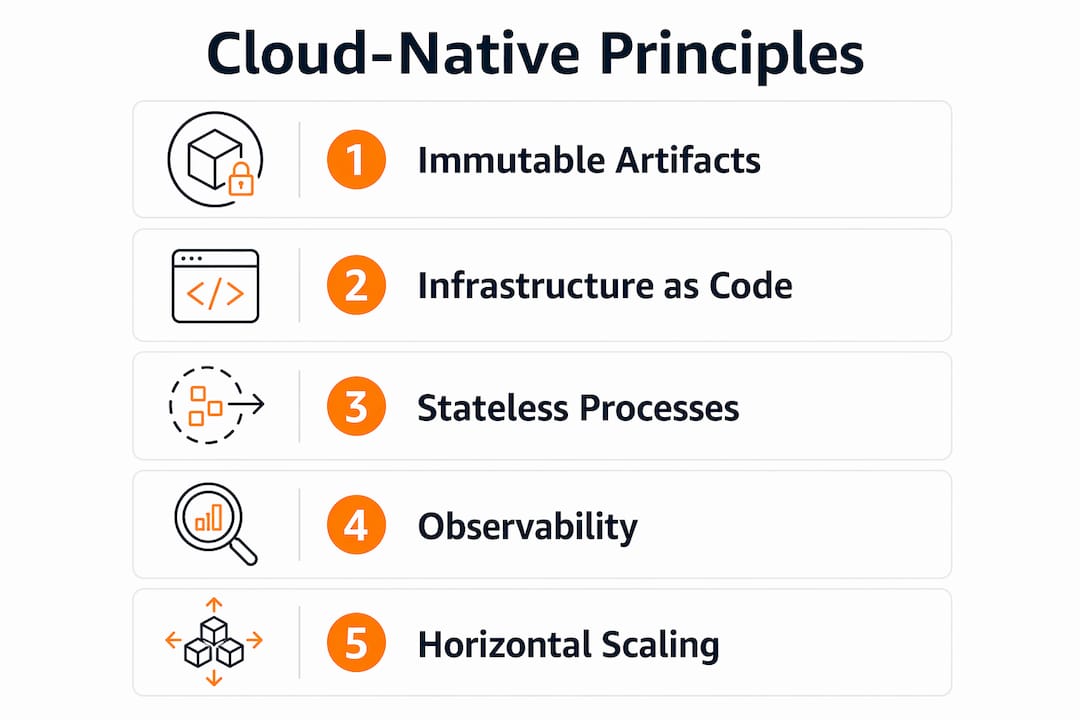
Observable systems and SLO-driven operations. Observability must be designed in, not added after deployment. Services emit structured logs, expose metrics endpoints, and propagate trace context. SLOs define what “working” means so alerting fires on user impact, not on arbitrary thresholds.

Horizontal scale and failure as normal. Cloud-native systems assume components fail. The platform restarts crashed pods, reroutes traffic away from unhealthy instances, and scales replicas based on load. Designing for failure means circuit breakers, retries with backoff, and graceful degradation rather than hoping the server stays up.
Platform-owned infrastructure vs. application capability. The platform (Kubernetes, managed cloud services) handles scheduling, networking, storage provisioning, and certificate rotation. Application teams own business logic. That boundary is what lets small teams ship independently.
The mental model shift from on-premises is significant. On-prem, you scale up (bigger server). Cloud-native, you scale out (more replicas). On-prem, you repair a broken server. Cloud-native, you replace it. Google Cloud’s principles put it plainly: designing for cloud constraints rather than treating cloud as “servers in someone else’s data center” is what separates cloud-native from lift-and-shift.
Key technologies and the trade-offs each one introduces
A practical inventory matters here because every technology in the cloud-native stack adds operational surface area alongside its benefits.
Containers (Docker-style images) package application code with its runtime dependencies into a single immutable artifact. They solve the “works on my machine” problem and make deployments reproducible. The trade-off: image sprawl and base-image vulnerability management require discipline — a container registry without automated scanning becomes a liability.
Kubernetes is the de facto orchestration standard. It schedules containers across nodes, restarts failed pods, manages rolling deployments, and exposes services. Kubernetes is the orchestration layer, not the full definition of cloud-native. Success requires organizational alignment (Conway’s Law applies directly), platform contracts between teams, and SLO-driven operations. The operational burden of running Kubernetes yourself is real; managed offerings like Amazon EKS, Google GKE, and Azure AKS absorb much of it.
Service mesh (Istio / Linkerd style) adds a programmable communication layer between microservices: mutual TLS, traffic management, retries, circuit breaking, and observability — without changing application code. The trade-off is added latency and significant operational complexity. A service mesh is worth it at scale; for a handful of services, it is over-engineering.

Serverless functions (AWS Lambda and equivalents) provision, scale, and manage compute automatically per invocation. They are ideal for event-driven workloads and traffic spikes. The trade-offs: cold starts affect latency-sensitive paths, and vendor lock-in is real because function runtimes and triggers are provider-specific.
Managed backing services — RDS, DynamoDB, SQS, S3 on AWS; equivalent services on GCP and Azure — offload operational responsibility for databases, queues, and storage to the cloud provider. The trade-off is cost at scale and some loss of configuration control. For most teams, the operational savings outweigh both.
CI/CD tooling (GitHub Actions, AWS CodePipeline, Tekton, ArgoCD) automates the path from commit to production. A well-designed pipeline builds the image, runs unit and integration tests, scans for vulnerabilities, and promotes through environments via GitOps. The trade-off: pipeline complexity grows with the number of services; invest in pipeline-as-code from the start.
Infrastructure as Code (Terraform, AWS CDK, Pulumi) makes infrastructure reproducible and auditable. The trade-off: state management (Terraform state files, drift detection) requires its own operational process.
GitOps (ArgoCD, Flux) uses Git as the single source of truth for cluster state. Deployments happen by merging a pull request, not by running scripts. This gives you a full audit trail and makes rollbacks trivial.
Observability tooling — Prometheus and Grafana for metrics, Jaeger or AWS X-Ray for distributed tracing, structured logging shipped to a log aggregator — closes the feedback loop between deployment and production behavior.
| Component | Purpose | Primary trade-off |
|---|---|---|
| Containers | Immutable, portable runtime artifacts | Image sprawl; vulnerability management overhead |
| Kubernetes | Scheduling, self-healing, scaling | Operational complexity; steep learning curve |
| Service mesh | Secure inter-service communication | Added latency; significant ops burden |
| Serverless (Lambda) | Event-driven, auto-scaling compute | Cold starts; vendor lock-in |
| Managed backing services | Offload DB/queue/storage ops | Cost at scale; reduced config control |
| CI/CD pipelines | Automated build, test, deploy | Pipeline complexity grows with service count |
| IaC (Terraform/CDK) | Reproducible, auditable infrastructure | State management; drift detection required |
| GitOps (ArgoCD/Flux) | Git-driven deployment and rollback | Requires disciplined branching strategy |
| Observability stack | Telemetry, tracing, alerting | Cardinality costs; retention planning needed |
A reference architecture ties these together: a CI pipeline builds an immutable container image, pushes it to a registry (Amazon ECR), and updates a GitOps manifest. ArgoCD detects the change and deploys to Kubernetes (EKS). The service mesh handles mTLS between pods. Managed RDS and SQS serve as backing services. Prometheus scrapes metrics; X-Ray traces requests end to end.
What your organization actually gains from going cloud-native
The benefits are real, but they are not automatic. They depend on architectural discipline, not just on adopting the tooling.
- Faster feature delivery. Independent deployability means a team can ship a change to the payment service without coordinating a release with the catalog team. Deployment frequency improves because the blast radius of any single change is bounded.
- Fault isolation and resilience. A failure in one microservice does not cascade to the entire application when circuit breakers and bulkheads are in place. Cloud resilience becomes a structural property rather than a recovery procedure.
- Horizontal scalability. Traffic spikes are absorbed by adding replicas, not by provisioning a larger server. For eCommerce workloads, this means handling a flash sale without pre-buying capacity that sits idle the rest of the year.
- Efficient cost model. Serverless and autoscaling align spend with actual usage. That said, poorly designed cloud-native systems can cost more than a well-tuned monolith. Cost efficiency requires right-sizing, spot instance strategies, and managed service selection.
- Portability. Container-based workloads run on AWS, GCP, Azure, or on-premises Kubernetes with minimal changes. This reduces vendor lock-in at the compute layer, though managed backing services reintroduce it at the data layer.
Cloud-native’s delivery velocity and resilience benefits only materialize when the architecture genuinely decouples services, automates the delivery pipeline, and instruments observability from the start. Moving a monolith to Kubernetes without refactoring produces a cloud-hosted monolith — fragile, expensive, and unable to scale horizontally. The lift-and-shift path typically leads to systems that cannot take advantage of managed cloud services or elastic scaling.
Benefits are most likely to materialize when teams start with a well-bounded pilot service, instrument observability before going to production, and define SLOs before writing deployment manifests.
Design patterns that make cloud-native systems work in practice
Twelve-Factor principles
The Twelve-Factor App methodology defines how to build services that are portable, scalable, and operationally clean. The most critical factors for cloud-native work: store config in the environment (not in code), treat backing services as attached resources, and keep build/release/run stages strictly separate. Violating factor III (config in code) is the single most common reason a containerized app cannot be promoted across environments without manual edits.
Microservices and bounded contexts
Decompose along business capability boundaries, not technical layers. A “user service” that owns authentication, profile, and preferences is a bounded context. A “database service” that wraps a shared schema is not. Domain-Driven Design’s bounded context concept is the right tool for drawing these lines. Avoid when: the team is small, the domain is not well understood, or the operational overhead of distributed systems outweighs the deployment independence benefit.
Strangler pattern
Incrementally replace a monolith by routing specific request paths to new microservices while the monolith handles the rest. The strangler fig grows around the old tree until the old tree is gone. Use this for brownfield migrations where a full rewrite is too risky. Avoid when the monolith’s data model is so entangled that extracting a service requires touching the shared database schema on every change.
Sidecar pattern
Deploy a secondary container alongside the main application container in the same pod. The sidecar handles cross-cutting concerns: log shipping, metrics collection, mTLS termination, or configuration injection. This keeps the application container focused on business logic. Service meshes like Istio use the sidecar model (Envoy proxy) extensively.
Circuit breaker and retry patterns
A circuit breaker tracks failure rates on a downstream call and opens (stops sending requests) when the failure rate exceeds a threshold, giving the downstream service time to recover. Retries with exponential backoff and jitter prevent thundering-herd problems. Both patterns are table stakes for any service that calls another service over the network.
Event-driven and message-based integration
Services communicate via durable message queues (SQS, Kafka, SNS) rather than synchronous HTTP calls for workflows that can tolerate eventual consistency. This decouples producers from consumers, improves resilience, and enables replay. The trade-off: debugging event-driven flows requires distributed tracing and careful idempotency design.
Bulkheading and throttling
Isolate resource pools (thread pools, connection pools) per downstream dependency so a slow dependency cannot exhaust shared resources. Rate limiting and throttling protect services from traffic spikes that exceed capacity. Both patterns require explicit capacity planning and SLO definitions.
| Pattern | Problem it solves | Key operational consideration |
|---|---|---|
| Twelve-Factor | Config drift, environment coupling | Requires secret management discipline |
| Strangler | Incremental monolith replacement | Needs traffic routing layer (API gateway) |
| Sidecar | Cross-cutting concerns without code changes | Pod resource overhead; version coupling |
| Circuit breaker | Cascading failures | Requires tuning thresholds per dependency |
| Event-driven | Tight coupling, synchronous bottlenecks | Idempotency design; tracing complexity |
| Bulkhead | Resource exhaustion from slow dependencies | Capacity planning per pool required |
Observability, resilience, and security: what ops teams must build in
Observability checklist
Observability is not monitoring. Monitoring tells you something is wrong; observability lets you understand why, even for failure modes you did not anticipate. Design telemetry into services from the start rather than adding it after deployment.
- Structured logs (JSON) with correlation IDs, service name, and deployment version in every log line
- Distributed traces propagating W3C Trace Context headers across all service boundaries
- High-cardinality metrics (request rate, error rate, latency percentiles) per service and per endpoint
- SLO-driven alerting: alert on error budget burn rate, not on CPU thresholds
- Retention plans: hot storage for recent data, cold storage for compliance and post-incident review
- Telemetry correlated to deployment artifacts so you can answer “did this deploy cause the latency spike?”
Pro Tip: Define your SLOs before you write your first Kubernetes manifest. An SLO without a corresponding alert and runbook is just a number in a document.
Resilience engineering
Failure injection (chaos testing with tools like AWS Fault Injection Simulator) validates that your circuit breakers, retries, and graceful degradation actually work before a real incident does. Autoscaling strategies — Horizontal Pod Autoscaler in Kubernetes, target tracking policies in AWS — need load testing to validate their thresholds. Idempotency in message consumers prevents duplicate processing when a message is delivered more than once.
Security for cloud-native systems
Cloud-native security requires a different mental model than perimeter-based security. The supply-chain hardening approach: sign every image, generate SBOMs, scan base layers in CI, and use admission controllers (OPA Gatekeeper, Kyverno) to reject non-compliant images at deploy time. For runtime protections, enforce pod security standards, use runtime scanning (Falco), and rotate secrets via a secrets manager (AWS Secrets Manager, HashiCorp Vault) rather than baking credentials into images or environment variables.
Zero-trust networking: every service-to-service call is authenticated and authorized, regardless of network location. Network policies in Kubernetes restrict which pods can communicate. A service mesh enforces mTLS automatically.
Governance and compliance
Cloud-native environments need policy-as-code to stay compliant at scale. AWS Config rules, OPA policies, and automated compliance scanning in CI pipelines catch drift before it reaches production. For regulated industries (fintech, healthcare), audit logging of all API calls (AWS CloudTrail) and immutable log storage are non-negotiable.
Challenges and trade-offs you should plan for
Cloud-native architecture solves real problems and creates new ones. Going in with clear eyes about the trade-offs is what separates successful migrations from expensive lessons.
- Operational complexity and toolchain sprawl. Running Kubernetes, a service mesh, a GitOps controller, an observability stack, and a secrets manager simultaneously requires dedicated platform engineering capacity. Teams that underestimate this end up with a fragile, under-observed system. Mitigation: start with managed services (EKS, managed Prometheus) and add complexity only when the simpler option hits a real limit.
- Unexpected cost drivers. Data transfer between availability zones, NAT gateway fees, and the per-request cost of managed services can surprise teams used to fixed-cost on-premises budgets. Architects must shift from a fixed-cost mindset to usage-based thinking, with cost tagging and budget alerts from day one.
- Data gravity and stateful services. Stateless services are straightforward to scale and replace. Stateful services (databases, file stores, session caches) are not. Migrating a large PostgreSQL database to a managed service mid-migration is one of the highest-risk steps. Plan data migration separately from compute migration.
- Testing distributed systems. Unit tests are not enough. Contract testing (Pact), integration testing against real backing services, and end-to-end tests in a staging environment that mirrors production topology are all required. Flaky tests in a distributed system erode confidence in the pipeline.
- Organizational change. Conway’s Law means your microservice boundaries will reflect your team structure whether you plan it or not. Misaligned team ownership produces services with unclear boundaries and shared databases. Platform engineering teams that provide self-service infrastructure reduce cognitive load for product teams but require investment and clear platform contracts.
- Anti-pattern: lift-and-shift without refactor. Moving a monolith to Kubernetes without decoupling state and defining backing services produces a fragile, expensive system that cannot horizontally scale. This is the single most common migration mistake.
- Anti-pattern: over-architecting early. A two-person startup does not need a service mesh and twelve microservices. Start with a modular monolith, extract services when team boundaries and scaling requirements make it necessary, and adopt platform tooling incrementally.
How to adopt cloud-native architecture: migration strategies and a practical checklist
Choosing the right migration strategy
- Rehost (lift-and-shift). Move the workload to cloud VMs with minimal changes. Fast and low-risk, but delivers almost none of the cloud-native benefits. Use it as a temporary step to get off a data center lease, with a refactor planned immediately after.
- Replatform. Make targeted changes to use managed services (swap self-managed MySQL for RDS, replace a message broker with SQS) without rearchitecting the application. Delivers meaningful operational savings with moderate effort. The right choice for stable applications where full refactor ROI is unclear.
- Refactor / rearchitect. Decompose the application into microservices, containerize, and deploy to Kubernetes with full CI/CD and observability. Highest effort, highest long-term value. Use the strangler pattern to do this incrementally rather than as a big-bang rewrite.
- Rebuild. Rewrite the application from scratch using cloud-native patterns. Justified when the existing codebase is too entangled to refactor and the business logic is well understood.
- Replace. Retire the application and adopt a SaaS alternative. Often the right answer for commodity functions (HR, CRM) that are not core differentiators.
Practical migration checklist
- Infrastructure audit. Inventory all services, dependencies, data stores, and traffic patterns. Identify cloud workload boundaries and compliance requirements.
- SLO definition. Define availability, latency, and error rate targets for each service before migration begins.
- Dependency mapping. Map all synchronous and asynchronous dependencies. Identify shared databases and tight coupling that must be resolved before decomposition.
- Identify strangler candidates. Find the highest-value, lowest-risk services to extract first — typically stateless, well-bounded services with clear API contracts.
- CI/CD pipeline setup. Build the automated pipeline (build, test, scan, promote) before migrating the first service.
- IaC baseline. Express all target infrastructure in Terraform or AWS CDK before provisioning anything manually.
- Observability instrumentation. Instrument the pilot service with structured logging, metrics, and distributed tracing before it handles production traffic.
- Security and compliance gating. Add image scanning, SBOM generation, and policy checks to the CI pipeline. Configure AWS CloudTrail and Config rules.
- Pilot and canary phases. Route a small percentage of production traffic to the new service. Validate SLOs. Expand gradually.
- Runbook handover. Document incident triage flows, on-call playbooks, and post-incident review cadence before the pilot goes live.
| Migration phase | Typical duration | Primary cost drivers |
|---|---|---|
| Discovery and audit | a few weeks | Staffing; tooling licenses |
| Pilot service migration | several weeks | Engineering time; managed service setup |
| Phased rollout (per service) | multiple weeks per service | Data transfer; managed service run costs |
| Full refactor (complex monolith) | many months | Engineering capacity; parallel run costs |
A mid-size eCommerce platform with multiple services typically completes a pilot in several weeks, phases the remaining services over months, and reaches full cloud-native operation within a year — assuming the team has dedicated platform engineering capacity and the data migration is planned separately. The most common scheduling trap: underestimating the time required to decouple a shared database schema.
Pro Tip: Avoid migrating your data store and your application logic in the same sprint. Treat the database migration as a separate workload with its own SLO, rollback plan, and validation criteria.
For teams evaluating on-premises vs. cloud trade-offs, cloud-native patterns can also run on-premises if equivalent platform automation and managed backing services are in place. The architecture matters more than the hosting location.
How an experienced migration partner implements cloud-native architecture
The gap between understanding cloud-native principles and executing a production migration without downtime is where most teams encounter the real difficulty. An experienced AWS migration partner closes that gap through structured phases, not just advice.
Engagement phases IT-Magic follows:
- Discovery and infrastructure audit. Map the existing environment: services, dependencies, data flows, compliance requirements, and cost baseline. This produces a prioritized migration backlog and a risk register.
- Migration plan and priorities. Define the target architecture, select migration strategies per workload (rehost, replatform, refactor), set SLOs, and establish the IaC baseline and CI/CD pipeline.
- Pilot migration and validation. Migrate the first candidate service, instrument observability, run canary traffic, and validate SLOs. The pilot surfaces integration issues before they affect the full migration.
- Phased rollout and optimization. Migrate remaining services in priority order. Optimize managed service configurations, right-size compute, and tune autoscaling policies. AWS cost optimization is an ongoing activity, not a one-time task.
- Post-migration operability and continuous improvement. Hand over runbooks, on-call playbooks, and observability dashboards. Establish a post-incident review cadence and a continuous improvement backlog.
IT-Magic’s case studies document measurable outcomes across eCommerce and fintech migrations: reduced AWS spend, improved system resilience, and faster deployment cadence. If you want to understand where your current infrastructure stands before committing to a migration strategy, request a free infrastructure audit.
Pro Tip: The free infrastructure audit is the highest-leverage first step. It surfaces the cost, risk, and complexity profile of your current environment and gives you a defensible basis for the migration business case — before you spend a dollar on cloud resources.
Key Takeaways
Cloud-native architecture delivers faster delivery, resilience, and scalable cost models only when microservices, containers, orchestration, observability, and CI/CD automation are adopted together as a system, not piecemeal.
| Point | Details |
|---|---|
| Definition and scope | Cloud-native means building for cloud constraints: microservices, containers, Kubernetes, CI/CD, and observability working together. |
| Lift-and-shift fails | Moving a monolith to cloud without refactoring produces a fragile, expensive system that cannot scale horizontally. |
| Observability first | Design structured logs, distributed traces, and SLO-driven alerting into services before they handle production traffic. |
| Migration strategy choice | Rehost for speed, replatform for managed service savings, refactor for full cloud-native benefits — match strategy to workload maturity. |
| IT-Magic’s approach | IT-Magic covers the full migration lifecycle, from infrastructure audit through phased rollout and post-migration optimization, as an AWS Advanced Tier Partner. |
The part most cloud-native guides skip
The technical stack is the easy part. Kubernetes, containers, CI/CD — these are solved problems with mature tooling and extensive documentation. What actually determines whether a cloud-native migration succeeds or stalls is organizational alignment and the willingness to treat platform engineering as a first-class product.
Most teams I see struggle not because they chose the wrong service mesh but because they tried to run twelve microservices with a team structure designed for a monolith. Conway’s Law is not a suggestion. If your team boundaries do not match your service boundaries, your services will develop hidden coupling regardless of how clean the initial API contracts look. The Inverse Conway Maneuver — deliberately shaping team structure to match the target architecture — is the most underrated tool in a cloud-native migration.
The second thing guides underemphasize: observability is not a phase you add at the end. I have seen migrations where teams spent months containerizing services and zero days instrumenting them. The first production incident after go-live becomes a multi-day debugging exercise because there are no traces, no structured logs, and no SLOs to tell you what “normal” looks like. Build the telemetry pipeline before you migrate the first service. It pays back immediately.
The do/don’t list that actually matters in practice:
Do: Define SLOs before writing deployment manifests. Treat the database migration as a separate workload. Invest in a GitOps workflow from the first service. Use managed services aggressively — the operational savings are real.
Don’t: Adopt a service mesh before you have more than five services. Migrate shared databases and application logic in the same sprint. Let “we’ll add observability later” survive a single sprint review.
Cloud-native architecture is worth the investment. The teams that get the most out of it are the ones who treat it as an organizational change with a technical implementation, not the other way around.
IT-Magic handles the migration so your team can focus on the product
Migrating to a production-grade cloud-native architecture on AWS is a different problem than understanding one. IT-Magic is an AWS Advanced Tier Partner with 700+ completed migrations, specializing in high-load eCommerce and fintech environments where downtime and cost overruns are not acceptable outcomes.
The engagement starts with a free infrastructure audit that maps your current environment, identifies migration risks, and produces a prioritized roadmap with realistic cost and timeline estimates. From there, IT-Magic takes full ownership of execution: IaC baseline, CI/CD pipeline setup, phased service migration, observability instrumentation, security hardening, and post-migration optimization. Fixed-price projects mean no billing surprises. Zero-downtime migration means no revenue risk during cutover.
If your team is planning a move to AWS and needs a partner who has done this at scale, start with the free audit or review the AWS migration best practices to see how the process works end to end.
Useful sources and further reading
- CNCF — Cloud Native Computing Foundation: The canonical vendor-neutral definition of cloud-native, plus the CNCF landscape of graduated and incubating projects.
- What Is Cloud Native — Google Cloud: Google’s practitioner-oriented definition and the five principles for cloud-native architecture.
- Cloud-Native Architecture Definition — Microsoft Docs: Microsoft’s detailed treatment of immutable artifacts, pets vs. cattle, and supply-chain integrity.
- What Is Cloud Native — Microsoft Azure: Azure’s overview of microservices, containers, orchestration, and DevOps practices for cloud-native development.
- Cloud-Native Architecture Principles — IEEE Computer Society: Six principles covering scalability, resilience, observability, automation, and security.
- The Twelve-Factor App: The foundational methodology for building portable, scalable, operationally clean services.
- What Is Cloud Native — Oracle: Oracle’s treatment of cloud-native on hybrid and on-premises environments.
- Cloud-Native Principles — Ascendion Engineering: Practitioner-level guidance on observability-first design and SLO-driven operations.
- Managed Service Provider perspectives — NetFusion Designs: MSP perspective on offloading operational responsibilities and hybrid backing services.
- Scalable infrastructure migration steps — IT-Magic: Step-by-step migration guidance and checklist for teams planning a cloud-native move.
- Cloud security best practices — IT-Magic: Supply-chain security, secrets management, and runtime protections for cloud-native environments.
FAQ
What is cloud-native architecture in one sentence?
Cloud-native architecture is an approach to building software using containers, microservices, Kubernetes orchestration, and CI/CD automation so that applications can scale horizontally, recover from failure automatically, and be updated independently without downtime.
How does cloud-native differ from just running in the cloud?
Running in the cloud means hosting an existing application on cloud infrastructure; cloud-native means the application was designed from the ground up to exploit cloud capabilities — immutable artifacts, managed backing services, horizontal scaling, and automated delivery pipelines.
Is Kubernetes the same as cloud-native architecture?
No. Kubernetes is the orchestration layer that schedules and manages containers, but cloud-native architecture also requires organizational alignment, observability, supply-chain controls, CI/CD pipelines, and microservice decomposition to deliver its benefits.
What is the biggest risk in a cloud-native migration?
Lift-and-shift without refactoring: moving a monolith to Kubernetes without decoupling state and defining backing services produces a cloud-hosted monolith that is fragile, expensive, and unable to scale horizontally.
How does IT-Magic approach a cloud-native migration?
IT-Magic starts with a free infrastructure audit to map risks and priorities, then executes the migration in phases — IaC baseline, CI/CD setup, pilot service, phased rollout, and post-migration optimization — as an AWS Advanced Tier Partner with full ownership of outcomes.