
TL;DR:
- Refactoring in cloud migration involves restructuring an application’s architecture and code to leverage cloud-native features for better scalability and resilience. It requires significant effort but offers the highest long-term return, especially for strategic, growth-oriented applications. Proper planning, disciplined testing, and aligning scope with business value are essential to successful outcomes.
Refactoring in cloud migration is defined as the process of modifying an application’s architecture and code to optimize it for cloud-native capabilities, rather than simply moving it as-is to a new environment. Unlike a basic lift-and-shift, refactoring changes application structure at the code level to unlock autoscaling, managed services, and cloud-native resilience. The Microsoft Azure Cloud Adoption Framework, NetApp, and AWS all treat refactoring as a distinct modernization strategy that sits between simple rehosting and a full rebuild. For IT professionals and decision-makers planning a migration in 2026, understanding where refactoring fits and what it actually demands is the difference between a migration that pays off and one that creates new problems.
What is refactoring in cloud migration, technically?
Refactoring in cloud migration means keeping the core business logic of an application while restructuring its architecture and code to align with how cloud platforms actually work. The goal is not cosmetic cleanup. It is architectural transformation that lets the application take full advantage of services like AWS Lambda, Amazon RDS, or Kubernetes-based container orchestration.

The most common technical change is breaking a monolithic application into microservices or modular components. A monolith runs as a single deployable unit, which means one failing component can bring down the entire system. Transforming monoliths into microservices allows each service to scale, deploy, and fail independently, which is a fundamental shift in how the application behaves under load.
Beyond architecture, refactoring also involves:
- Replacing hardcoded configurations with cloud-managed services such as AWS Secrets Manager or Azure Key Vault
- Removing legacy framework dependencies that are incompatible with containerized or serverless environments
- Updating data access layers to use managed databases like Amazon Aurora instead of self-managed instances
- Introducing infrastructure as code using tools like Terraform or AWS CloudFormation
- Enabling autoscaling policies and health-check integrations that cloud platforms require to manage workloads automatically
The Microsoft Azure Cloud Adoption Framework organizes refactoring work into five cross-cutting categories: reliability, security, operational excellence, cost optimization, and performance efficiency. This framing is useful because it stops teams from treating refactoring as a pure code exercise. Security changes like secrets rotation and identity federation are just as much a part of refactoring as splitting services.
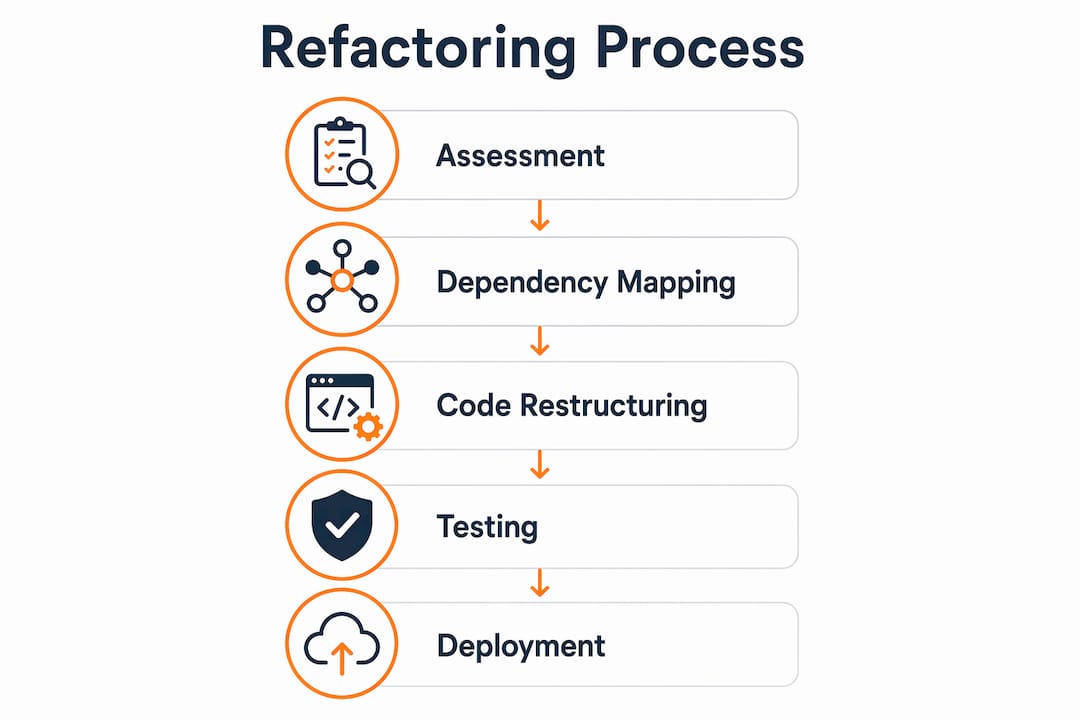
Pro Tip: Before writing a single line of refactored code, map every external dependency your application has. Third-party APIs, legacy authentication systems, and on-premises data connections are the most common sources of scope creep in refactoring projects.
How does refactoring compare to rehosting and replatforming?
The three most common cloud migration strategies are rehosting, replatforming, and refactoring. Each represents a different level of change, cost, and long-term payoff.
Rehosting (also called lift-and-shift) moves an application to the cloud with no code changes. The application runs on cloud infrastructure but behaves exactly as it did on-premises. It is the fastest and cheapest option, but it leaves performance, cost, and scalability problems intact.
Replatforming makes targeted infrastructure changes without modifying core application logic. Swapping a self-managed MySQL instance for Amazon RDS is a replatforming move. The application code stays the same, but it now benefits from managed backups, patching, and scaling.
Refactoring goes further than both. Refactoring requires significant code changes and architectural redesign, which makes it the most resource-intensive option. It is also the one that delivers the highest long-term return on investment.
| Strategy | Code changes | Time to migrate | Long-term ROI | Best for |
|---|---|---|---|---|
| Rehosting | None | Fast | Low | Legacy apps, urgent timelines |
| Replatforming | Minimal | Moderate | Medium | Stable apps needing managed services |
| Refactoring | Significant | Slow | High | Strategic apps with growth potential |
The right choice depends on the application’s strategic value. A billing system that processes millions of transactions daily is a strong refactoring candidate. An internal reporting tool used by 10 people is not. Aligning migration strategy to business value is the decision that separates well-planned migrations from expensive ones.
What are the challenges and risks of cloud refactoring?
Refactoring is the most time- and investment-intensive migration strategy, and teams that underestimate this consistently run into scope creep, timeline overruns, and reliability problems. The complexity is real, and it requires active management rather than optimism.
The most common risks include:
- Scope underestimation. Teams frequently confuse refactoring with rehosting or replatforming, which leads to underestimated timelines and skill misalignment. A project scoped as a two-month replatform can quietly become a six-month refactor once the team starts touching the code.
- Testing gaps. Without disciplined testing, the complexity of refactoring produces reliability problems instead of improvements. Unit tests, integration tests, and load tests must be defined before refactoring begins, not after.
- Skill misalignment. Refactoring cloud-native applications requires engineers who understand both the application domain and cloud-native patterns like event-driven architecture, container orchestration, and serverless function design. Teams without this combination need to hire or upskill before starting.
- Technical debt transfer. Refactoring done without a clear architectural target can move technical debt from one form to another rather than eliminating it. Breaking a monolith into poorly designed microservices creates distributed technical debt that is harder to manage than the original problem.
- Governance gaps. Without clear ownership of refactoring decisions, teams make inconsistent architectural choices across services. This is especially damaging in larger organizations where multiple teams are refactoring different parts of the same application.
The Azure Cloud Adoption Framework addresses this directly by framing refactoring as cross-cutting engineering work that requires a structured checklist covering reliability, security, and operational excellence. Teams that treat it as a checklist exercise rather than a creative coding sprint consistently produce better outcomes.
Pro Tip: Run a two-week spike before committing to a full refactoring scope. Pick the most complex component of your application, attempt to refactor it, and use the actual effort to recalibrate your timeline and resource estimates.
What are the long-term benefits of refactoring for cloud migration?
The case for refactoring is built on operational and financial outcomes that compound over time. Well-refactored cloud applications scale dynamically, consume fewer resources, and use cloud-native security and management features that reduce manual overhead. The upfront cost is real, but the long-term math favors refactoring for any application with a multi-year lifespan.
The primary long-term benefits, in order of impact:
- Dynamic scalability. Refactored applications use autoscaling groups, serverless functions, and container orchestration to match resource consumption to actual demand. This eliminates the over-provisioning that inflates cloud bills for lift-and-shift migrations.
- Reduced operational costs. Organizations that invest in refactoring see lower storage and monitoring costs, fewer manual maintenance activities, and smoother deployments. Managed services replace operational tasks that previously required dedicated engineering time.
- Lower technical debt. Refactoring removes legacy dependencies and outdated frameworks that slow down every future development cycle. Teams that ship features faster after a refactoring project consistently report that the architectural cleanup was the primary reason.
- Improved security posture. Cloud-native security patterns, including secrets management, identity-based access control, and automated compliance checks, are built into refactored architectures from the start. This is harder to retrofit into rehosted applications.
- Higher development velocity. Modular microservice architectures allow independent teams to deploy changes without coordinating with every other team. This is the organizational benefit that often surprises decision-makers who focused only on infrastructure costs when evaluating the migration.
For cloud performance optimization at scale, refactoring is the only strategy that addresses the root causes of performance problems rather than working around them.
Key takeaways
Refactoring in cloud migration delivers the highest long-term ROI of any migration strategy, but only when executed with disciplined testing, clear architectural targets, and alignment to business value.
| Point | Details |
|---|---|
| Refactoring defined | Modifying application architecture and code to optimize for cloud-native capabilities, not just moving infrastructure. |
| Higher complexity, higher return | Refactoring demands more time and resources than rehosting or replatforming, but produces the highest long-term ROI. |
| Structured approach required | The Azure Cloud Adoption Framework organizes refactoring across reliability, security, cost, performance, and operational excellence. |
| Biggest risk is scope confusion | Confusing refactoring with rehosting leads to underestimated timelines, skill gaps, and failed outcomes. |
| Long-term benefits compound | Dynamic scaling, lower operational costs, reduced technical debt, and faster development velocity all increase over time. |
Refactoring is a business decision, not just a technical one
After working on cloud migrations across eCommerce and fintech environments, the pattern I see most often is this: teams treat refactoring as a purely technical exercise and then wonder why the business case falls apart six months in.
The applications that benefit most from refactoring are the ones where the business is actively constrained by the current architecture. If your engineering team cannot ship a new feature without touching five unrelated services, that is a refactoring signal. If your infrastructure bill grows faster than your user base, that is another one. Microsoft frames this precisely: refactoring unblocks development velocity when technical debt or non-optimized cloud code is the bottleneck. The question is not whether to refactor. It is what business outcome is currently blocked by the existing architecture.
The other mistake I see regularly is treating refactoring as a one-time project with a defined end date. In practice, refactoring is an ongoing discipline. The initial migration refactor gets the application to a cloud-native baseline. Subsequent refactoring cycles improve performance, reduce costs, and keep the architecture aligned with how the business is actually growing. Teams that understand this from the start build the governance structures and testing practices that make each cycle faster and less risky than the last.
The AWS migration best practices that produce the best outcomes share one characteristic: they treat refactoring scope as a business conversation first and a technical conversation second.
— Oleksandr
Plan your refactoring migration with IT-Magic
IT-Magic has completed 700+ AWS migrations as an AWS Advanced Tier Partner, including complex refactoring projects in eCommerce and fintech where downtime and performance gaps directly affect revenue. The team takes full ownership of execution, from infrastructure audit through post-migration optimization, applying rehost, replatform, or refactor strategies based on what each application actually needs.
If your application is constrained by legacy architecture or your cloud costs are growing faster than your business, a structured refactoring engagement is the right next step. Visit IT-Magic’s AWS Migration Services to review case studies, understand the methodology, and start a conversation about your migration scope. The goal is a predictable, secure, and cost-efficient outcome without adding operational burden to your team.
FAQ
What is refactoring in cloud migration?
Refactoring in cloud migration is the process of modifying an application’s architecture and code to optimize it for cloud-native capabilities such as autoscaling, managed services, and container orchestration. It goes beyond moving infrastructure and involves structural changes to how the application is built and deployed.
How is refactoring different from rehosting?
Rehosting moves an application to the cloud with no code changes, while refactoring modifies the application’s architecture and code to align with cloud-native patterns. Refactoring takes more time and resources but delivers significantly higher long-term performance and cost benefits.
What are the main risks of cloud refactoring?
The primary risks are scope underestimation, testing gaps, and skill misalignment. NetApp notes that without disciplined testing and risk control, refactoring complexity can produce reliability problems rather than improvements.
When should a company choose refactoring over replatforming?
Choose refactoring when an application has high strategic value, when the current architecture limits development velocity, or when infrastructure costs are growing disproportionately. Replatforming is sufficient for stable applications that only need managed services without structural changes.
How long does a cloud refactoring project typically take?
Refactoring is the most time-intensive migration strategy, with timelines varying based on application complexity, team skill, and scope. A two-week spike on the most complex component is a reliable way to generate an accurate estimate before committing to a full project timeline.