TL;DR:
- Effective cloud migration requires designing for scalability from the outset to ensure performance, cost efficiency, and growth potential without transferring on-premises limitations. Implementing automated intake, cloud-native architecture, and high availability strategies enables migrations to handle fluctuating demand seamlessly while reducing operational risks. Treat scalability as a core, non-negotiable requirement to deliver long-term value and avoid costly retrofits after migration completes.
Scalability in cloud migration is defined as the architecture’s capacity to dynamically adjust compute, storage, and network resources in response to changing application demands without disrupting production workloads. Enterprise IT leaders who treat scalability as a first-class design constraint during migration avoid the most expensive mistake in cloud adoption: replicating on-premises limitations inside a cloud wrapper. Platforms like Microsoft Azure and Salesforce have demonstrated that scalable migration planning separates organizations that grow efficiently in the cloud from those that simply pay cloud prices for on-premises problems. Tools like Oracle ZDM and Salesforce MIPS show what purpose-built scalability looks like in practice.
Why prioritize scalability in migration: the core benefits
Scalability is not a feature you add after migration. It is the outcome that determines whether your cloud investment pays off or compounds your existing infrastructure debt.

Microsoft Azure defines cloud scalability as adapting capacity to meet application needs, enabling responsive and efficient resource usage during demand fluctuations. That definition carries a direct financial implication: organizations that build scalability into their migration design avoid over-provisioning costs and sustain user experience during peak load without manual intervention.
The benefits of scalable migration fall into three categories that matter to enterprise decision-makers.
Performance reliability under variable load. A scalable cloud environment responds to demand spikes quickly and scales down when load diminishes, ensuring cost efficiency without sacrificing performance. For eCommerce and fintech workloads, this is not a theoretical benefit. A flash sale or a regulatory reporting deadline can multiply traffic tenfold within minutes.
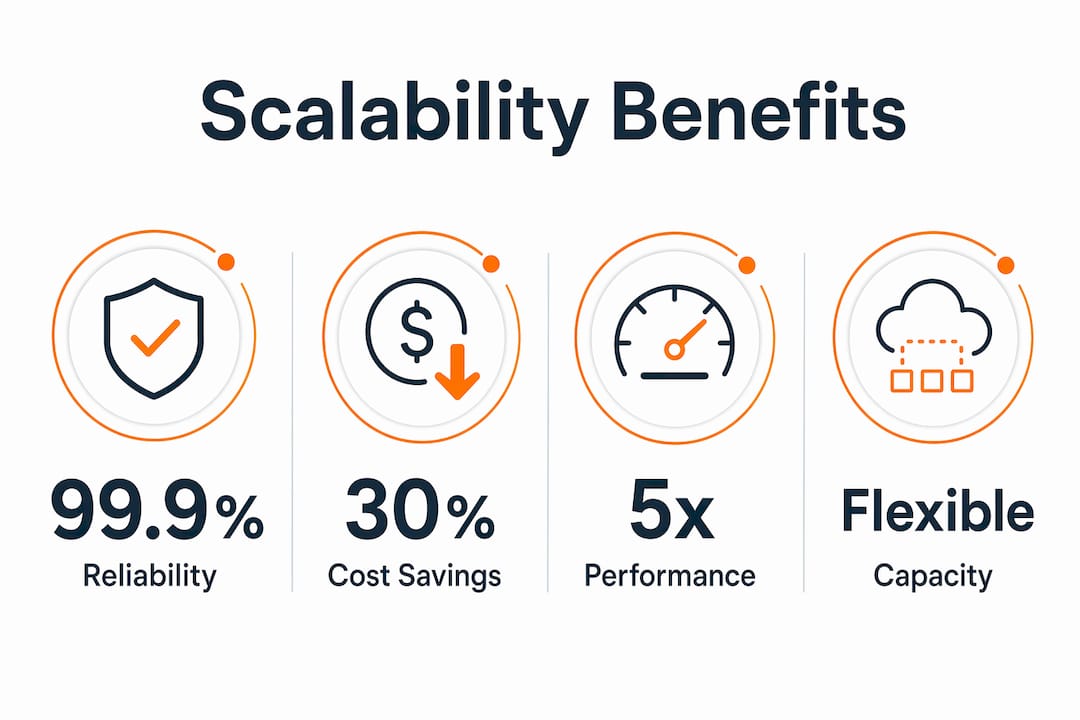
Cost discipline tied to actual usage. Static infrastructure forces you to provision for peak capacity at all times. Scalable architecture provisions for average load and expands automatically, which means you pay for what you use. This is the FinOps argument for scalability: it converts a fixed infrastructure cost into a variable one aligned with revenue.
Long-term flexibility for growth. Crunch-IS research confirms that migration strategy determines whether you create a scalable infrastructure or simply transfer existing constraints to the cloud. Organizations that plan for scalability during migration retain the flexibility to add regions, services, and workloads without re-architecting from scratch.
Key scalability benefits for enterprise migration projects include:
- Dynamic capacity adjustment without manual provisioning
- Reduced over-provisioning costs through pay-per-use resource allocation
- Consistent application performance during demand spikes
- Faster time-to-market for new services built on scalable foundations
- Reduced operational risk when onboarding new workloads post-migration
How scalability shapes migration strategy and execution
The most consequential decision in any migration program is not which workloads to move first. It is which architectural pattern governs how they are moved.
Crunch-IS makes this explicit: the migration approach, including workload selection, sequencing, and strategy, is the primary lever for achieving scalable outcomes rather than migrating existing limits. Two organizations can migrate the same workload to AWS and arrive at completely different scalability outcomes depending on whether they chose lift-and-shift or cloud-native re-architecture.
Lift-and-shift, also called rehosting, moves workloads to the cloud with minimal changes. It is fast and low-risk in the short term, but it preserves the architectural constraints of the original system. A monolithic application that struggled to scale on-premises will struggle to scale on AWS unless the migration includes re-platforming or refactoring decisions. Cloud-native re-architecture delivers 15 to 22 percent greater savings and scalable performance compared to simple rehosting. That gap widens as workload complexity increases.
The architectural elements that enable scalability in a migrated environment include modular service design, automated scaling policies tied to real-time metrics, and multi-region deployments that distribute load geographically. Each of these requires deliberate planning before the first workload moves. Retrofitting them after migration is significantly more expensive and disruptive than building them in from the start.
Pro Tip: When sequencing workloads for migration, prioritize stateless or loosely coupled services first. These are the easiest to re-architect for auto-scaling and give your team a working model of scalable design before tackling complex, stateful workloads. Review your migration best practices checklist to embed scalability gates at each phase.
What operational challenges does scalability solve during large-scale migrations?
The operational bottlenecks in large-scale migrations rarely appear where teams expect them. Raw data movement is rarely the constraint. The bottleneck is almost always in intake, validation, and decision-making layers.
Salesforce’s Hyperforce MIPS platform illustrates this precisely. MIPS processed over 95,000 migrations with high throughput and reliability by automating deterministic checks while routing exceptions for manual review. The system handled more than 15,000 migration requests in approximately one year, with over 90 percent safely automated. That throughput was not achieved by adding staff. It was achieved by separating the validation logic from the execution layer and automating every decision that could be made deterministically.
The architectural insight here applies directly to enterprise IT programs: automated intake pipelines with safe-failure routing improve scalability by enabling consistent throughput and precise decision-making even at high volumes. When exceptions are escalated to humans rather than blocking the entire queue, the system scales without losing correctness or auditability.
The table below maps common operational challenges in large-scale migrations to the scalability mechanisms that address them.
| Operational challenge | Scalability solution |
|---|---|
| Intake bottlenecks blocking migration throughput | Automated validation pipelines with deterministic logic |
| Manual review creating queue backlogs | Safe-failure routing that escalates only true exceptions |
| Inconsistent decision-making at scale | Standardized checks applied uniformly across all requests |
| Audit gaps under high volume | Built-in auditability at every automated decision point |
| Staffing constraints limiting throughput | Decoupled intake and execution layers scaled independently |
Salesforce’s approach treats scalability as an operational design constraint encompassing capacity, throughput, and failure modes. That framing is more useful than treating scalability as a purely infrastructure concern, because it forces teams to examine every layer of the migration program, not just the compute and storage tiers.
How do zero downtime and high availability techniques support scalable migrations?
Zero downtime migration and scalability are not separate concerns. They are two expressions of the same architectural discipline: designing systems that maintain reliable performance under changing conditions.
Oracle Zero Downtime Migration demonstrates this integration directly. Oracle ZDM leverages Data Guard and GoldenGate to migrate databases with zero to negligible downtime while maintaining high availability throughout the process. The automation layer reduces human error and keeps production workloads running during migration. This is not just a reliability feature. It is a scalability feature, because it allows migration programs to run continuously without scheduling maintenance windows that compress throughput.
Zero downtime methodologies require explicit scenario-based objectives and integration of high availability tools to sustain performance and reliability during migration. That means defining acceptable downtime for each workload class before migration begins, not after an incident forces the conversation.
The high availability components that directly support scalable migration execution include:
- Oracle Data Guard for continuous database replication during migration
- Oracle GoldenGate for real-time data synchronization across source and target
- Automated failover policies that remove single points of failure
- Scenario-based recovery time objectives defined per workload tier
- Continuous monitoring and alerting integrated into the migration pipeline
For enterprise IT teams running large-scale AWS migrations, the lesson from Oracle ZDM is that high availability architecture and scalability planning must be designed together. An architecture that cannot handle a failover gracefully will also struggle to handle a demand spike gracefully. The underlying requirement is the same: the system must absorb change without degrading.
Key takeaways
Scalability built into migration design prevents infrastructure constraints from transferring to the cloud and enables reliable performance, cost control, and long-term growth.
| Point | Details |
|---|---|
| Scalability is a design constraint | Treat capacity, throughput, and failure modes as migration requirements, not post-migration additions. |
| Strategy determines scalability outcomes | Cloud-native re-architecture delivers 15 to 22 percent greater savings than lift-and-shift approaches. |
| Automate intake to scale throughput | Salesforce MIPS processed 95,000+ migrations by decoupling validation from execution and automating deterministic decisions. |
| Zero downtime supports scalable execution | Oracle ZDM’s Data Guard and GoldenGate integration keeps migrations running continuously without compressing throughput. |
| FinOps and SRE must align | Viewing scalability as both a reliability and cost lever ensures migration programs deliver measurable financial and operational returns. |
The mistake I see most often in enterprise migration programs
Most enterprise migration programs I have observed treat scalability as a future concern. The team focuses on getting workloads moved, and scalability becomes a phase two item that never quite arrives. By the time the business needs it, re-architecting a production system under load is far more expensive and risky than building it right the first time.
The more useful mental model is to treat scalability the same way you treat security: as a non-negotiable design constraint that shapes every architectural decision from day one. When I look at programs that delivered measurable results, the common thread is not the tools they used. It is that the team distinguished between moving workloads and delivering scalable outcomes. That distinction, which Crunch-IS identifies as central to migration strategy, changes how you sequence workloads, how you define success criteria, and how you allocate engineering effort.
The Salesforce MIPS case is the clearest example I know of scalability treated as an operational design constraint rather than an infrastructure feature. The team did not scale by adding people. They scaled by redesigning the decision-making layer. That is the kind of thinking that separates migrations that deliver long-term value from migrations that simply relocate the problem.
My recommendation to any enterprise IT leader entering a migration program: define your scalability requirements before you define your migration timeline. If your cloud performance optimization targets are not embedded in the architecture from the start, you will spend the next two years retrofitting them under pressure.
— Oleksandr
Build scalable AWS migrations with IT-Magic
IT-Magic has completed 700+ AWS migration projects as an AWS Advanced Tier Partner, specializing in high-load eCommerce and fintech environments where scalability gaps translate directly into lost revenue. The team takes full ownership of execution, from infrastructure audit through post-migration optimization, applying rehost, replatform, or refactor strategies based on your specific scalability and cost targets. Every architecture is designed to handle demand spikes, reduce over-provisioning costs, and maintain production-grade reliability from day one.
If you are planning a migration and need scalability built in from the start, explore IT-Magic’s AWS migration services or review the migration best practices that govern every engagement.
FAQ
Why does scalability matter more during migration than after?
Scalability is harder and more expensive to retrofit into a production system than to build in during migration. Architectural decisions made during migration, such as service coupling, data layer design, and auto-scaling policies, determine the ceiling of your cloud environment for years.
What is the difference between scalability and high availability in migration?
Scalability refers to the system’s ability to handle increasing load by adjusting resources. High availability refers to the system’s ability to remain operational during failures. Both require deliberate architectural design and are most cost-effective when planned together during migration.
How does lift-and-shift affect long-term scalability?
Lift-and-shift migrations preserve the architectural constraints of the original system, which means scalability limitations transfer to the cloud along with the workload. Cloud-native re-architecture unlocks elasticity and managed services that deliver measurably better scalability outcomes.
What role does automation play in scalable migration programs?
Automation removes human bottlenecks from intake, validation, and decision-making layers. Salesforce MIPS demonstrated that automating deterministic checks while routing exceptions for manual review enabled throughput scaling across 95,000 migrations without proportional staffing increases.
How should enterprises define scalability requirements before migration?
Define scalability requirements by workload tier, specifying peak load targets, acceptable response times, and recovery time objectives for each class of application. These targets should be embedded in the migration architecture before workload sequencing begins, not added as post-migration optimization tasks.