TL;DR:
- Effective migration planning is crucial for controlling costs, minimizing risks, and ensuring success in cloud transitions. It involves detailed assessment, stakeholder alignment, phased approaches, and post-migration support to avoid delays, overspending, and operational instability. Treating migration as a strategic business initiative rather than solely an IT project maximizes value and reduces failure rates.
Migration planning is the structured process of assessing, designing, and executing an IT infrastructure transition in a way that controls cost, protects data, and preserves business continuity. For organizations moving workloads to AWS or any major cloud platform, the role of migration planning is not a preliminary formality. It is the difference between a predictable outcome and a project that consumes twice the budget and delivers half the value. Up to 83% of enterprise data migration projects either fail or exceed their budgets and timelines, primarily because organizations underestimate data complexity and skip structured planning. The industry term for this discipline is cloud migration strategy, and it encompasses everything from initial infrastructure audits to post-migration governance.
What is the role of migration planning in cloud transitions?
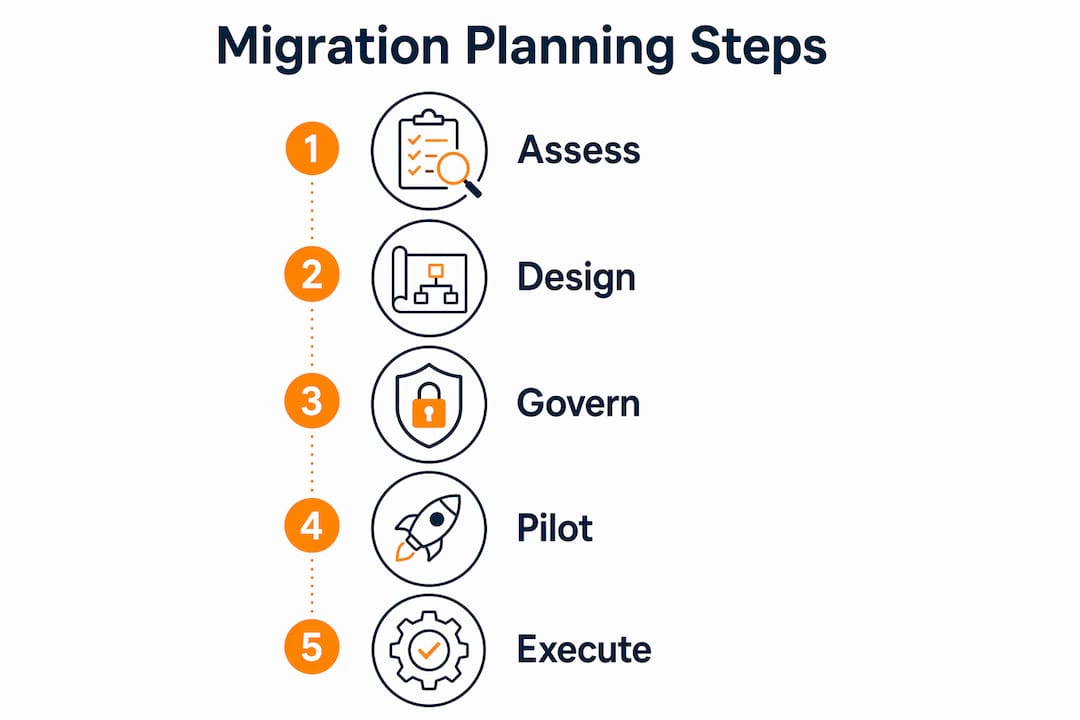
Migration planning functions as the strategic backbone of any cloud transition. Without it, technical teams execute in isolation, stakeholders receive surprises, and the business absorbs costs that were entirely avoidable. The five core phases of a sound migration plan are assessment, design, testing, execution, and post-migration optimization. Each phase builds on the last, and skipping any one of them compounds risk in the phases that follow.

The assessment phase is where most value is created and most shortcuts are taken. Auditing and retiring 15 to 25% of unused data before migration begins can reduce total migration effort by 20 to 30%. That means a project scoped at six months could realistically complete in four, simply by cleaning up what does not need to move. IT leaders who treat data hygiene as optional are effectively paying to migrate junk.
Governance and stakeholder alignment belong in the planning phase, not the execution phase. When business owners, security teams, and IT architects agree on objectives before a single workload moves, the project has a defined scope, a shared definition of success, and a clear escalation path when problems arise. Projects that skip this alignment routinely experience scope creep that adds months and budget overruns measured in six figures.
Pro Tip: Build your rollback plan before you build your migration plan. Rollback plans must define triggers, reversion timelines, and the specific personnel authorized to execute them. Test the rollback with the same rigor you apply to the migration itself.
Pilot migrations are another underused planning tool. Running a non-critical workload through the full migration process before committing production systems reveals integration gaps, performance bottlenecks, and configuration errors at a fraction of the cost of discovering them mid-project. For a practical migration planning checklist that covers these phases in detail, IT-Magic has published a structured resource aligned with AWS best practices.
How does migration planning impact project outcomes?
The financial case for structured planning is not theoretical. Poorly planned migrations exceed budgets by 30 to 50% and slip timelines by at least six months. That is not a minor inconvenience. For a mid-market company, a six-month delay in cloud adoption means six additional months of legacy infrastructure costs, six months of delayed performance improvements, and six months of competitive disadvantage.
The contrast with well-planned migrations is stark. Organizations that invest in structured planning unlock operational cost reductions of 30 to 50% within 18 months of migration completion. Those savings come from right-sized cloud resources, eliminated redundant systems, and automated operations that previously required manual intervention.
| Scenario | Budget impact | Timeline impact | Post-migration outcome |
|---|---|---|---|
| Poor or no planning | 30 to 50% over budget | 6+ months delayed | Ongoing instability, technical debt |
| Structured migration planning | On budget or under | On schedule | 30 to 50% operational cost reduction within 18 months |
The average business loses approximately $315,000 per migration project from timeline delays, security gaps, and incorrect tool selection. That figure represents real revenue lost to preventable mistakes. Security gaps in particular carry consequences beyond the migration itself, including compliance violations, breach liability, and reputational damage that no post-migration optimization can reverse.
Business disruption is the risk that executives feel most acutely. When a migration lacks a tested cutover plan, production systems go down during business hours, customer-facing applications become unavailable, and the IT team spends its first week in the cloud firefighting rather than optimizing. Structured planning eliminates this scenario by defining cutover windows, communication protocols, and fallback procedures before the first workload moves.
What strategic frameworks optimize cloud migration planning?
The six migration strategies, commonly called the 6 Rs, give IT leaders a structured vocabulary for deciding how each workload should move. The six options are rehost (lift and shift), replatform (lift and reshape), repurchase (replace with SaaS), retain (keep on-premises), retire (decommission), and refactor (re-architect for cloud-native). Applying the right strategy to each workload is itself a planning activity, and it requires workload-level assessment rather than a blanket decision applied to the entire portfolio.
IT-Magic applies this framework on every engagement. For eCommerce and fintech clients where performance and compliance are non-negotiable, refactoring is often the right call for core transaction systems, while peripheral tools get rehosted or retired. The right migration strategy depends on workload criticality, technical debt, and the organization’s tolerance for re-architecture investment.
The choice between a Big Bang migration and a phased approach is one of the most consequential decisions in migration planning. Big Bang migrations move everything at once, which minimizes the period of running parallel environments but concentrates all risk into a single cutover event. Big Bang migrations carry high failure rates, while phased approaches with feedback loops limit disruption and produce smoother subsequent migrations.
The phased approach most suited to complex IT environments is the strangler fig pattern. It works by routing traffic incrementally to new cloud infrastructure while the legacy system remains live, allowing teams to validate each component before decommissioning the old one. Strangler fig migrations offer controlled risk with incremental validation, making them the preferred choice for organizations with high-load or compliance-sensitive workloads.
Pro Tip: Start cloud cost governance on day one of migration, not after go-live. Tagging resources, setting budget alerts, and defining ownership policies during the planning phase prevents the cost sprawl that erases cloud savings in the first quarter.
- Map every workload to one of the 6 Rs before writing a migration timeline.
- Define your phased migration sequence based on workload criticality and dependency mapping.
- Build a testing and validation gate between each migration phase.
- Assign cloud cost ownership to a named team or individual before migration begins.
- Schedule a formal post-migration review at 30, 60, and 90 days after cutover.
What challenges commonly arise in migration planning?
Data complexity is the most consistently underestimated challenge in migration projects. Organizations frequently discover that their data estate contains duplicate records, orphaned files, deprecated schemas, and compliance-sensitive data that was never properly classified. Moving all of it without prior cleanup increases cost, time, and the surface area for errors. The solution is a pre-migration data audit that categorizes data by business value, regulatory requirement, and migration readiness.
Scope creep is the second most common cause of budget and timeline overruns. It typically begins when stakeholders who were not involved in the planning phase introduce new requirements during execution. A migration that was scoped to move 40 workloads quietly becomes a 60-workload project because a department head requested additions after the plan was locked. Formal change control processes and a clearly documented scope baseline are the only reliable defenses against this pattern.
Security and compliance gaps create a different category of risk. Migrations that move data across environments without validating encryption standards, access controls, and audit logging can introduce vulnerabilities that did not exist in the legacy environment. For fintech and healthcare organizations, these gaps can trigger regulatory penalties that dwarf the cost of the migration itself. Security requirements belong in the assessment phase, not as a post-migration checklist item.
Pro Tip: The first 30 to 90 days post-migration are the highest-risk period for any cloud transition. Reinforce support protocols during this window rather than treating cutover as the finish line. Assign dedicated resources to monitor performance, resolve incidents, and capture lessons learned.
Change management is the challenge that technical teams most often ignore. Users who interact with migrated systems need training, communication, and a clear point of contact for issues. Organizations that treat migration as a purely technical event and skip change management find that adoption lags, workarounds proliferate, and the business value of the migration takes years to materialize. For a broader view of how cloud consultants manage governance and change through complex transitions, IT-Magic has documented this in detail.
Key takeaways
Effective migration planning is the single greatest predictor of whether a cloud transition delivers its promised value or becomes a costly, extended recovery project.
| Point | Details |
|---|---|
| Planning prevents overruns | Unstructured migrations exceed budgets by 30 to 50% and slip timelines by six months or more. |
| Data audits reduce scope | Retiring 15 to 25% of unused data before migration cuts total effort by up to 30%. |
| Phased beats Big Bang | Strangler fig and phased approaches reduce risk and allow incremental validation in complex environments. |
| Governance starts at day one | Cloud cost controls and ownership policies must be defined during planning, not after go-live. |
| Post-migration is not the finish line | The 30 to 90 day window after cutover requires reinforced support and formal review cycles. |
Migration is a business decision, not just a technical one
I have seen organizations spend months building technically sound migration plans that still fail. The reason is almost always the same: the plan treated migration as an IT project rather than a business transformation. The workloads moved. The infrastructure changed. But the business objectives that justified the migration were never formally connected to the execution plan, so no one could measure success, and no one owned the outcomes after go-live.
CIOs who treat migration as an organizational transformation strategy consistently outperform peers who delegate it as a technical task. That framing changes everything. It means migration objectives connect to IT modernization goals like tool rationalization and service management improvements. It means stakeholder alignment is not a kickoff meeting but an ongoing governance practice. It means the migration plan includes a change management workstream with the same priority as the technical workstream.
The organizations I have seen get this right share one habit: they invest heavily in the pre-migration phase and treat the post-migration period with the same intensity as cutover. The cloud total cost of ownership calculation only works in your favor if governance extends well beyond go-live. Technical debt accumulates fast in cloud environments when no one owns the ongoing optimization. The teams that plan for that reality from the start are the ones who realize the 30 to 50% cost reductions the research promises.
— Oleksandr
Ready to plan your AWS migration the right way?
IT-Magic has completed 700+ AWS migrations for eCommerce and fintech companies where downtime and cost overruns are not acceptable outcomes. As an AWS Advanced Tier Partner, IT-Magic takes full ownership of the migration lifecycle: infrastructure audit, strategy selection, hands-on execution, and post-migration optimization.
If your organization is evaluating a cloud transition and wants a migration plan built on proven architecture rather than guesswork, the AWS migration services team at IT-Magic is ready to assess your environment and define a path forward. You can also review AWS migration best practices to understand the execution standards IT-Magic applies to every project before committing to a timeline.
FAQ
What is migration planning in cloud computing?
Migration planning is the structured process of assessing workloads, selecting migration strategies, defining timelines, and establishing governance before moving IT infrastructure to a cloud environment. It covers every phase from initial data audit through post-migration optimization.
Why do so many cloud migrations fail?
Up to 83% of enterprise migration projects fail or exceed budgets primarily because of insufficient planning and underestimated data complexity. Skipping structured assessment, stakeholder alignment, and rollback planning are the most common causes of project failure.
What is the 6 Rs framework in migration planning?
The 6 Rs are six migration strategies: rehost, replatform, repurchase, retain, retire, and refactor. IT leaders apply the appropriate strategy to each workload based on its technical complexity, business criticality, and long-term architecture goals.
How long does post-migration support need to last?
The first 30 to 90 days after cutover represent the highest-risk period and require reinforced monitoring and incident response. Formal review cycles at 30, 60, and 90 days help capture issues before they become embedded technical debt.
What is the difference between Big Bang and phased migration?
A Big Bang migration moves all workloads at once, concentrating risk into a single cutover event. A phased migration moves workloads incrementally, allowing teams to validate each component and apply feedback before proceeding, which significantly reduces the probability of widespread failure.