TL;DR:
- A PCI DSS compliant AWS migration involves moving payment data workloads with proper segmentation, encryption, and access controls. Completing compliance can take four to twelve months, depending on workload scope and security readiness. Post-migration ongoing monitoring ensures continued PCI DSS adherence through automated tools and regular assessments.
A PCI DSS compliant AWS migration is the process of moving payment card data workloads to Amazon Web Services while meeting all Payment Card Industry Data Security Standard requirements through proper segmentation, encryption, access control, and continuous monitoring. AWS holds PCI DSS Level 1 certification, the highest available, maintained through continuous assessments by Qualified Security Assessors. That certification covers the infrastructure layer. Your organization still owns the controls applied to data, applications, and access. Achieving full compliance takes 4–12 months depending on workload scope and existing security maturity.
What are the prerequisites for a PCI DSS compliant AWS migration?
Preparation determines whether your migration succeeds or stalls at audit time. Compliance officers and IT security managers who skip scoping work early end up rebuilding architecture mid-project.

Define your cardholder data environment
The cardholder data environment (CDE) is every system that stores, processes, or transmits primary account numbers (PANs) and related cardholder data. PCI DSS scope covers the CDE and every system connected to it. Defining this boundary tightly is the single most effective way to reduce compliance cost and complexity. Systems outside the CDE face fewer controls, so a narrow, well-documented scope saves significant effort.
Understand the AWS shared responsibility model
AWS secures the physical infrastructure, hypervisor, and certified managed services. Your organization secures the operating systems, applications, data, and network configurations you deploy on top. The AWS Artifact portal provides the Attestation of Compliance (AOC) and AWS Responsibility Summary, which clarify exactly where AWS obligations end and yours begin. Review both documents before your migration plan is finalized.
Build the right team and documentation
A compliant migration requires collaboration across three functions: cloud engineering, information security, and compliance. Assign a Qualified Security Assessor (QSA) or internal compliance lead to review architecture decisions before implementation. Document governance policies for every PCI DSS control domain, including access management, encryption, logging, and incident response. Gaps in documentation are the most common reason audits fail, not gaps in technical controls.
Key preparatory steps before migration begins:
- Map all systems that touch cardholder data and document data flows
- Assess your current environment’s compliance status and technical debt
- Identify which AWS services are in scope for PCI DSS and verify their certification status
- Establish change management and approval workflows for CDE modifications
- Assign ownership for each PCI DSS requirement to a named team or individual
Which AWS services support PCI DSS compliance during migration?
AWS provides a full set of native security controls for PCI DSS, including VPC segmentation, Security Groups, Network Firewalls, KMS encryption, CloudTrail logging, and GuardDuty threat detection. Each maps directly to specific PCI DSS requirements. Knowing which service covers which requirement prevents both over-engineering and compliance gaps.
Network segmentation and access control
Isolate your CDE inside a dedicated Virtual Private Cloud (VPC) with private subnets. Place no CDE resources in public subnets. Use Security Groups as stateful firewalls at the instance level and Network Access Control Lists (NACLs) at the subnet level. Deploy AWS Network Firewall for deep packet inspection and centralized traffic filtering across your CDE boundary. AWS WAF protects web-facing applications from injection attacks and other OWASP Top 10 threats that directly affect PCI DSS Requirement 6.
For containerized workloads, Amazon EKS supports PCI DSS compliance through Kubernetes namespaces, network policies, Pod Security Standards, and IAM role-based access. Dedicated hosts are not required when these controls are properly configured.
Encryption for data at rest and in transit
AWS Key Management Service (KMS) manages encryption keys for EBS volumes, S3 buckets, RDS databases, and most managed services. For workloads requiring hardware-backed key storage, AWS CloudHSM provides FIPS 140-2 Level 3 validated modules. PCI DSS Requirement 3.5.1.2 specifically requires encrypting PANs before storage. Encrypt PAN data using the AWS Encryption SDK in addition to KMS to meet this requirement on EBS volumes.
Pro Tip: Use AWS KMS key policies to enforce separation of duties. Require two separate IAM roles to decrypt CDE data: one to request decryption and one to authorize it. This satisfies PCI DSS dual-control requirements without custom tooling.
Logging, monitoring, and threat detection
| AWS Service | PCI DSS Function | Requirement Covered |
|---|---|---|
| AWS CloudTrail | API activity logging | Requirement 10 (audit logs) |
| AWS Config | Configuration change tracking | Requirement 11 (change monitoring) |
| Amazon CloudWatch | Metrics, alerts, and dashboards | Requirement 10 (log review) |
| Amazon GuardDuty | Threat detection and anomaly alerts | Requirement 11 (intrusion detection) |
| AWS Security Hub | Centralized compliance findings | Requirement 12 (security management) |
Enable CloudTrail in all regions, not just your primary region. Attackers frequently exploit inactive regions to avoid detection. Store CloudTrail logs in a dedicated S3 bucket with object lock enabled to prevent tampering, which satisfies PCI DSS log integrity requirements.
What is the step-by-step process for a compliant migration to AWS?
AWS recommends a migrate-first approach for complex PCI environments: rehost or replatform workloads to establish a stable cloud foundation before any refactoring. This reduces the number of variables in play during compliance validation. Refactoring while migrating multiplies risk and extends your compliance timeline.
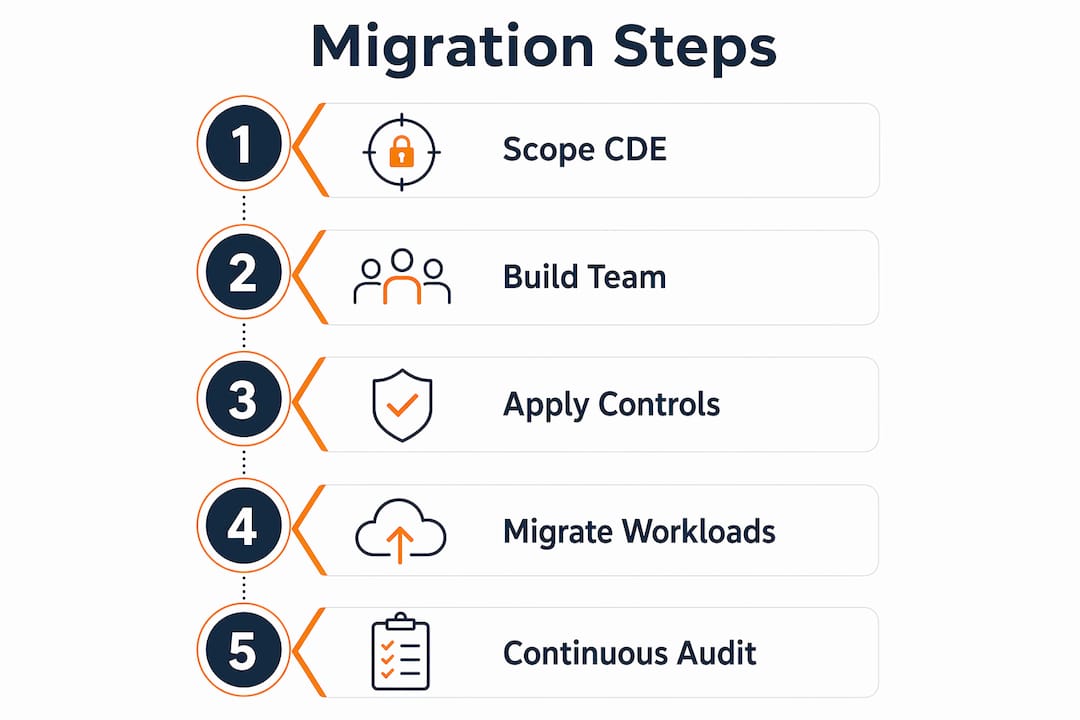
Follow this sequence for a compliant migration:
- Validate AWS service PCI status. Confirm every AWS service in your architecture appears on the current AWS PCI DSS Services in Scope list. Services not on that list cannot be used to process, store, or transmit cardholder data.
- Build the CDE architecture before migrating data. Deploy VPCs, subnets, Security Groups, Network Firewalls, and IAM policies. Apply encryption to all storage targets. Verify logging is active. Only move data after controls are confirmed operational.
- Migrate workloads in phases. Start with non-CDE systems to validate your migration process. Move CDE workloads last, after your team has resolved any operational issues in the non-sensitive environment.
- Run continuous vulnerability scans during migration. Use Amazon Inspector for automated vulnerability assessments on EC2 instances and container images. Do not wait until post-migration to identify weaknesses.
- Collect compliance evidence with AWS Audit Manager. The prebuilt PCI DSS v4.0 framework in AWS Audit Manager automates evidence collection mapped to specific controls. Start collecting evidence from day one of the migration, not just before the audit.
- Remediate gaps before cutover. Run a formal gap assessment against all 12 PCI DSS requirement domains. Document every finding and its remediation. Your QSA will review this record during the audit.
Pro Tip: Use AWS Config conformance packs with the PCI DSS template to get automated, continuous compliance checks across your CDE. This gives your compliance team a real-time view of control status without manual reviews.
For a detailed pre-migration planning framework, the AWS migration checklist covers security and operational readiness in one structured workflow.
How do you maintain PCI DSS compliance after migrating to AWS?
Post-migration compliance is an ongoing operational discipline, not a one-time project. PCI DSS requires annual assessments, quarterly vulnerability scans, and continuous monitoring. AWS provides the tools. Your team must configure and act on them consistently.
Ongoing compliance requires these practices:
- AWS Config rules: Deploy managed rules for PCI DSS controls, such as checking that S3 buckets are not publicly accessible, CloudTrail is enabled, and root account MFA is active. Set rules to trigger automated remediation where possible.
- AWS Security Hub: Aggregate findings from GuardDuty, Inspector, and Config into a single compliance dashboard. Security Hub maps findings to PCI DSS controls so your team can prioritize by requirement.
- IAM least privilege: Review IAM policies quarterly. Remove permissions that are no longer needed. Use AWS IAM Access Analyzer to identify overly permissive policies automatically.
- Penetration testing: PCI DSS requires annual penetration testing of the CDE. AWS permits penetration testing on your own resources without prior approval for most services. Coordinate with your QSA on scope and methodology.
- PCI DSS v4.0 readiness: Version 4.0 introduced new requirements for multi-factor authentication, customized controls, and targeted risk analysis. Review the cloud security best practices that apply to these updated requirements in AWS environments.
Pro Tip: Schedule a quarterly internal compliance review using AWS Audit Manager reports. Treat it like a mini-audit. Teams that do this consistently find and fix issues before their annual QSA assessment, which shortens audit cycles and reduces remediation costs.
Continuous monitoring and automated evidence collection with AWS Audit Manager and Config rules reduce the burden of audit preparation significantly. The goal is to make compliance a background process, not a fire drill every twelve months. For broader data protection strategies, the guide on data security on AWS covers encryption, access control, and monitoring in depth.
Key Takeaways
A PCI DSS compliant AWS migration requires tight CDE scoping, AWS-native security controls, a migrate-first execution strategy, and continuous post-migration monitoring to satisfy all 12 PCI DSS requirement domains.
| Point | Details |
|---|---|
| Define CDE scope early | Narrow, documented scope reduces compliance cost and architectural complexity. |
| Use AWS native controls | VPC segmentation, KMS, CloudTrail, and GuardDuty cover the core PCI DSS requirements. |
| Migrate first, refactor later | Rehost or replatform before modernizing to reduce risk during compliance validation. |
| Automate evidence collection | AWS Audit Manager’s PCI DSS v4.0 framework collects control evidence continuously, not just at audit time. |
| Treat compliance as ongoing | Quarterly IAM reviews, annual penetration tests, and Config rules keep controls active between assessments. |
What I’ve learned from PCI DSS migrations that most guides won’t tell you
The biggest mistake I see compliance teams make is treating PCI DSS as a checklist to complete rather than a control state to maintain. They sprint to pass the audit, then let controls drift. Six months later, a Config rule is disabled, a Security Group has been widened “temporarily,” and the CDE boundary has expanded without documentation. That is how organizations fail their next assessment after passing the first one.
The second mistake is underestimating scope creep. Every system that touches the CDE falls under PCI DSS. Teams add a logging server, a monitoring agent, or an analytics pipeline and forget to assess whether it connects to cardholder data. Suddenly the scope doubles. The fix is architectural: use cloud security controls for enterprise migrations that enforce strict network boundaries from the start, so new systems cannot accidentally join the CDE without a deliberate architecture change.
The migrate-first approach genuinely works. I have seen teams try to refactor and migrate simultaneously in PCI environments. The compliance evidence becomes inconsistent, the architecture changes mid-audit, and the QSA cannot validate a moving target. Rehost first. Stabilize. Then modernize with a clean compliance baseline already in place.
The teams that handle this best treat security and compliance as a shared engineering responsibility, not a separate audit function. When developers understand why a Security Group rule matters for PCI DSS, they stop widening it for convenience. That cultural shift is worth more than any single technical control.
— Oleksandr
How IT-Magic handles PCI DSS compliant AWS migrations
Regulated industries cannot afford compliance gaps during migration. IT-Magic has completed 700+ AWS migrations as an AWS Advanced Tier Partner, including complex fintech and eCommerce environments where PCI DSS compliance is non-negotiable.
IT-Magic takes full ownership of the migration lifecycle: infrastructure audit, CDE architecture design, security control implementation, and post-migration compliance monitoring. The team configures AWS-native tools including KMS, GuardDuty, CloudTrail, and AWS Audit Manager to meet PCI DSS requirements from day one. For organizations ready to move payment workloads to AWS without compliance risk, IT-Magic’s AWS migration services provide the execution depth and security expertise the process demands. You can also review real migration outcomes from fintech and eCommerce clients who completed compliant migrations on schedule.
FAQ
What does PCI DSS Level 1 certification mean for AWS?
AWS is a PCI DSS Level 1 Service Provider, the highest certification level, validated by an independent Qualified Security Assessor. This covers AWS infrastructure but not the applications and data your organization deploys on it.
How long does a PCI DSS compliant AWS migration take?
Achieving compliance during an AWS migration typically takes 4–12 months depending on workload complexity and your organization’s existing security maturity.
What is the migrate-first strategy for PCI environments?
The migrate-first strategy means rehosting or replatforming workloads to AWS before any refactoring. AWS recommends this approach for complex PCI environments because it creates a stable compliance baseline before modernization introduces new variables.
Which AWS service automates PCI DSS audit evidence collection?
AWS Audit Manager includes a prebuilt PCI DSS v4.0 framework that automatically collects and maps evidence to specific PCI DSS controls, reducing manual audit preparation work.
Do containerized workloads on AWS need dedicated hosts for PCI DSS?
No. Amazon EKS supports PCI DSS compliance through Kubernetes namespaces, network policies, and IAM controls without requiring dedicated hosts, provided all required security configurations are correctly applied.