TL;DR:
- Migrating from a monolith to microservices on AWS involves a staged approach emphasizing internal boundary enforcement and operational readiness. The process includes a modular monolith stage, careful service extraction, and implementing CI/CD, observability, and appropriate AWS compute platforms. The migration generally takes 18 to 36 months, with costs rising due to increased operational overhead but yielding benefits such as faster deployment and improved fault isolation.
Migrating from a monolith to microservices on AWS is defined as the process of decomposing a single, tightly coupled application into independently deployable, domain-aligned services running on AWS infrastructure. The industry term for this approach is service decomposition, and it delivers three concrete outcomes: independent scaling per service, faster deployment cycles, and team autonomy. Enterprise migrations typically take 18–36 months, with teams extracting one to two services per quarter. That timeline reflects real complexity. Teams that skip preparation stages consistently overspend and underdeliver. A staged approach, starting with a modular monolith and progressing through incremental extraction, is the method that works.
How to prepare for monolith to microservices on AWS
The biggest mistake teams make is jumping straight from a monolith to distributed services. Successful migrations progress through a modular monolith stage first, enforcing domain boundaries and reducing coupling inside a single deployment before any service is extracted. This intermediate step is not optional. It is the foundation that prevents the most expensive failure mode in this space: the distributed monolith, where services exist but remain tightly coupled through shared databases and synchronous chains.

Domain boundary identification is the first concrete task. Teams map the codebase into bounded contexts aligned with business capabilities: payments, inventory, user management, and so on. Each context becomes a module with a defined interface. Code that crosses those interfaces gets refactored before extraction begins. This work takes time, but it compresses the risk of every subsequent migration phase.
Operational prerequisites must be in place before the first service reaches production. CI/CD pipelines, monitoring, and observability are prerequisites, not post-migration goals. Without mature deployment pipelines and distributed tracing, microservices add coordination complexity faster than they remove it. Teams need centralized logging, health checks, and automated rollback before they extract a single service.
Team readiness matters as much as technical readiness. Developers accustomed to a monolith need training on container operations, service contracts, and API versioning. Budget 6–9 months before the first extracted service reaches production for infrastructure setup and team training. That window feels long. It pays for itself by preventing production incidents caused by operational gaps.
Key preparation steps before extraction begins:
- Map bounded contexts and enforce module interfaces inside the monolith
- Stand up CI/CD pipelines with automated testing and rollback
- Deploy centralized logging and distributed tracing (AWS CloudWatch, AWS X-Ray)
- Train teams on container operations and API contract management
- Define service ownership so each extracted service has a clear team responsible for it
Pro Tip: Use AWS Application Discovery Service during the preparation phase to map dependencies across your monolith. Hidden cross-module calls are the most common source of extraction failures.
What AWS services should you use for microservices deployment?
AWS offers three primary compute platforms for microservices, and choosing the wrong one adds operational cost without adding capability. ECS on Fargate suits steady request/response microservices, Lambda fits event-driven bursty workloads, and EKS applies when Kubernetes orchestration is specifically required. Each platform has a different operational profile, and mixing them across services based on workload type is correct practice.
Containers solve environmental inconsistency by standardizing the runtime across development, staging, and production. That consistency is critical when you run dozens of services written by different teams. Without it, “works on my machine” becomes a production incident. AWS App2Container automates containerization of existing Java and .NET applications directly to ECS or EKS, which removes weeks of manual Dockerfile work for teams migrating legacy codebases.
| Compute platform | Best fit | Operational complexity |
|---|---|---|
| ECS on Fargate | Steady HTTP microservices | Low |
| AWS Lambda | Event-driven, bursty workloads | Very low |
| Amazon EKS | Advanced orchestration, multi-tenant | High |
EKS provides a production-ready Kubernetes control plane with native AWS integrations, Kubernetes network policies, and pod-level IAM. That security depth matters for fintech and eCommerce workloads. The tradeoff is real: EKS demands Kubernetes expertise that most teams building their first microservices architecture do not yet have. Start with ECS unless your team already operates Kubernetes in production.
For teams evaluating AWS service options across the full migration lifecycle, the service selection decision should be locked before extraction begins, not revisited mid-migration. Changing compute platforms mid-project doubles the work.
Pro Tip: Use AWS Transform (formerly Migration Hub Refactor Spaces) to create an API routing layer over your monolith before extraction. This gives you a traffic control point for the Strangler Fig pattern without touching the monolith’s internal code.
How does the Strangler Fig pattern work on AWS?
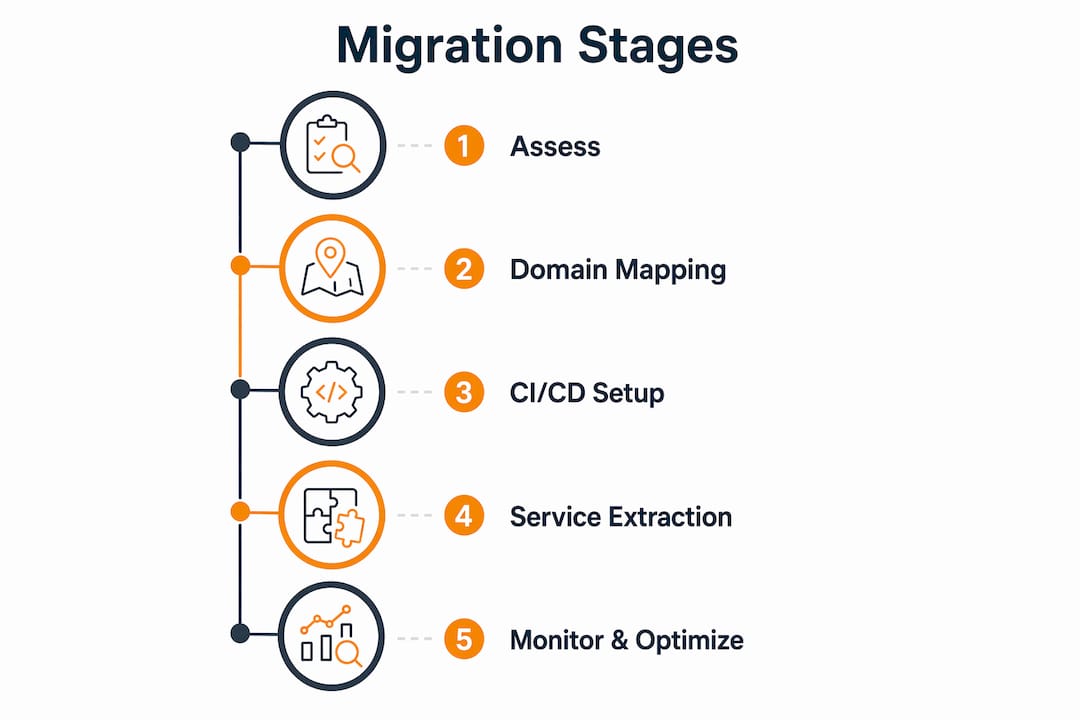
The Strangler Fig pattern is the industry-standard method for incremental service extraction. It works by routing traffic through an API gateway that sits in front of both the monolith and the new microservice. As each service matures, traffic shifts from the monolith to the new service until the monolith component is decommissioned. A single domain service migration using this pattern takes 4–12 weeks across five phases.
The five phases of a single service extraction:
- CDC setup. Deploy Change Data Capture streaming from the monolith’s database transaction logs to the new service’s data store. CDC synchronization lag stays within 1–2 seconds, which means the new service’s data is current enough for read traffic immediately.
- Domain overlay. Build the new microservice alongside the monolith. The service reads from its own data store, which CDC keeps synchronized with the monolith’s source of truth.
- Read routing. Switch read traffic to the new microservice through the API gateway. The monolith continues handling all writes. This phase validates the new service under real production load with zero write risk.
- Write cutover. Migrate write operations to the new service. The monolith becomes a consumer of the new service’s API for that domain. A read-first approach enables instant rollback by switching the API gateway back to the monolith if writes fail.
- Decommission. Remove the monolith component and its database tables for that domain. The service now owns its data independently.
Database decomposition is the hardest part of this process. Shared schemas create hidden coupling that survives service extraction. Each extracted service must own its data store. The saga pattern handles distributed transactions across services: instead of a single database transaction, each service publishes events that trigger compensating actions in other services if a step fails. AWS EventBridge and Amazon SQS are the standard tools for implementing event-driven sagas on AWS.
| Migration phase | Duration | Rollback option |
|---|---|---|
| CDC setup | 1–2 weeks | Full: monolith unchanged |
| Domain overlay | 1–3 weeks | Full: monolith unchanged |
| Read routing | 1–2 weeks | Instant: API gateway switch |
| Write cutover | 1–3 weeks | Fast: API gateway switch |
| Decommission | 1–2 weeks | None: service is live |
For teams planning scalable infrastructure migration steps, the write cutover phase is where most production incidents occur. Test rollback procedures in staging before every write cutover. Treat rollback as a planned operation, not an emergency response.
The modular monolith stage described earlier pays off most visibly here. Teams that enforced domain boundaries before extraction find that CDC setup and domain overlay take days, not weeks. Teams that skipped that stage spend the first two phases untangling shared code that should have been separated months earlier.
What are the real costs and benefits of microservices on AWS?
The operational overhead of microservices is real and quantifiable. Infrastructure overhead increases 30–50% due to container orchestration, service mesh, distributed logging, and monitoring. That cost increase is not a bug. It is the price of independent deployability and fault isolation. Teams that treat it as a surprise have not planned the migration correctly.
“The distributed monolith is the worst outcome of a microservices migration. You pay the full operational cost of distributed systems while keeping all the coupling of the original monolith. It happens when teams extract services without enforcing data ownership or removing synchronous dependencies.”
Direct engineering costs range from $500,000 to $5,000,000 depending on system scale, and ROI typically materializes over 18–24 months. The return comes from faster deployment velocity, independent scaling of high-traffic services, and reduced blast radius when a service fails. A payment service outage no longer takes down the entire application.
Common pitfalls that destroy ROI:
- Premature extraction of services before domain boundaries are clear
- Shared databases between “independent” services, which recreates monolith coupling
- Skipping distributed tracing, which makes debugging across services nearly impossible
- Treating the API gateway as optional, which removes the traffic control mechanism the Strangler Fig depends on
The teams that see ROI within 18 months share one characteristic: they invested in AWS migration best practices before extraction, not after. CI/CD maturity and observability coverage are the two metrics that predict migration success more reliably than any architectural decision.
Key Takeaways
Migrating from a monolith to microservices on AWS requires a staged approach: modular monolith first, then incremental service extraction using the Strangler Fig pattern, with CI/CD and observability in place before the first service goes live.
| Point | Details |
|---|---|
| Modular monolith first | Enforce domain boundaries inside the monolith before extracting any service to prevent distributed coupling. |
| Match AWS compute to workload | Use ECS for steady services, Lambda for event-driven workloads, and EKS only when Kubernetes expertise exists. |
| Strangler Fig with CDC | Extract services incrementally using CDC streaming and a read-first approach to enable instant rollback. |
| Budget for overhead | Expect 30–50% infrastructure cost increase; plan for ROI over 18–24 months, not immediately. |
| CI/CD and observability first | Mature pipelines and distributed tracing are prerequisites, not post-migration additions. |
What I’ve learned from watching migrations succeed and fail
The teams that struggle most with service decomposition are not the ones with the worst codebases. They are the ones that underestimate the organizational change required. Microservices are a team topology decision as much as an architecture decision. When a single team owns the monolith, extracting services without reassigning ownership just creates a distributed monolith with extra steps.
My strongest recommendation is to resist the pressure to extract more than one or two services per quarter in the early phases. The temptation to accelerate is real, especially after the first successful extraction. But each new service adds operational surface area. Teams that move too fast accumulate observability debt and end up debugging production incidents across a dozen services with inadequate tracing.
AWS managed services genuinely reduce the operational burden here. ECS on Fargate removes cluster management entirely. AWS X-Ray provides distributed tracing without custom instrumentation. EventBridge handles event routing without managing message broker infrastructure. These are not marketing claims. They are the specific tools that make the difference between a migration that delivers ROI and one that stalls in operational complexity.
The modular monolith stage is the part most teams want to skip. Every team I have seen skip it has regretted it. The six months spent enforcing boundaries inside the monolith saves twelve months of painful extraction work later. Treat it as the real migration, not the preparation for the migration.
— Oleksandr
How IT-Magic accelerates your migration to microservices
Moving from a monolith to a distributed architecture on AWS is one of the highest-risk infrastructure projects a development team undertakes. IT-Magic has completed 700+ AWS migrations as an AWS Advanced Tier Partner, including complex refactoring projects for eCommerce and fintech environments where downtime translates directly into lost revenue.
IT-Magic takes full ownership of execution: infrastructure audit, migration strategy, hands-on implementation, and post-migration optimization. For teams modernizing monolithic applications, that means applying the right decomposition pattern for your codebase, selecting the correct AWS compute platform, and standing up the observability stack before the first service goes live. Explore IT-Magic’s AWS migration services to see how a structured, risk-managed approach applies to your environment. Teams dealing with high-load systems can also review migration pitfall prevention strategies built from real project experience.
FAQ
How long does a monolith to microservices migration take?
Enterprise migrations typically take 18–36 months, with one to two services extracted per quarter. Teams should budget 6–9 months before the first extracted service reaches production.
What is the Strangler Fig pattern in AWS migrations?
The Strangler Fig pattern routes traffic through an API gateway that sits in front of both the monolith and the new microservice, shifting traffic incrementally until the monolith component is decommissioned. A single service extraction takes 4–12 weeks.
Should I use ECS, EKS, or Lambda for microservices on AWS?
Use ECS on Fargate for steady HTTP microservices, Lambda for event-driven bursty workloads, and EKS only when your team already has Kubernetes expertise and requires advanced orchestration.
What is a distributed monolith and how do I avoid it?
A distributed monolith occurs when services are extracted but remain coupled through shared databases or synchronous dependency chains. Avoid it by enforcing per-service data ownership and removing synchronous cross-service calls before extraction.
What does microservices migration cost on AWS?
Direct engineering costs range from $500,000 to $5,000,000 depending on system scale, with infrastructure overhead increasing 30–50%. ROI typically occurs over 18–24 months through faster deployments and independent scaling.