TL;DR:
- Organizations must integrate compliance into cloud governance from day one to avoid costly risks and failures. The shared responsibility model clarifies obligations, emphasizing the importance of proactive data and access management across service types. Continuous evidence collection and strict control verification during migration turn compliance into a strategic business advantage beyond mere regulation.
Most organizations treat compliance as the final sign-off before going live in the cloud. That instinct is costly. The role of compliance in cloud migration starts before the first workload moves, runs through every migration wave, and continues long after the cutover. Regulatory requirements for cloud migration don’t pause while your infrastructure changes, and regulators don’t grant grace periods for organizations in transition. Getting this right means building compliance into your governance model from day one, not scrambling to retrofit controls after the fact.
Table of Contents
- Key takeaways
- The role of governance frameworks in cloud compliance
- Understanding the shared responsibility model
- Compliance during the active migration phase
- Data governance and regulatory requirements
- Compliance as a business asset beyond migration
- My perspective on where compliance really breaks down
- How Awsmigrationservices handles compliance from day one
- FAQ
Key takeaways
| Point | Details |
|---|---|
| Compliance starts before migration | Build governance frameworks and assign responsibilities before moving a single workload to the cloud. |
| Shared responsibility creates gaps | Misreading what your cloud provider covers versus what you own is the most common source of compliance failures. |
| No grace period exists | Regulatory controls must translate from day one of migration, not after cutover is complete. |
| Data classification drives decisions | Knowing what data you hold and where it can legally reside shapes every technical architecture choice. |
| Compliance accelerates trust | Strong compliance programs reduce audit cycles, speed up procurement, and lower long-term operational risk. |
The role of governance frameworks in cloud compliance
Compliance failures arise primarily from poor governance structure, not from technology limitations. A cloud governance framework defines the policies, controls, and enforcement mechanisms that keep your migration aligned with regulatory requirements from the start. Without one, compliance becomes reactive. Teams scramble to apply controls after architecture decisions have already locked in risk.
A properly constructed governance framework does several things at once. It maps your regulatory environment, such as HIPAA for healthcare or PCI DSS for payment data, to specific technical controls. It assigns clear ownership across security, engineering, and compliance teams. It sets the guardrails that prevent unauthorized configurations from ever reaching production.
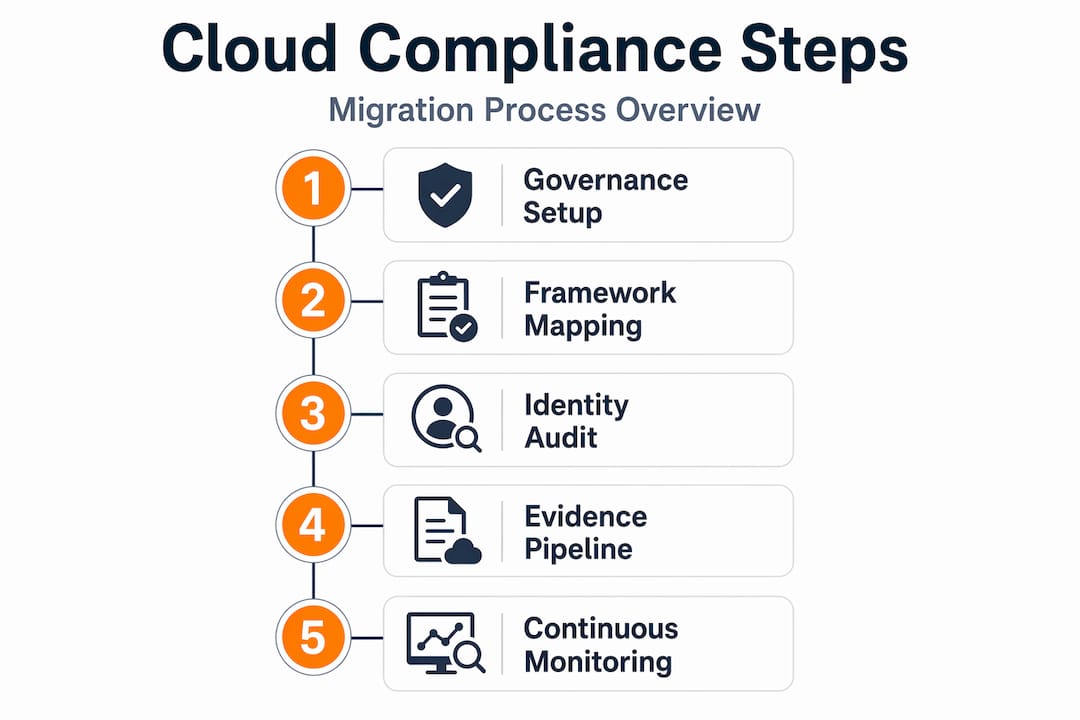
The cloud migration compliance guidelines that matter most are not checklists. They are living policies enforced by automated mechanisms. For example, AWS Service Control Policies can block any action that would move sensitive data outside an approved region, regardless of who initiates the request. That kind of enforcement doesn’t require manual review after the fact.
Key elements of an effective cloud governance framework include:
- Policy definitions that translate regulatory language into specific technical requirements
- Role clarity documented through RACI matrices so every compliance obligation has an owner
- Continuous audit processes that validate controls at every migration phase, not just at completion
- Cost and performance guardrails that prevent compliance trade-offs being made silently under delivery pressure
- Incident response alignment so compliance evidence is preserved when security events occur
Pro Tip: Map your governance framework to your specific regulatory environment before you select cloud services. Choosing the wrong storage class or compute region after workloads are live costs far more to remediate than getting the architecture right beforehand.
The role of governance in cloud migration is to make compliance a structural property of your environment, not a property of individual team members’ diligence.
Understanding the shared responsibility model
Misunderstanding shared responsibility is one of the most common causes of compliance failures in cloud migration. The model divides security and compliance obligations between the cloud provider and the customer based on the service type: IaaS, PaaS, or SaaS. The provider secures the physical infrastructure, the hypervisor, and the underlying network. You own everything you deploy on top of it.
The practical implication is stark. AWS secures its data centers and guarantees the integrity of the underlying compute fabric. You are responsible for identity and access management, data classification, encryption configuration, and network access controls. In an IaaS model, that responsibility is extensive. In SaaS, it narrows but never disappears entirely.
| Service model | Provider responsibility | Customer responsibility |
|---|---|---|
| IaaS | Physical infrastructure, hypervisor, network hardware | OS patching, IAM, encryption, firewall rules, data |
| PaaS | Infrastructure plus runtime and middleware | Application code, IAM, data handling, access controls |
| SaaS | Everything up to the application layer | User access management, data inputs, configuration |
Identity management failures are one of the most frequent customer responsibility lapses during migration. Teams moving quickly often grant overly broad IAM permissions to reduce friction during the transition. Those permissions stay in place long after migration completes, creating a persistent compliance exposure.
Pro Tip: Conduct an IAM audit at each migration wave, not just at project close. Temporary elevated access granted to ease a migration step has a documented history of becoming permanent by default.
Documenting responsibilities using RACI matrices is not bureaucracy. The UK’s DWP cloud security policy mandates explicit responsibility allocation and RACI documentation as required artifacts for regulated cloud deployments. It is the difference between a compliance posture you can defend and one you can only hope holds up under scrutiny.
Compliance during the active migration phase
There is no grace period. Regulatory and data privacy obligations apply from the moment data begins moving, not after migration is declared complete. That window between source and destination is precisely where compliance risk concentrates.
The migration phase introduces specific vulnerabilities that a stable production environment does not have. Configuration drift occurs when teams apply temporary workarounds to get workloads moving and never close them out. Data in transit between on-premises systems and cloud environments can be exposed if encryption is not applied consistently. IAM permissions expand to allow migration tooling access and then are not revoked.

The most dangerous period is during migration waves, when multiple workloads move simultaneously. Transient misconfigurations during these waves are a well-documented source of security failures. The solution is control verification gates: a defined set of compliance checks that must pass before each wave proceeds.
Operational practices that hold compliance together during active migration include:
- Encryption in transit and at rest applied before workloads move, not as a post-migration hardening step
- Change control documentation for every configuration applied during migration, creating an audit trail
- Validation gates between migration waves that verify IAM permissions, security group rules, and data residency settings
- Evidence collection at each gate, feeding the compliance documentation that auditors will later review
- Incident response readiness so any exposure detected during migration triggers a response, not a delay in the migration timeline
The importance of compliance in cloud environments like FedRAMP is instructive here. FedRAMP continuous monitoring requires ongoing evidence management, monthly reporting, and vulnerability management throughout the lifecycle. Organizations migrating to FedRAMP-authorized environments quickly discover that compliance is an operational function, not a project milestone.
Pro Tip: Build your evidence pipeline during migration, not after it. Every wave should produce compliance artifacts automatically, through logging, configuration snapshots, and access reviews. Reconstructing evidence after the fact is expensive and often incomplete.
Data governance and regulatory requirements
Data classification is the foundation of regulatory compliance in cloud migration. Not all data carries the same risk, and not all data can legally reside in the same place. Before a single byte migrates, you need a clear map of what you hold, how sensitive it is, and where regulations require it to be stored and processed.
Jurisdictional complexity grows quickly when cloud infrastructure spans regions. GDPR restricts where EU personal data can be processed. HIPAA requires controls around protected health information regardless of where it travels. A fintech company operating across multiple markets may face four or five overlapping regulatory frameworks, each with specific storage location requirements.
The contractual layer matters as much as the technical layer. Embedding legal and procurement artifacts as technical requirements means your Data Processing Agreements and Business Associate Agreements are not separate legal documents. They actively constrain which cloud services you can select and how your architecture must be configured.
Practical steps for managing data governance during migration:
- Classify all data assets before migration begins, assigning sensitivity tiers and identifying applicable regulations for each.
- Map jurisdictional requirements to specific AWS regions and services, documenting which workloads must stay within which geographic boundaries.
- Execute DPAs and BAAs with your cloud provider and any third-party tools used during migration before data transfer begins.
- Conduct supplier due diligence on migration tooling vendors, verifying that their data handling practices meet your regulatory obligations.
- Validate architecture against legal requirements at each design review, treating compliance requirements as constraints, not as optional enhancements.
| Regulation | Primary requirement | Cloud migration impact |
|---|---|---|
| GDPR | EU personal data processing controls | Restricts region selection and data transfer mechanisms |
| HIPAA | PHI protection and audit logging | Requires BAAs, specific access controls, and encryption |
| PCI DSS | Cardholder data environment isolation | Network segmentation and continuous compliance validation |
| FedRAMP | Continuous monitoring for federal data | Ongoing evidence pipeline and ConMon reporting |
Compliance as a business asset beyond migration
Strong compliance programs accelerate procurement and trust, reduce audit cycles through automated guardrails, and lower the cost of demonstrating security posture to enterprise customers. Compliance is a commercial advantage, not merely a regulatory burden.
Organizations that build continuous evidence pipelines, rather than relying on point-in-time checklists, are significantly better positioned during audits. The audit itself becomes a retrieval exercise rather than a reconstruction project. That efficiency has direct financial value: shorter audit cycles mean lower consulting costs, faster certifications, and reduced distraction for engineering teams.
The broader financial case for compliance investment is straightforward. The average cost of a data breach in regulated industries runs into millions before penalties are applied. Compliance controls that prevent misconfigurations, enforce least-privilege access, and detect anomalies early are genuinely cheaper than breach response and regulatory fines. Cloud security and compliance, when treated as a unified operational function, reduce risk exposure in ways that pure technical hardening cannot achieve alone.
Designing for ongoing cloud governance post-migration means your compliance posture does not degrade over time. Guardrails enforce policies automatically. Baseline configurations drift detection triggers alerts. Evidence pipelines feed audit systems continuously. The AWS migration checklist approach works when compliance requirements are built into the checklist from the start, not appended as a final review.
My perspective on where compliance really breaks down
I’ve seen organizations with excellent technology stacks and sophisticated cloud architectures fail compliance audits because their teams had no shared understanding of who owned which controls. The hardest compliance challenges are not technical. They are organizational. Governance across teams and tools, not the tools themselves, is where compliance programs succeed or collapse.
What I’ve learned from watching migrations under pressure is that the migration wave window is genuinely dangerous. Teams move fast. Temporary configurations get applied and forgotten. IAM roles created for migration tooling persist in production. These are not technology failures. They are discipline failures, and no amount of automation fully compensates for a team that hasn’t internalized why the controls exist.
My practical advice for IT and compliance leadership is this: treat compliance as an evidence-producing operational function before migration begins. Build the audit trail into your migration runbooks. Make control verification a gate condition, not an optional review. And remember that the fastest migrations I’ve seen succeed are the ones that invested in cloud security upfront rather than treating security and compliance as brakes on delivery speed. They’re not. They’re the difference between a migration that holds up under scrutiny and one that quietly accumulates risk.
— Oleksandr
How Awsmigrationservices handles compliance from day one
Compliance isn’t a phase Awsmigrationservices adds at the end. It’s built into every migration engagement from the infrastructure audit through post-migration optimization.
As an AWS Advanced Tier Partner with 700+ completed projects, Awsmigrationservices brings proven governance frameworks, IAM discipline, and continuous monitoring practices to every engagement. Whether your environment falls under HIPAA, PCI DSS, GDPR, or FedRAMP requirements, the approach maps regulatory obligations to technical architecture before any workload moves. Compliance controls are enforcement mechanisms in the environment, not items on a post-go-live list. If you’re planning a migration and need a partner who takes full ownership of security and compliance outcomes, explore AWS migration services or review migration best practices to see how compliance-first migrations work in practice.
FAQ
What is the role of compliance in cloud migration?
Compliance in cloud migration defines the controls, governance structures, and regulatory obligations that must be active throughout the migration process, not just at its completion. It covers data protection, access management, audit evidence, and regulatory alignment from the first workload move through ongoing cloud operations.
When should compliance planning start for a cloud migration?
Compliance planning should start before architecture decisions are made. Governance frameworks, data classification, and regulatory mapping must be in place before migration begins, since architectural choices made early directly determine whether compliance requirements can be met at all.
What are the biggest compliance challenges in cloud migration?
The most common challenges in cloud compliance are organizational rather than technical. IAM misconfigurations, transient security gaps during migration waves, unclear ownership of compliance controls, and lack of continuous evidence pipelines are the leading causes of compliance failures during cloud migration.
How does the shared responsibility model affect cloud compliance?
The shared responsibility model determines which compliance obligations belong to the cloud provider and which belong to the customer. Customers retain full responsibility for IAM, data configuration, encryption settings, and access controls regardless of which service model they use, and misunderstanding this boundary is a frequent source of compliance exposure.
How does compliance support business outcomes beyond regulatory requirements?
Strong compliance programs reduce audit cycle times, accelerate enterprise procurement processes, and lower breach risk. Organizations with mature, automated compliance postures spend less on audit preparation, face fewer regulatory penalties, and demonstrate security credibility to customers and partners more efficiently than those treating compliance as a periodic review.