TL;DR:
- The 7 Rs of cloud migration are strategies used to move workloads efficiently to the cloud. Applying each approach based on workload-specific needs maximizes ROI and minimizes technical debt.
The 7 Rs of cloud migration are the seven strategic approaches — Rehost, Relocate, Replatform, Refactor, Repurchase, Retire, and Retain — that organizations use to move applications and workloads to the cloud. Recognized as the industry standard framework for categorizing migration strategies by effort, cost, and long-term business value, the 7 Rs give IT leaders a structured way to make workload-by-workload decisions rather than applying a single blanket approach. Without this structure, teams default to lift-and-shift for every workload, which consistently underdelivers on ROI. Understanding cloud migration options through the 7 Rs lens is the first step toward a migration that pays off.
What are the 7 Rs of cloud migration?
Each of the seven strategies targets a different combination of speed, cost, and modernization depth. Choosing the wrong one for a given workload wastes budget and creates technical debt. Here is how each strategy works in practice.
Rehost moves an application to the cloud with no code changes. It is the fastest path and works well for stable, low-complexity workloads where speed matters more than optimization. The catch: rehosting exclusively produces about 40% lower ROI compared to modernizing or refactoring workloads. That gap reflects hidden cost inefficiencies that accumulate when cloud elasticity goes unused.
Relocate moves entire virtualized environments, such as VMware clusters, to cloud infrastructure without changing the operating model. This strategy suits organizations that want to exit a data center quickly while preserving existing management tools. It requires minimal retraining and carries low execution risk.
Replatform makes targeted infrastructure changes without altering core application logic. A common example is moving a self-managed MySQL database to Amazon RDS. The application code stays the same, but the team gains managed backups, patching, and scaling. This strategy delivers meaningful operational savings with moderate effort.
Refactor rebuilds applications to use cloud-native services such as AWS Lambda, Amazon ECS, or microservices architectures. It carries the highest upfront cost and complexity. The payoff is real: cloud-native refactored applications improve developer productivity by approximately 25% and deliver higher long-term business value. Refactor is the right choice for business-critical applications where performance and agility directly affect revenue.

Repurchase replaces an existing application with a SaaS alternative. A legacy CRM migrating to Salesforce is the textbook example. This strategy eliminates infrastructure responsibility entirely but requires change management and data migration planning.
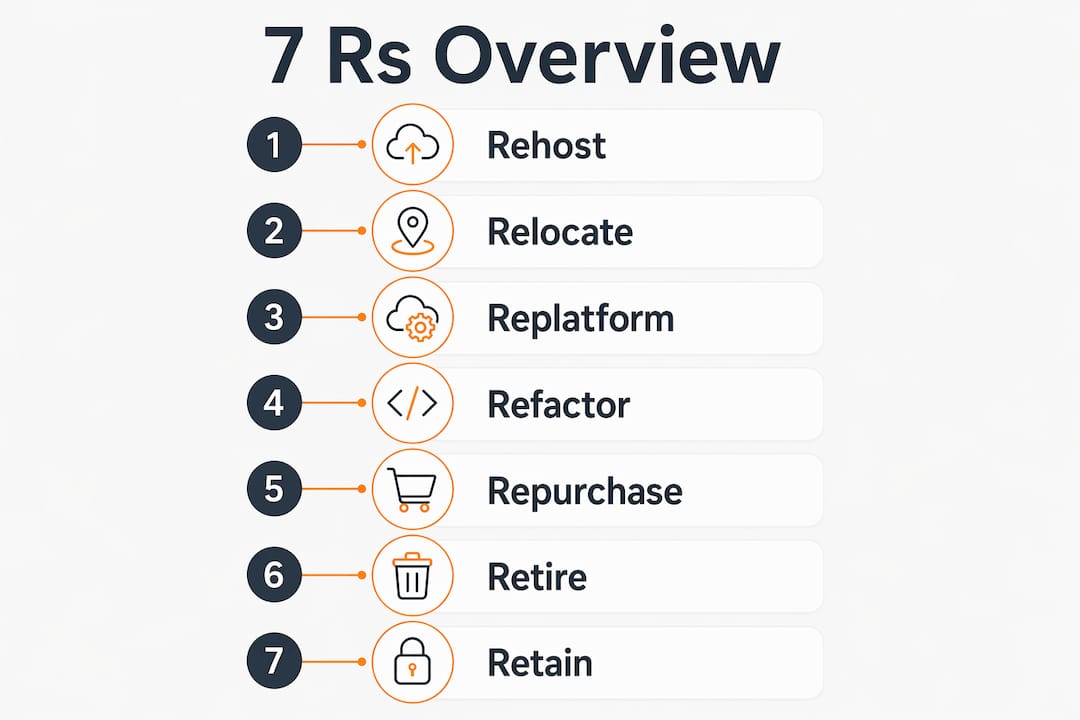
Retire decommissions applications that no longer serve a business purpose. Well-executed migrations plan for retiring between 10% and 25% of an application portfolio, which drives immediate cost savings before a single workload reaches the cloud. Retire is the most underused strategy and the fastest source of budget recovery.
Retain keeps specific workloads on-premises, either temporarily or permanently. Regulatory constraints, latency requirements, or recent hardware investments all justify this decision. Retain is not a failure to migrate. It is a deliberate choice that prevents unnecessary risk.
| Strategy | Effort | Cost | Modernization | Best for |
|---|---|---|---|---|
| Rehost | Low | Low | None | Fast exits, stable workloads |
| Relocate | Low | Low | None | VMware environments |
| Replatform | Medium | Medium | Partial | Databases, middleware |
| Refactor | High | High | Full | Revenue-critical apps |
| Repurchase | Medium | Variable | Full | Legacy SaaS replacements |
| Retire | Low | Negative (saves) | N/A | Unused or redundant apps |
| Retain | None | None | None | Regulated or recent investments |
Pro Tip: Run a Retire pass before you finalize your migration wave plan. Cutting 10–25% of your portfolio before execution reduces scope, cost, and risk across every remaining workload.
Why use the 7 Rs framework for cloud migration planning?
The 7 Rs framework forces a workload-by-workload decision rather than a portfolio-wide assumption. That distinction matters because no two applications have the same risk profile, business value, or technical complexity. Applying a single strategy across an entire estate is how organizations end up with cloud bills that exceed their on-premises costs.
The framework also creates a shared language between IT, finance, and business stakeholders. When a migration team can say “this workload is a Replatform, and here is why,” governance conversations become faster and more grounded. Decisions get documented, not debated repeatedly.
Three specific benefits stand out for IT leaders who apply the 7 Rs consistently:
- Cost control. Retiring unused applications and replatforming databases eliminates waste before it reaches the cloud. Teams that integrate FinOps early with tagging, budget alerts, and identity controls avoid the cost shock that hits organizations who accelerate migration without governance in place.
- Speed without recklessness. Rehost and Relocate handle time-sensitive workloads while Refactor projects run in parallel for high-value applications. The framework lets you move fast where it is safe and invest deeply where it counts.
- Reduced technical debt. Assigning the right strategy upfront prevents the pattern of rehosting everything and then refactoring it later at double the cost.
The most common mistake teams make is treating Rehost as the default and Refactor as the exception. The 7 Rs framework inverts that assumption. It requires you to justify every strategy choice against explicit success criteria, which is exactly the discipline that separates migrations with measurable ROI from those that simply move the problem to a different data center.
Pro Tip: Define success criteria for each R before you assign workloads. For Rehost, that might be “zero unplanned downtime during cutover.” For Refactor, it might be “25% reduction in compute cost within 90 days post-migration.”
How to apply the 7 Rs in a real migration project
Applying the framework in practice requires four sequential steps. Skipping any one of them increases the probability of a costly rework cycle.
-
Conduct a full application and dependency inventory. Map every application, its dependencies, its data flows, and its current performance baseline. Tools like AWS Application Discovery Service automate much of this work. Without a complete inventory, you will assign strategies based on assumptions rather than facts.
-
Score each workload against business value and technical fit. Business value covers revenue impact, customer-facing criticality, and regulatory exposure. Technical fit covers code age, architecture complexity, and vendor support status. High business value plus high technical debt points to Refactor. Low business value plus stable architecture points to Rehost or Retire.
-
Build phased migration waves with explicit go/no-go gates. Phased waves with rehearsed rollback procedures reduce downtime and risk during cutover transitions. Each wave should include a rollback rehearsal before the production cutover date. Teams that skip this step discover their rollback plan does not work at the worst possible moment.
-
Run a pilot migration before committing the full portfolio. Select one low-risk workload from each strategy category and execute it end to end. A pilot surfaces integration gaps, tooling issues, and team skill gaps before they affect business-critical systems. Typical mid-market migrations budget 3–6 months for the full end-to-end process including assessment, planning, and execution. A pilot compresses the learning curve within that window.
-
Validate post-migration against your defined success criteria. Check performance, cost, security posture, and availability against the baselines you set in step one. Run post-migration discovery scans immediately after each wave to catch dependency gaps where services remain on-premises unintentionally. These gaps cause operational incidents if left undetected.
For a structured checklist that covers each of these steps, the AWS migration checklist from IT-Magic provides a practical starting point for planning your waves.
Pro Tip: Treat your pilot migration as a dress rehearsal, not a proof of concept. Document every issue, resolution, and time-to-resolve. That log becomes your risk register for every subsequent wave.
Common pitfalls when applying the 7 Rs framework
The 7 Rs framework does not prevent mistakes on its own. It only works when teams apply it with discipline. These are the four failure patterns that appear most often in real migration projects.
-
The Rehost trap. Organizations rehost an entire portfolio to meet a deadline, then discover their cloud bill exceeds their on-premises cost. Rehosting is a value trap when applied indiscriminately. It moves cost without reducing it and eliminates the opportunity to use cloud elasticity. The fix is to apply Rehost only to workloads where speed genuinely outweighs optimization value, and to schedule a replatform or refactor pass within 12 months for any rehosted workload with significant business value.
-
Dependency gaps after cutover. Even after a detailed inventory, post-migration dependency gaps are common. Services remain on-premises unintentionally, creating broken integrations and operational risk. Running automated discovery scans immediately after each wave cutover catches these gaps before they affect users.
-
Cost shock from premature acceleration. Teams that skip governance setup and accelerate migration without FinOps controls in place routinely face unexpected cost overruns. Identity policies, resource tagging, and budget alerts must be active before you move beyond the pilot phase.
-
Untested rollback procedures. Infrastructure experts consistently identify untested rollback plans as a leading cause of prolonged migration downtime. A rollback plan that exists only in a document is not a rollback plan. Rehearse it against a staging environment before every production cutover.
-
Misclassifying Retain as temporary. Teams often label workloads as Retain with the intention of migrating them later, then never revisit the decision. Retain workloads need a formal review cycle, typically quarterly, to determine whether the original constraint still applies.
For a deeper look at how to avoid migration pitfalls, IT-Magic has published a dedicated 2026 guide covering these failure patterns with remediation steps.
Key takeaways
The 7 Rs framework delivers measurable migration ROI only when each workload receives the right strategy based on business value, technical fit, and explicit success criteria.
| Point | Details |
|---|---|
| Rehost carries hidden costs | Exclusive rehosting produces about 40% lower ROI than modernizing workloads. |
| Retire first, migrate second | Retiring 10–25% of your portfolio before migration cuts scope and saves budget immediately. |
| Refactor pays long-term | Cloud-native refactored apps improve developer productivity by approximately 25%. |
| Governance before acceleration | FinOps controls, tagging, and budget alerts must be active before migration scales up. |
| Rollback plans require rehearsal | Untested rollback procedures are a leading cause of prolonged migration downtime. |
What most teams get wrong about the 7 Rs
The 7 Rs framework looks straightforward on paper. In practice, the hardest part is not understanding the definitions. It is having the organizational discipline to apply them honestly.
The teams I have seen struggle most are the ones that treat the framework as a labeling exercise rather than a decision tool. They assign strategies quickly during a planning workshop, then execute without revisiting those assignments as new information surfaces. By the time they hit wave three, half the Rehost decisions have become problems that require unplanned rework.
The most undervalued strategy in the framework is Retire. Every organization I have worked with has more dead weight in its application portfolio than its initial inventory suggests. Committing to a genuine Retire pass before migration begins is the single fastest way to reduce cost and complexity. It also builds credibility with finance stakeholders, because it produces visible savings before the cloud bill arrives.
The other pattern worth calling out is the tendency to treat Refactor as a reward for well-behaved applications. Refactor should be driven by business value, not technical elegance. If a workload directly affects revenue or customer experience, it deserves the investment regardless of how messy the codebase is. Waiting for the “right time” to refactor a revenue-critical application usually means waiting forever.
My honest recommendation: run the 7 Rs assessment with your architecture team and your finance team in the same room. The conversation changes when cost accountability is present from the start. That alignment is what separates migrations that deliver on their business case from those that simply move infrastructure from one location to another.
— Oleksandr
How IT-Magic applies the 7 Rs to AWS migrations
IT-Magic is an AWS Advanced Tier Partner with 700+ completed migration projects. The team applies the 7 Rs framework across every engagement, from initial infrastructure audit through post-migration cost optimization.
Every project starts with a full application inventory and strategy assignment before a single workload moves. IT-Magic’s approach covers governance setup, FinOps controls, and rollback rehearsals as standard deliverables, not optional add-ons. For organizations in eCommerce and fintech where downtime translates directly into lost revenue, that execution depth matters. If you want to see how the framework applies to your specific portfolio, the AWS migration services page outlines the full engagement model. For teams focused on cost outcomes, the guide on optimizing AWS costs covers post-migration financial governance in detail.
FAQ
What are the 7 Rs of cloud migration?
The 7 Rs are Rehost, Relocate, Replatform, Refactor, Repurchase, Retire, and Retain. Each represents a distinct migration strategy with a different balance of effort, cost, and modernization value.
Which of the 7 Rs delivers the highest ROI?
Refactor delivers the highest long-term ROI for business-critical applications, improving developer productivity by approximately 25%. Retire delivers the fastest short-term savings by eliminating 10–25% of portfolio costs before migration begins.
Why does rehosting alone underperform?
Rehosting moves workloads without using cloud elasticity or managed services, which means cost structures remain similar to on-premises. Organizations that rely solely on rehosting see about 40% lower ROI compared to those that modernize workloads.
How long does a 7 Rs migration project take?
Mid-market organizations typically budget 3–6 months for the full end-to-end process covering assessment, planning, and execution. Complex portfolios with significant Refactor workloads extend that timeline.
When should a workload be classified as Retain?
A workload belongs in Retain when regulatory requirements, latency constraints, or recent capital investment make migration impractical or risky in the current planning cycle. Retain decisions should be reviewed on a regular schedule to determine whether the original constraint still applies.